
Interview with Jordan Wolfson


The interplay of the two artists’ work has produced a show that works like a “four-handed performance using a single piano… a harmonious, collaborative installation in a single space”. This is the first in a series of three interviews with each of the participants in this exhibition.

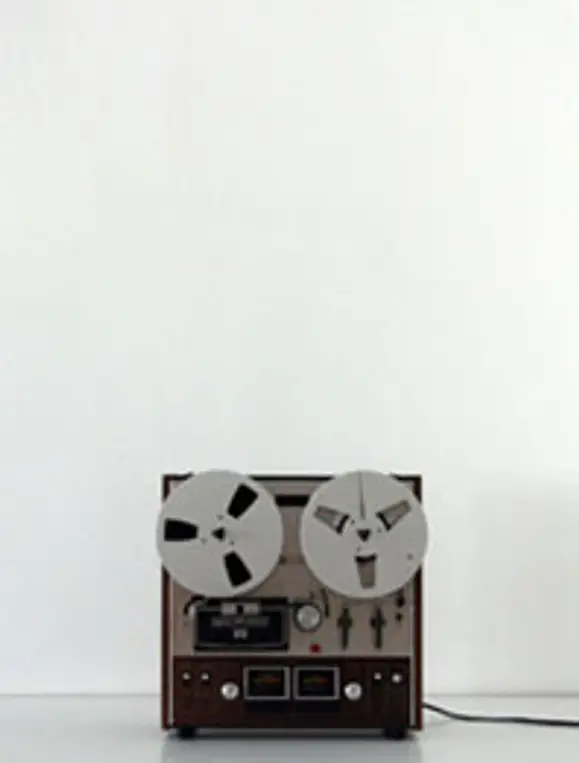
Two of Jordan’s works are on show in the current exhibition. The first is Day, a sound installation of matches being struck played out on an open-reel tape recorder. The second is Instructions for Returning, an unfinished drawing of words, reminiscent of film subtitles, instructing those who are lost on how to find their way back to civilization.
Also on display is a DVD of his past video works. I talked to Jordan about the ideas and influences that inspired these works and how they relate to the works in this exhibition.


In your past works you have used certain icons such as Charlie Chaplin, Christopher Reeve, Eric Satie, and Michael Jackson. Can you explain your interest in these subjects and how you see them functioning in the development of your work as a whole?
I’m interested in the unconsciousness that exists within our culture and using these icons as references to connect with the viewer. In Jiem-No-Pedti you can hear Satie being played but I’m not interested in Satie; I think his music is great, but that work is not about referencing Satie himself. I’m not an audiophile or a filmophile: I just use these subjects as beginning points and then combine them with something else so as to create a question. In Infinite Melancholy, I’m not intrigued by Christopher Reeve beyond the point of wanting to make a work referencing him.
Music is a recurrent feature in your work, and in most of your work the music seems to be classical piano music. Is there a particular reason for that?
As I said, I’m not interested in formalities as being content in their own rights, but instead the goal is to use this combination of both contextual and formal references to create an open question.
While you may not be interested in Satie himself, in this case you are also integrating a strongly personal element to Jiem-No-Pedti: it’s your mother playing the piano, isn’t it?
Yes, it’s true of course that I have some person connection to the references I am using. All I can really say is that I’m also a viewer of my own work and that I cannot avoid having an experience with the work that is personal to me.

And with the use of Christopher Reeve’s name in Infinite Melancholy — which also has your mother playing the piano soundtrack — if you’re not interested in Reeve himself, what does he represent to you? Some reviewers have focused on the contrast of the soaring sensation viewers get out of that video — recalling his role as superman — versus our knowledge of the physical reality of what happened to him.
Of course it has to do with the physical reality of what happened to him but in a more complex way. I saw the name Christopher Reeve as a symbol: a symbol of the sediment of the United States at that moment post 9/11. It’s like a temperature reading, so instead of saying ‘94 degrees’ or ‘98 degrees’, it’s ‘Christopher Reeve’. I thought that it was a reading of culture, that his name became a symbol of a way of how we perceived our culture at a certain moment. For example, you could say that Christopher Reeve was optimistic and paralyzed at the same time, a kind of ‘paralyzed optimism’. This was the feeling that prevailed in the US after 9/11 and I don’t think that’s how we feel now. Now we’re confused and lost.

Can you explain your interest Chaplin as a symbol?
At a certain point, Charlie Chaplin was the most recognized person on the face of the planet, even more than Jesus Christ. I am interested in universal symbols of global culture. For example, if you travel Africa, people are reciting Snoop Dogg songs, even if they don’t really speak English; everyone knows who Michael Jackson is in Africa, and Charlie Chaplin was huge in the Middle East, right when cinema began. In the beginning Charlie Chaplin communicated objectively without language in his silent films; The Great Dictator was his first ‘talkie’. In the final scene, Chaplin breaks character and makes this irrationally idealistic communist-utopian speech about the plight and hope of mankind. My reproduction of his speech resilenced this moment of incongruity and brought him back to silent film.
Was this a reaction to the impossibility of what he proposed in the speech? Do you think of your act of resilencing him as a political statement?
It was a reaction to impossibility of what he proposed in the speech but I would like to state that there is a very thin line here when it comes to judging whether I’m making a subjective political statement. Of course this is a fair assumption and yes I have political values and beliefs. However, historically this speech was one of the reasons why Chaplin was deported during the McCarthy era just one year before the US entered World War II. I’m not stating an opinion that human beings can’t live in peace but it’s more about using the assumption that the work is a political statement and the history that the work references as an opportunity to propose questions about the world we live in. So in that sense it’s political but it’s not my politics.
!['Chaplin Piece' 16mm film, black and white, 2:37 minutes (2005) [Full title available at Jordan Wolfson’s homepage]](/tablog/images/JordanWolfson8.jpg "Photo courtesy of the artist")
What about the reference to Jorgen Leth’s film The Perfect Human?
The aesthetic of the work was taking directly from that film, made in 1967. The bridge between The Perfect Human and the Great Dictator is that they are both proposing two different views on the possibilities of mankind living in harmony. The Perfect Human proposes it ironically, as an impossibility, while Chaplin’s speech idealistically insists that we can make it. My intention was to combine these polar opposites into an opportunity to ask a question.
What’s the question?
That’s up to you to decide, not me. I just made the work.
The title of the work is the entire speech, written out for those who can’t understand the sign language. How does the transcription of the title relate to the film itself?
The work is not so much a film but more a conceptual gesture. There was a negative review of the work that stated that once you read the title you never need or want to watch the film again. That critic got it right because it’s not about watching a film but recognizing the construction of a film. The film element constituted only 50 percent of the piece and the title made up the other 50 percent. So it was a conceptual gesture: it wasn’t about having a complete formal, visceral experience with the artwork.
In Neverland, you took what is probably the only original, natural feature left on Michael Jackson’s face — his eyes — and by erasing everything else, including the speech he was making, you allowed his eyes to do all the talking. They swing from side to side, as though he were communicating the word “no” again and again. This work was made in the same vein as the others?
Michael Jackson had made a live broadcast from his own home and I remember thinking that this was the worst moment of his life, this incongruent humiliating moment when he crossed the line between public and private and addressed the world. That was my first work to take me in this direction and I think that it brought up connotations that “the eyes never lie”.

On one level, his eyes could be seen as giving the same message as his speech, that “no” he didn’t commit this crime. On the other hand, I couldn’t help but think of them as saying “no, no, this isn’t happening to me, I can’t believe this”, that while he’s giving a public speech, he continues to retreat into denial and cocoon himself in his childish world. Were you aiming to highlight this disconnect between that physical message and the verbal message he was trying to give?
Well, I can’t say much about it because this is your experience of the work.
But you’re happy for people to make their own interpretations?
Yes. I try to have a lot of openness with this. I’m not making a judgement call: I can have my own opinion of my own work as a viewer, but I’m not going to fence the work for anyone. I create a situation of recognition, but I’m not going to define it for anyone.
Someone once described your work as ‘poetic conceptualism’. Does that sound like a contrived category to you?
I don’t think of it that way as I’m making it, but I can’t prevent the way I’m bracketed into categories and I’m not going to negate that kind of description. If someone wants to say that about me or they want to define what it is I do, then that’s fine because it’s their experience of the work and I have to respect that.
Have there been any particular sources of inspiration that you have had for your work?
I have rare moments of a sort of unfamiliar sense of recognition and clarity. It’s similar to when you go to the optician and have your vision calibrated; everything is out of focus and then for a moment in focus and then ‘click’ it’s out of focus again.
For example I was walking down the street in New York and I lit a match for a cigarette and that was it, the sound piece Day. I also got it when I heard my mother playing the piano. There was so much melancholy in it: it made me so sad to hear this person struggling to play the piano and suddenly everything became about time and death. That led to the soundtracks for Infinite Melancholy and Jiem-No-Pedti. I remember I was at a party, stoned out of my mind in Italy and I saw Charlie Chaplin in the Great Dictator bouncing the globe on his knee and at that moment I knew I had to go into that and I knew that I wanted to make a piece with Chaplin in it.
So it’s the human experience I’m interested in, as well as these moments of consciousness and unconsciousness. I try and retranslate that kind of clarity into the work.
It’s interesting that you should answer that way. I realize now that when I asked you this question, I didn’t specifically say “who are your inspirations?” but I was actually thinking of who the artists are that have inspired you. It’s refreshing that you’ve responded by talking about life instead. Having said that, who are the artists that have inspired you?
It changes a lot. Artists who I’m interested in are… of course, Felix Gonzalez-Torres. I would say he’s the most important artist to me. I respect Carsten Höller, Elaine Sturtevant, Ceal Floyer, Koo Jeong-A and Mike Kelley, who are all artists I find pretty interesting. While I was at art school, I used to go into libraries, pick up art books and be totally absorbed… but now I’m more looking outwardly towards culture rather than looking inwardly back at art.
In terms of technique, your work uses a variety of different approaches. You have works that are projected on both a large scale and a small scale. Some have the projector concealed and some have it exposed and you’ve also made use of animation. For a start, how did you achieve the rolling effect in the Figure 8 piece?
That was a 3D animation program, so there’s no construction residue within the work and that’s important. Except with the piece here in Tokyo, I’m showing the viewers that it’s a recording and that’s also important. The recording is presented as being on a machine so as to make a demonstration of that recording, that there’s this machine in the physical space. It exists as a recording when you hear the sound and it exists as a sound when you hear the recording. It’s more isolated than it would be if it were just on a CD player, which would be mundane and cold.

Can you explain the intention behind how you installed the Charlie Chaplin/Great Dictator film at the Whitney Biennial?
I had an interesting moment at the Whitney Biennial discussing with the curator Chrissie Iles how I was going to present the film. We talked about having it behind glass so that you don’t see the projector; but if people walk in and don’t see the projector then they’ll expect that it’s a film and will sit down. But if you put the projector in the middle of the room, then the viewer will see that it’s a construction and look at it as a machine projecting a film. Without creating this gesture in the installation, there’s no bridge to the title.
Your work Dreaming of the dream of the dream also presents the machine as an integral feature of the projection. Except in this case, you allow the film to be played all day long, with the knowledge that the images on the film will degrade or the film stock itself will eventually be worked to destruction. And once that happens, you have no intention of remaking the work.
No, then it’s over and that’s the content of the work. It isn’t just the water but it’s the defining of how it will be exhibited and reproduced. It becomes a life.

So much of the information that we’re given now is neither interactive, nor does it have any particularly useful function. On the one hand you have technology, which has always been essentially about function, and on the other hand, with the so-called ‘information’ age, despite all the other advantages it has brought, there is so much useless information being produced. Faced with this situation, I think it’s quite a challenge for artists, who are each adding to the mass of information out there, to know where to situate themselves and their work. So, with a work like Dreaming of the dream of the dream, which shows the functional side of itself so clearly, it shows that you are, in some sense, responding to that problem.
Right, that’s a really interesting point. For example, I’ve recently started applying rules to my work, because I wasn’t just satisfied with making work for the sake of having work. The drawing Instructions for Returning on show here in Tokyo is unfinished, because without that it’s just a drawing. By being unfinished, I it opens up so much more: it’s not just a drawing anymore, it’s this unfinished action. Dreaming of the dream of the dream is one edition that will slowly kill itself. When I made that piece, I wasn’t satisfied with having made a formalistic water film; I thought it was an unnecessary work, that there’s no reason for this work to exist. There’s been enough work done using filmed appropriation and I had to reconcile it by giving it the rule that it would only have one life. It was originally going to be this long, abstract film about water, but then I limited it to being one minute long, to be repeated over a day-long period; it became one edition, one single print and eventually it’ll die.
When do you expect it to die? What happens when it does?
Actually, I almost accept any offer to show it; wherever the gallery or museum can facilitate the work I’ll show it, because if I don’t show it, then it becomes an undemocratic decision for a work that was so democratically created. It’s currently showing at the Daniel Reich Gallery in New York. Will it break there? Maybe, I don’t know. It’s okay if the film splits apart because ultimately there’s no way of saving it. I’ll tell you, it’s a miracle that we managed to play it for a month at Kunsthalle, Zürich in 2005; it was also shown for one week at the Crédac in Paris and now I’m showing it in New York and I think this will probably be the ending.
As for the question of what to do when the film breaks, I was thinking that maybe I would just leave the projector on without any film in it, just playing out for the rest of the show. Or the projector could be turned off and/or removed from the space. Should I give a kind of funeral for the piece, or approach the end of its life in a ritualistic way? In a way, I don’t think I should, but I can’t just deny that the piece existed. I think that it should be just left projecting blank light into the gallery. All of these things become quite tricky because you’re not just dealing with image-making, you’re dealing with the articulation of an image. That’s really what I’m interested in: not just articulating the image’s form, but its consequence.
To see Jordan Wolfson’s homepage, click here.
To read the interview with the show’s curator, Yukie Kamiya, click here.
To read the interview with Gabriel Lester, click here.

 0Posts
Ashley Rawlings
Ashley Rawlings