
Integrating Flaws as an Essential Element


Soetsu Yanagi was one of the first artists to see beauty in mass-production, and together with his fellow potters Hamada Shoji and Kawai Kanjiro, he formed the Mingei (folk art) movement in Japan during the 1920s. Yanagi founded the Japan Folk-Crafts Museum in 1936 – a beautiful, traditional building of stone, stucco, tile, and wood – and in celebration of its 70th anniversary, it is holding an exhibition of old Tamba pottery from Hyogo Prefecture where Yanagi was based for part of his life.
Exquisite in its simplicity, this exhibition represents a lovely subset of the craftwork shown throughout the space – The museum’s collection includes pottery, textiles, metalwork, woodcarvings, bamboo work, and other traditional crafts. The approximately 200 pieces in this show span the Medieval, Kamakura and Edo periods and vary in size from small containers, about 9 cm high, to large floor jars, up to 60 cm in height.

The main display of the pottery is in a large and open exhibition space on the second floor. Around the perimeter are a series of wooden and glass cases, often with a single piece per shelf and subtle, minimal lighting. The method of display corresponds perfectly with the austere quality of the work, which is simple, functional, elegant, and direct. The material fully speaks for itself. A single criticism of the display is that so much of the work is behind glass. It is much harder to notice the subtle differences in these modest ceramics when distracted by reflections. Also, though it is completely impractical in a museum setting, these pieces whisper to be picked up, touched and held – they seduce you. Created primarily as functional objects, the best experience of these pieces would be to live with them every day.

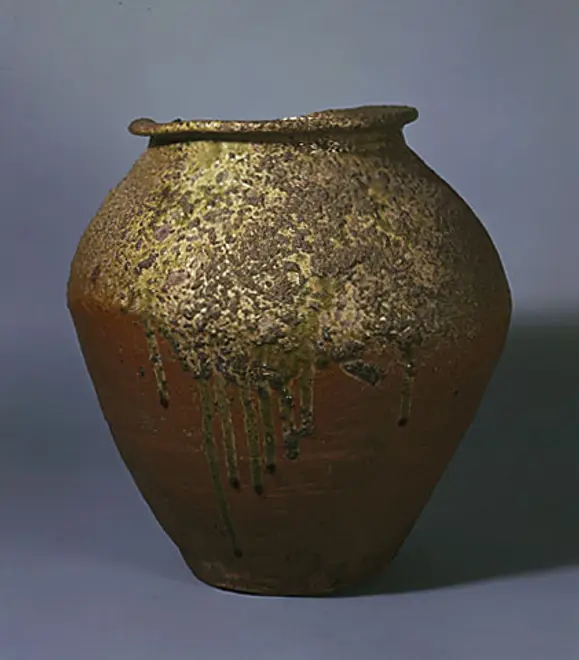
Taken as a whole, Yanagi’s pottery collection exhibits a narrow range in terms of surface, color, and form, yet within that continuum there is a wealth of subtle variation. The illusion of simplicity melts away on closer inspection. Ash, iron and drip glazes produce complex surface layering. Colors are muted and earth-toned – rust, burnt umber, chocolate, putty – with hints of olive and moss green appearing now and then. If you take the time to view the pots from several angles, the light strikes the various layers, highlighting new colors.

This work captures the wonderful paradox often found in traditional Japanese pottery of intentionally integrating flaws as an essential element. Accidental drips land in just the right spot and the lip of a jar curves asymmetrically in a way that seems predestined. Studying these exhibits closely induces a profound feeling of calm reflection. If you enjoy traditional Japanese craft, don’t miss this exhibition of old Tamba pottery – it is the perfect acknowledgement of the beauty of imperfection.

 0Posts
Lori Kornegay
Lori Kornegay