

"Melting Point" Exhibition
at Tokyo Opera City Art Gallery
in the Shinjuku area
This event has ended
187 people bookmarked this.
45 people recommend this.
3 people reviewed this.
When this writer was a small baby, too helpless to take to his own feet and explore this world, his thoughtful parents had an idea. They bought a toy designed to stimulate his senses and placed it in his cot. It was a colourful piece of kit with plenty of baubles, windows that opened and many different textures: scratchy, fluffy, smooth and so on. The centrepiece was a plastic mirror so that baby D would come to know the fact of his own existence. I suppose this is all true but I don’t remember anything of it now.
28 years later and the same baby has cast aside his infantile obsession with colourful, attention-grabbing objects in order to become an art critic. Due to a confluence of factors too complex to describe here, he enters an exhibition called Melting Point at a leisure emporium called Opera City in the city of Tokyo, Japan.
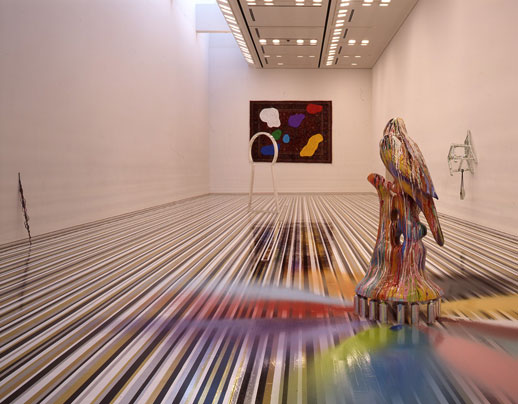
Who’s this in the first room? It’s Scottish dean of pop art, Jim Lambie. What does he do? Visual overload, that’s what. Lambie’s laying down of stripes of reoccurring bright colours on the floor cites the confident Cool Britannia (Oh no! I said it!) of a Paul Smith shirt. No, let’s be honest: boxer briefs, aren’t they? Mirrors? Check. Novelties? Mirrored chair. Textures? So many I want to run my chubby infant mitts over each and every one, but this is a gallery and I mustn’t stick my hands out of the pram. Lambie’s creations are not just for babies though: for adults of a certain age who share his taste culture of retro rock-meets-disco hedonism, Lambie is pure Donna Summer bending over to fellate Jimi Hendrix while a stupendous joint cries Mary from the axe maestro’s hand and lights my fire on a paisley carpet spattered with the tragically young vomit of a choking Jim Morrison. Anyway, on a commercial note, Lambie’s visual perception jokes are guaranteed to pull in the crowds of intricacy-oriented Japanese art students who packed out the Super-Escher show in Tokyo last year. The floor lines are not just to (mis)guide you to the exit either; they link works that, viewed separately, are no more than conceptual half-puns and spin them into an inexplicably groovy whole. Incidentally, Lambie was doing something similar at the Mizuma Gallery in Nakameguro before that and Opera City have rather disingenuously used those images to promote this exhibition.
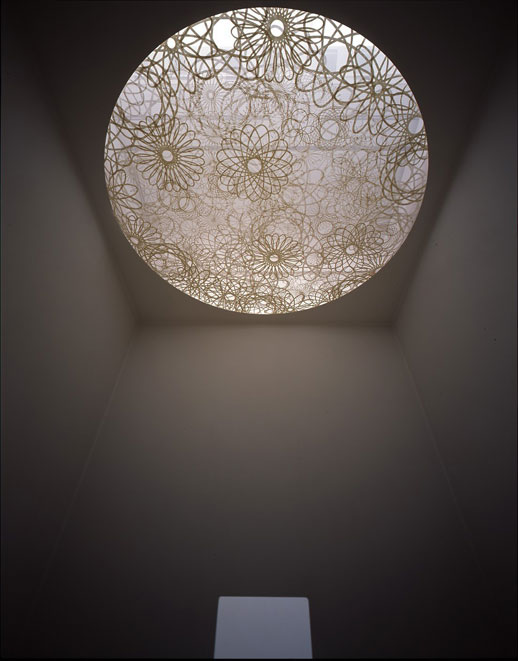
After Lambie’s rainbow rock-out, Kiyomichi Shibuya wants to show you the finer details. He wants to train your baby’s eye to notice the subtlest fluctuations of light and shape. Only works of the purest white are good enough to attest to light’s glory. Refute this colourific bombast of Lambie, he appears to be saying while waving his tiny scissors. Because, yes, Shibuya’s preferred medium is the paper doily. The doily! That useless piece of symmetrical trash that you took home to your mother in third grade and she had to pretend to like before ‘accidentally’ dropping it into the paper shredder while you were taking your bath and, here’s the thing, nobody could spot the difference afterwards! Of course I’m jesting. Kiyomichi Shibuya’s doilies and dainty doodles are the very epitome of Eastern philosophy and nature appreciation and I’ve just been infused with rock ‘n’ roll attitude by Jim Lambie’s carpet of vomit. In other words, I’m not convinced by the juxtaposition of these two artists.
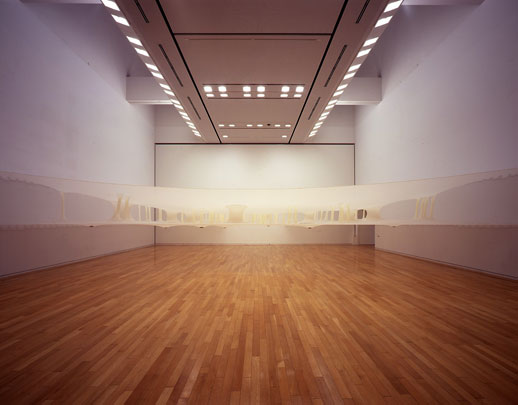
So, is there a grand unifier in the house? Is there a third artist who will step up to the microphone and apply thematic lubrication to indifferent lovers who have thus far failed to conjoin? Who are you? Ernesto Neto. What do you do? I hang giant gauze condoms. Where? From ceilings mainly, but also from giant membranes stretched between walls. Is that easy? Well, I must fill my fabric sacks with objects such as pebbles or colourful pus to weigh them down. What’s the point? So that people might discover new ways of interacting in the unique spaces created by my enormous sheaths. Do you mean, like, pretend to be sperm? That’s up to people. Can I take a photo of my friend pretending to be a sperm? No, absolutely not.
To go back to my original metaphor, that of a sensory plaything for babies, the point is that each element stimulates differently but they needn’t make sense as a whole. Melting Point is a bit like that: a console of fun-looking elements that, when you examine them together, don’t really have anything to say. No real problem there. A pick ‘n’ mix, play-oriented exhibition like this one doesn’t need a strong message but it should display a readiness to hand the initiative to the ‘player’, the visitor. Opera City, like most Tokyo galleries, is institutionally incapable of doing this. Rules, ‘this way’ arrows and hushed silences abound. Happily, the ticket includes entry to the upstairs gallery and Soju Tao’s very playful ruminations on music stardom. At least someone was allowed to rock out.


Spongebob
2007-10-28
Is that the mobile above the writers pram?
Is that a Hoxton haircut below the mobile above the writers pram?
That is an artistic use of the mobile above the writers pram.
john Sebben
2007-11-23
That is not criticism it reads like a High School forced report. Neto and Lambie deserve better, Try considering what they do and what is actually going on beyond the surface. try writing more before you publish and sign your name to it.
David Willoughby
2007-12-05
John,
For such a short one, your comment reveals a lot of assumptions.
Who decided that anyone writing about art, whether favourably or critically, must always do so with the utmost seriousness and objectivity?
Do artists automatically ‘deserve’ the frequently preposterous nonsense that is churned out by critics and copywriters to prop up their reputations? This inevitably leads into the question of who is entitled to call themselves an artist and thus collect their entitlement to devout status at the checkout.
What is it the art world has done to earn your considerable respect, besides award itself prizes? And does this respect only apply to internationally renowned artists since you don’t seem to think Kiyomichi Shibuya deserves better?
Since there are thousands of conceptual artists like Neto and Lambie who revel in their status as deliverers of wry commentaries on modern life that are too oblique for us mere mortals to fully comprehend, why should they themselves be immune from satire?
Far from deserving better, Neto and Lambie should fall to their knees and weep in gratitude to be the recipient of words from someone who isn’t paid to stroke their egos, even if he does have a Hoxton haircut.
john sebben
2007-12-09
Oh silly me, of course art writing is not supposed to be serious, and, well… art here in Tokyo rarely is so you have a point there. BTW have you actually read a critics writing? not a japanese critic but one who actually thinks his or her way through the pieces and not trying to just sell it? This is not satire it is just bad snotty writing by a high school kid who does not like his assignment.
As for the decorative Kiyomochi Shibuya, preciousness and wasted time in hand craft is not enough to call art. In fact go check out an architecture school and feast your eyes on thier laser cutter which can even make steel/aluminum/wood and MDF sheets into doilies. Just because he is not well known does not the ASSUMED reason that I dismiss his unconsidered decoration; it just lacks.
I do like emerging and younf artists who are actually struggling to make art that matters. There Is Takashi Tai at Zenshi Gallery, Takashi Masada at the nearby (Tokyo Opera City) up right now, although I have a few reservations about him.
Then there is Takahiro Kaneyama not shown in Japan. Shinichiro Kitaura and Tsukasa Yokozawa who all deserve a second look and perhaps a serious pice of criticism.
I think you mis understand art writing, or then just Art. Perhaps what you have read are press releases by the galleries who sell the work. If you have satire to write read a little more so you can learn how it is done.
Why would they be so gracious to be written by some pseudo-trendy fella with a passe haircut? When it has a name it is passe!
David Willoughby
2007-12-12
I must sincerely apologise if this piece of light entertainment has spoiled your humourless contemplation of the Tokyo art scene. At least it’s heartening to find out that you know the names of some artists. But why stop there? You can also post links to the critical writings you’ve done on each and every one.
Look, if you really want serious criticism of the main artist in this exhibition then here it is: like a lot of mediocre artists dealing in pop culture he’s above all a clever titler. His mundane, sub-Duchamp works of kitsch are called things like ‘The Byrds’ and ‘The Kinks’ to tap into a stream of ready-made symbolism from another realm more fascinating than the one he deals in. Most of his works are awful visual puns. Upon seeing them, one gets the measure of an unsuccessful writer or musician calculating in middle age that the art world might be the only place amenable to his underwhelming productions. Please feel free to tell us what it is you see when you look ‘beyond the surface’ of his work.
Now, when writing to be published we have to make a judgment, never losing sight of the subjectivity of our own opinions, as to whether a stinging personal attack on the artist is really the way to go. The answer is always no. It’s not surprising that writers tend to accept the artist’s stated agenda and proceed to criticise on the artist’s own terms, or else back off completely and make the piece entertaining for the reader as I have done here.
With your stubborn refusal to accept the free entertainment you’ve been given, you’ve forced me into humourlessly savaging an exhibition I had originally only gently teased. Are you satisfied?
There’s plenty of excellent, serious criticism on TABlog so, by all means, take a look around - and don’t forget to leave some positive comments. Again, I’m sorry that this one deviation into amusement has caused you suffering. I won’t be around to answer your comments from now on.
john Sebben
2007-12-12
It was not free i paid to see the show, I tend to over pay to see mindless shows. In your writing you forgot to name the he, but i will suspect you are referring to Lambie.
As for your proposal for me to have written critically on each of them, then by your own admission you must have made art just like every one you have criticized. Perhaps you don’t get contemporary art and you would be in the same category as Lucy Birmingham writing puff pieces on shows and craftspeople who razzle-dazzle the eye but leave the soul longing. If you are wanting to write about art on a supposedly serious website why do you play around here? Or if I am mistaken and TAB is just for fun and games then , my apologies, but don’t present yourself otherwise.
Ashley Rawlings
2007-12-12
I don’t believe that there is any one way to write about contemporary art. TABlog is clearly not just for fun and games, nor is it for sycophantic praise, and nor is it for relentless rabid criticism.
John, could you offer us a more constructive expression of your opinion and tell us more about what you think about the exhibition?
ivy watkins
2007-12-18
i thought that lambies pieces were crowded together and could be wrong here, but felt the curator added too much stuff the key door and the chair on the wall and the juju stick seemed to make not look empty. I thought the floor was amazing and the preciousness of the art if is was separable was that the splashed paint on the floor “ruined the foundation” invoking a horror, but simultaneous protection for the true hardwood floor as a “replaceable tape” I am rather unfamiliar with his work, but the show piqued my interest in his ideas and layout. Evidence of curatorial static is the salable Nesto and Lambie pieces in the exit hallway which serve no purpose of expanding the exhibited works. They might be nice but seem to try to give a little boost to the seemingly empty spaces. I sensed curatorial guilt for minimal works. Ernesto changes spaces and the dynamics of human interaction within them. The doily fella added nothing to the discourse except navel gazing. If he had gone to an architecture school there are a lot of laser-cutters that could knock those out in an hour, but his end point seemed to just sit and dwell in bucolic awe. Ernesto and Lambie engaged the audience and made me want to explore their spaces not because i was told to but out of my own curiosity.