
Toto, I Don’t Think We’re in the 21st Century Anymore

Artists from around the world are challenged to present their visions of space in the future, resulting in a fantastical experience.

poster for

"Space for Your Future" Exhibition

at Museum of Contemporary Art, Tokyo
in the Kiyosumi, Odaiba area
This event has ended

260 people bookmarked this.
47 people recommend this.
11 people reviewed this.

In Reviews by Melaney Lee 2007-12-21 print email

Pushing aside the vinyl curtain, she calmly walked into the dark room gingerly sliding her hands across the wall for a guide. With each step she moved closer and closer to the single beam of light and noticed the smoke dancing in the air. Suddenly all the color was sucked out of the room and she was placed in a black and white movie. As she continued down the path the color slowly began to return until finally she came across a crowd. They were silently staring upward, watching the vast silver object hovering gently in the air; no one wanted to make a sound, even to gasp in awe. They were mesmerized as the light danced off the shiny exterior and into their eyes. One thought replayed in her head, “So this is the ‘Space for Your Future’ exhibit.”
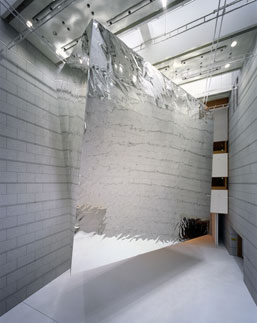
Junya Ishigami, 'balloon' (2007)

Such film noir and dream-like experiences can be found at this current exhibit at MOT, which showcases the work of artists from around the world who strive to redefine the physical, spiritual and functional definitions of space. Walking through the show, visitors are treated to a variety of views on the future, ranging from scenes plucked from a Sci-Fi novel to ordinary product design that one can realistically expect to hit shelves the within the next year.

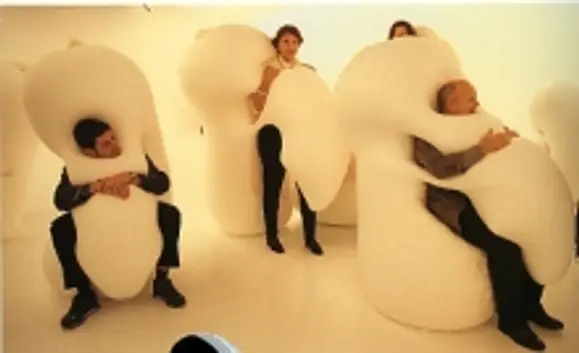
Probably the most prominent piece and best example of an artist’s Sci-Fi vision of the future was Junya Ishigami’s balloon, a gigantic three-story trapezoidal helium-filled aluminum balloon, weighted just right so it floats a couple of meters off the ground. The main viewing area for this piece in the basement, but it can be seen from balconies on all floors of the museum. Observing the visitors in the basement from the third floor was reminiscent of UFO watchers gawping in awe a spacecraft that finally lands and confirms their suspicions. Coupled with Ernesto Neto’s Philohumanoids bean bags, one might feel like they were on an episode of Star Trek. These wearable bean bags are open to the public to try on and be transformed into a neon green giant turtle. A bizarre sight, but surprisingly comfortable once you’re wearing them.

If you prefer an uncomfortable mix gaudyness and bleakness in your image of the future, then you should check out AVAF’s (Assume Vivid Astro Focus) anatato vuivui attoteki fukusayo. This two-floor, run down shack is decorated with hanging colorful plastic ribbon decorations, wall paper of demon like creatures and flashing neon signs. Visitors are welcomed to enter and explore at their leisure.
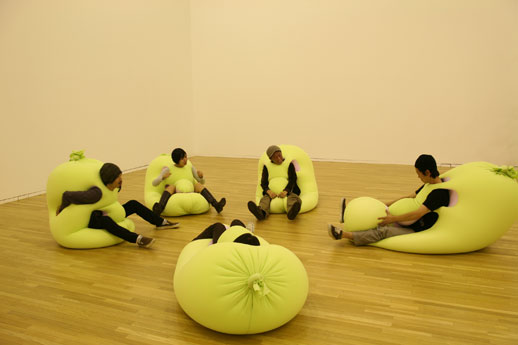
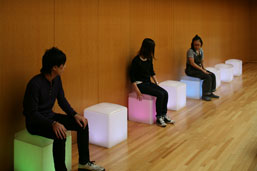
Ernesto Neto, 'phitohumanoids' (2007)MONGOOSE STUDIO, 'fuwapika future' (2007)

Other artists created works focused on our near future, more in the realm of prototype models. For example, DEMARKERSVAN’s Lace Fence turns an ordinary chain link fence into both a functional and aesthetically pleasing work of art by twisting the regular criss-cross of parallel lines of a fence into meandering floral patterns. Mongoose Studio’s fuwapicaa future is a series of lighted plastic stools that change color when sat on. (The more you weigh, the deeper the change in color.) Seen from the outside, Kiichiro Adachi’s e.e.no.24 is a transparent phone booth with a disco ball and music blasting from the headphones. Inquisitive visitors who step inside will find themselves surrounded by two-way mirrors, ‘alone’ in an infinite world of reflection. A new strategy to bring the public phonebox back from the brink of death?
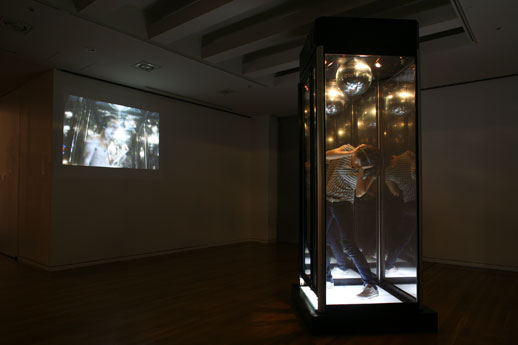
Kiichiro Adachi, 'e.e.no.24' (2004)

Some pieces of the show fall short on addressing what the future may be like and focus more on our interaction with space, like Carsten Nicolai’s room-sized installation fades. Entering through a dark corridor, visitors are at first forced to rely on their sense of touch and hearing alone to get to the center where they are entranced by smoke wafting across rays of light. Olafur Eliasson’s Quadruple suncooker lamp alters viewers’ perception of color and light. The yellow light bouncing off the blue reflectors removed any bright tones from the room, resulting in a techni-color effect often seen in old movies.
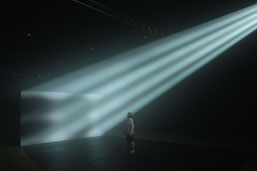
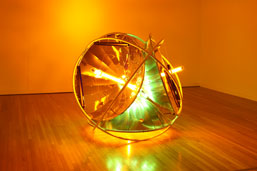
Carsten Nicolai, 'fades' (2006)Olafur Eliasson, 'Quadruple suncooker lamp' (2006)

“Space for Your Future” offers an atypical art experience and consists of a broad enough range of work to appeal to a wide audience. Though sometimes requiring a stretch of the imagination, you’ll find yourself treated to some unconventional views of space, the future and our space in the future through a variety of practical and visually stunning art, architecture and design.
Melaney Lee

Melaney Lee. Born in 1979 in Chicago. Graduated with a BA in East Asian Languages and Cultures and a BS in Management Information Systems from UIUC. Melaney moved to Tokyo in December 2006 for a two year international assignment for work. Growing up by Art Institute of Chicago allowed her to appreciate different styles from Renaissance to Post Modern art and to see famous works such as American Gothic and A Sunday Afternoon on the Island of La Grande Jatte up close and personal. Self-described as an observer of life, Melaney enjoys different forms of human expression that include music, arts, and the occasional book. » See other writings

Comments

  1. john Sebben
    2007-12-22

    This exhibition was a poorly pasted piece of poo!
    There were direct copies of: Tomoko Sawada, Thomas Demand, Anselm Kiefer-animated, Richi Albenda, The phony booth piece looks like something from The School of the Art Institute of Chicago. The lacy fences were nice but seemed familiar and the glued back together, lacy sculpture is something that we do in our first year Materials classes in Architecture- we used concrete and filled it with balloons when the concrete set, just pop them all out. The most, well…, egregious rip off was the faux Neto hanging canvas placed directly in front of Neto! I thought the exhibition was done by amateurs who either don’t know the field of art and need to spend abut 5 years in Manhattan and go to the art fairs. They also need to take a few classes in art theory and modern history. I thought it was a pastiche of likes from a year of searching put together by a postal worker or some other government worker. Is this not what the staff of MoT is? To call them curators gives them credit. Where do these people dig up this garbage, Assume Astral Vivid Focus is a weak bunch of kids and noting the galleries where some of those displayed lead me to believe this was a sort of museum commercial. Kind of like the Marlene Dumbass show and Koyonagi. The title and graphics lead me to hope that something could be gained in this show, and i did i found a lot of copyists and people who are ready to sell this Chinatown knock-offs to a naive public who tries to trust the museums as some sort of dispenser of ideas and discussion. If the pieces were clearly labeled in serious debt and HOMAGE to their originators, then something could have been done with the show. Try imagining this sort of show in NYC or London or Germany, or even Chicago. In New York it would be shown at Exit Art.

  2. Ashley Rawlings
    2007-12-24

    As you can probably tell from my paragraph on this show in my article about exhibitions in 2007, I wasn’t a big fan of this show either. Junya Ishigami’s ‘Cuboid Balloon’ made a strong impression at first, and was perhaps the only work in the show that actually had both a (classically) futuristic air about it and made a bold assertion in terms of space. Thereafter, the exhibition felt like a poorly conceived trade fair. The lacy fence was definitely on display at DesignTide 2006, which may be where you had seen it before. Ernesto Neto’s wearable ‘Humanoid’ bean bags felt like such a gimmick - comfortable when you’re in them, but also cumbersome and impractical to get in and out of. I like the idea behind Adachi’s telephone box, although I feel that it’s either being shown in the wrong context or it needs to be developed further in order to become relevant to this exhibition. So quite a disappointment overall.

  3. john sebben
    2007-12-25

    yeah i understand you are not much of a Neto Fan but had you seen the show in Moma around 1999 i think you might thimk otherwise. I think those were not his strongest peices, kind of like using ephemera as main points in a show. The fences i have seen by koons (stronger) but i have seen them before in several places and the tuttle table was a little too close for credit. The one man phonebooth discoteque is so Sony 80’s or boom box 70’s obvious and very un interesting. The big silver baloon was done by this Richi Albenda at Andre Kreps gallery in 2000! but better and more intensely. The show wa basically a wash trying ot be buyoed by a few pieces by “famous” established artists. The curator ought ot be fired and sent to schoolif she wants to continue curating. I just bought the catalog Art, Anti-Art Non Art, Postwar art in Japan 1950- 1970 and it is amazingly intense, the worst part about it is that is it is played in America and only partially over seen by Japanese. Why cant somethign serious be done ehre in Tokyo? the last amazing show, Besides Jakuchu Ito, i saw was Mono-Ha in 1996~ in Kita-Urawa. Why do these shows have to be so rare and far between eachother?

  4. Ashley Rawlings
    2007-12-25

    I do like Ernesto Neto, it’s just I found the ‘Humanoids’ work and the installation at Melting Point not to match up to what I’ve seen him come up with before. He had a good simultaneous solo show at Gallery Koyanagi and Tomio Koyama Gallery in summer 2006.

    So what brings you from the New York art scene to Tokyo?

  5. john Sebben
    2008-01-02

    Then while it is a poor excuse, HE might not have had ample time to really explore the spaces, and t=for Mot The show seemed curatorally imposed works to bend to her ideas. I don’t find those pillow bodies to be particularly challenging, but an artist is supposed to explore things not bang out salable and acceptable masterpieces continual. ( It is of course good to edit out the weaker pieces. ) But it is telling that Koyanagi and Koyama just happen to place their artists in museum shows and have the factory outlet sales simultaneously, or nearly the same time. Jason Teraoka Just so happens to have had pretty extensive showings for his derivative works at Hara ARC. Then there is Chiba and Marlena Dumbass, It is sad and creates a hostile atmosphere. Where is the real talent coming from? Why are these things so mediocre and derivative?

  6. takashi yamada
    2008-01-14

    yes this was bad

  7. Ashley Rawlings
    2008-01-19

    I wasn’t intending to see this show a second time, but I ended up taking a friend there. My overall impression of the exhibition hasn’t changed much, although taking a more attentive look at Apichatpong Weerasethakul’s video installation at the end, I found it to be a very engaging, hypnotic and poignant take on space. (A review of his solo show at SCAI the Bathhouse is due for publication on TABlog within the next couple of days.)

    Meanwhile, I was a little less enthused by Ishigami’s floating metal balloon. I still think it’s still one of the best features of the show, but it is true that a lot of its force simply comes from the initial “wow” factor.

  8. Tinelli Alessandro
    2008-01-28

    I wish to hear something about the Italian side of the exhibition since among the collaborations feature an italian curator. Four or five artists are the “little Italy” of this exhibition and the funniest is the work of Patrick Tuttofuoco, presenting his ’social’ studies on Asian metropolis in Tokyo. Like a Japanese showing the colosseum in Rome!

About TABlog

TABlog's writers and video reporters deliver regular reviews, features and interviews to stimulate discussion about all sides of Tokyo's creative scene.

T-shirt shop

The views expressed on TABlog are those of the author and do not necessarily reflect those of their employers, or Tokyo Art Beat, or the Gadago NPO.

All content on this site is © their respective owner(s).
Tokyo Art Beat (2004 - 2007) - About - Contact - Privacy - Terms of Use