
Creating a Myth: Conversation with IngridMwangiRobertHutter
Ingrid of the artistic personality known as “IngridMwangiRobertHutter” talks about the myth around it and the installation she brought from Germany for the “Goth” exhibition.

poster for

"Goth" Exhibition

at Yokohama Museum Of Art
in the Yokohama, Kanagawa area
This event has ended

125 people bookmarked this.
18 people recommend this.
5 people reviewed this.

How did you start working together as a group with Robert, IngridMwangiRobertHutter?

I purposely try not to speak too much about it, because we are creating a sort of a myth or a fictional personality, trying to redefine the history of this personality. It is very difficult to do, because people always try to split us up into two people. But basically we’ve been together over a decade. And there were different phases. We began by working for each other on projects and then quickly started working together. We had a phase when there was Ingrid Mwangi and Robert Hutter and at some point the two positions became really fused. We incorporated all previous work into the collective. And at that point we named it a collective, but now I’d like to correct you, we’re really not a group or a collective, but we try to be one artistic personality, or what I’d like to call an artist-collective-being.

So it’s not just an artistic concept, but also a life concept?

Yes. In daily life we’re married and we have two children. We also live with this tension of coming from two different cultural backgrounds. Being both artists, we use this personal history and also the artistic endeavour, which was always very similar, because we both studied performance and video art. It started with the medium of the camera turned towards the self and using that as material. So now the self has become a little bit more complex, has become the self made of these two bodies, two minds, two consciousness, two creative trajectories, which now meet in this point in time.

So it was really an organic development between theoreticising about the artistic concept and living it. It goes hand in hand. It is a conceptual idea, of course. It’s art, it’s not reality. Everybody who sees us finds it really difficult to say that we’re one person. But still, now I say I’m one person: I’m IngridMwangiRobertHutter. And I try to develop a consciousness in which I have those two bodies. So when I make art, I put that masculine white body in relationship to this feminine “black” body. This is very exciting, because we are dealing with the materiality of the body. It expands the breadth of the whole theme: the concept for me comes from living. It’s how you live it, how you work with it, how it manifests itself, rather than just projecting the idea that we want to be one person.
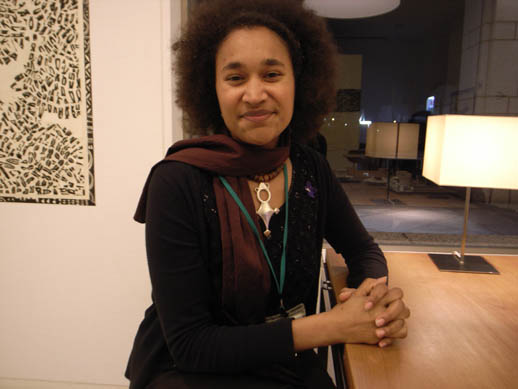
Ingrid of IngridMwangiRobertHutter

Tell us about the issue of violence in your past work and how your approach changed with the creation of the artistic personality you now are?

When I started talking about becoming a collective, there was a whole variety of reactions. Some people just did not accept it, because they were very attached to Ingrid Mwangi’s previous work, which was a lot about racism, the black body and black feminism. I remember one art collector couple: the woman found it such a shame that I’m now sharing my achievements with a man when I could have stood out with this work. It reminded me that of course there are some things that you have to let go of when becoming this collective being. A major part is letting go of your ego and constantly being able to incorporate the ideas and the realities of the other person, like daily exercise.

I really think that this is a model for the future. It’s about rethinking what the ego is and what the nature of self-interest versus common interest is and how we can create common interest as a basis of life. So it’s a kind of microscopic experiment, one which is totally necessary. I find the previous work, while it was very important, was in a way reactionary. I’m being discriminated against and I react, which is correct, but at some point you have to stop reacting and you have to act. You have to take your own position and we do this with art in a public arena. I think the more firmly you do that – put your lifestyle, your ideas and convictions in the social space – then these ideas can filter into the make-up of society. So since we are interested in overcoming cultural barriers and really communicating, we create and demonstrate a common vision. That’s our proposition.

Do you think one of you has a stronger influence on your work than the other?

There is a shift back and forth depending on who is doing what at the moment in question. We have to share all of our life responsibilities. That means making the art, traveling for art, bringing up the children, managing correspondence, dealing with the technology and so on. We have different talents, so part of being a collective being is that we don’t have to do everything the same. Not all parts of an organism have to function in the same way. There are certain aspects, which are carried out by one part and certain aspects more by the other. That’s why you see me traveling more and being more present as a kind of a front figure, which also gets confusing for people, because they find it hard to see more subtle aspects of what’s going on. But really, it’s very balanced.
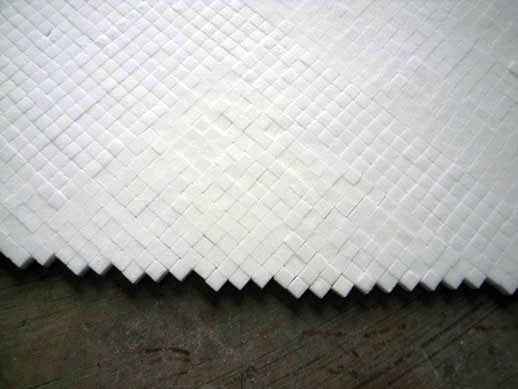
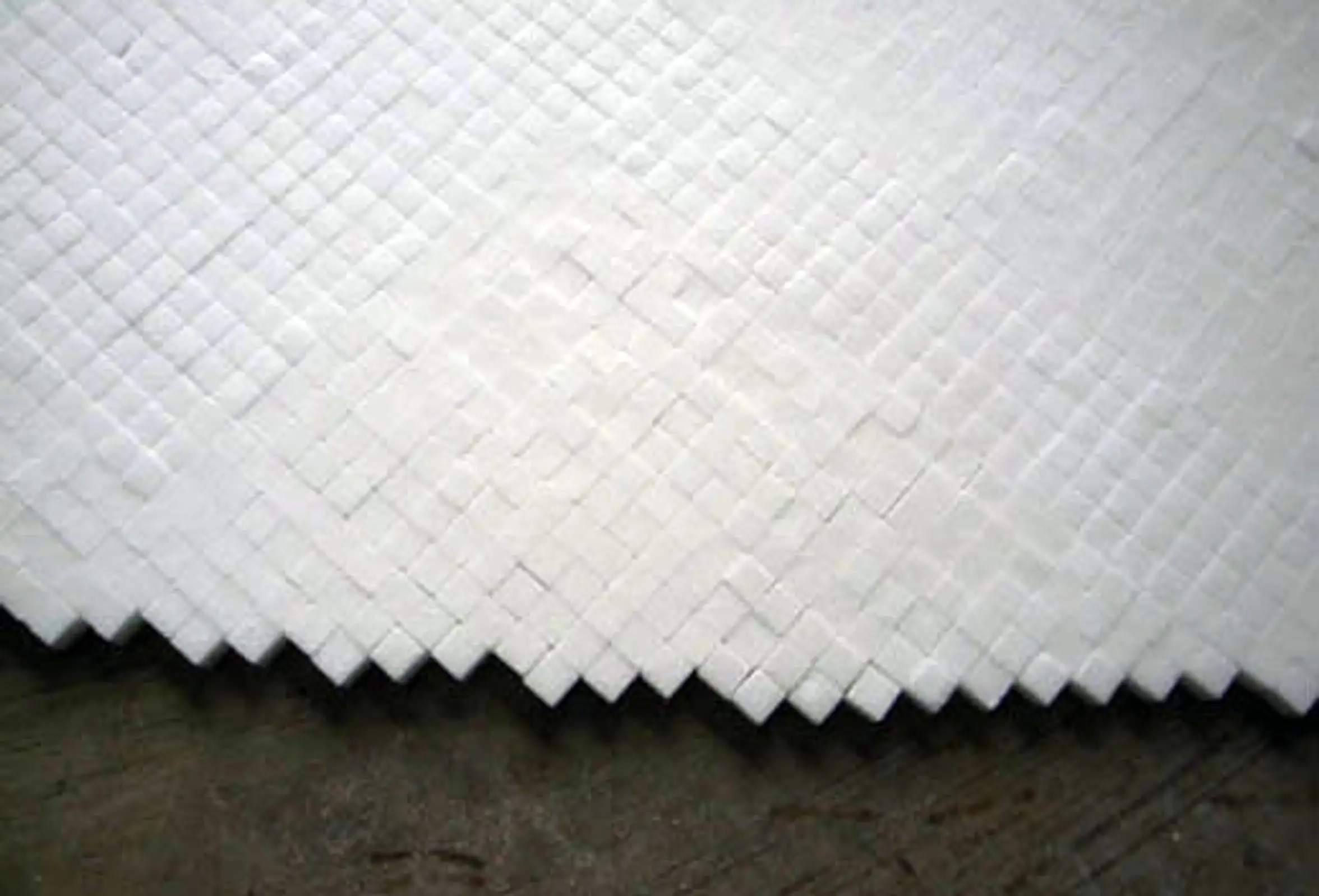
Projection surface made of sugar.

What about the work that you’re showing here? Can you tell us why you use sugar cubes as a material?

Definitely when you’re working with video it’s interesting to think about the projection surface and not always just depart from the white rectangle on the wall, but to use this ephemeral, light material to meet with other material. In many works you see experimentation with projections on materials, on fabric and so on. In this installation Performance of Doubt, the use of sugar is specifically to create a kind of ambivalence in the work, because it’s dealing with the fragility of life and different life stages. You see the projection of a baby, of a mature woman, of a couple, and an old woman. Most of the images have something to do with fragility or suffering. So at some point it became really important to find some material that typically has a positive connotation. Sugar makes me think of sweetness, it reminds me little bit of snow from its surface and this also has associations with purity. And out of this kind of pure circle – the circle also being a symbol of something complete and perfect – the two-sided wall in the center is jutting out. The wall is like a threshold to the reverse side that shows old age and death. We don’t really know what comes after death. The phase of birth and reaching maturity is on the other side of the wall – the process of trying to live life. So I think the sugar was really necessary to bring this kind of ambivalence into the work.
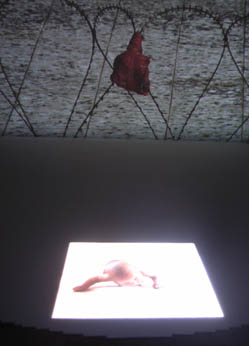
Baby projected on the sugar cubes.

The baby on one side of the wall seems to be in a kind of safe white environment…

I wouldn’t say safe, but rather sterile, maybe a little bit cold. It’s kind of uncomfortable to see the baby left there. And it was in fact a pretty tough thing to do. Both parts – Ingrid and Robert – were just standing there very concerned during the recording.

So it’s your own baby?

Yes, the video was shot four years ago. At that time I looked at our four month old child and thought about how to hold this helplessness, this absolute dependency that I saw there. I kept this video material, trying to think of a way for the work to make itself evident and in what context I could use it. So it took time before I could use it.

What about the themes in your older works?

To come to the theme of this work, it arose from realizing the limitations of working on such specific topics as racism, discrimination, political issues, war and so on. With time, I see that there are some points that are missing when we talk about these things. We are actually informed about a lot of issues; most of us know that war is bad, but there is also something about human existence, something very fundamental that causes us to repeat our mistakes. I remain interested in very specific issues of violence, but dealing with these on a direct level seems at some point to be missing some fundamental understanding. That’s why coming to this work now is to try to strip things down to the essential, to approach the question of why it’s so hard to be human, so hard to live correctly. One approach was to think about life and death. To look at death is a really difficult thing, I think. Moreover, to look one’s own death. This piece shows my child, myself and my mother, so it’s really a portrayal of how three generations are moving on.

Aneta Glinkowska

Aneta Glinkowska. Born in Poland. She has lived in New York since 1996, where she attended college and graduate school. To escape the routine of science labs in college, she went to the movies daily. Following an MA in Cinema Studies, she roams Tokyo as a writer, visiting art galleries daily and blogging about art events. She's looking for opportunities to write about art and cinema for all types of publications. Contact via email: aneta [at] tokyoartbeat [dot ]com. » See other writings

Comments

  1. kotosa motohashi
    2008-02-03

    IngridMwangiRobertHutterの作品は、Ingrid MwangiとRobert Hutterのそれぞれが持つアイデンティティー・性・文化背景が一つとなり、生まれるものである。故にどちらか一方が欠けてしまえば存在しない。Anetaさんのインタビューの冒頭は上記のことに配慮を欠いたものであるように思いました。皮肉的ではあるが、そのことがより一層Ingridさんに自分自身を語らせることになった点は、非常に面白いですが。。

  2. Aneta Glinkowska
    2008-02-04

    I know you can write English, as you have done it in the past. Why then would you make an effort to comment in Japanese? Anyway, fictional, double personality is this artist’s identity, so why not talk about it?

  3. Brian Evans
    2008-02-04

    As someone who admittedly has no prior knowledge of this pair / single art-entity, I find it odd that anyone would point fingers at this interview as missing the point of the singularity of this couple. To ignore that even as a single entity the components comprising IngridMwangiRobertHutter have different, unique, individual backgrounds (as Ingrid notes) and swallow wholly the “fictional” construct under which they operate, seems to be ignoring a lot of the context from which their art is derived.

    I’m for one grateful for a little background digging, however much it may have made Ingrid squirm. If we’re to understand why they operate as they do, it’s only sensible to understand their aggregate components. If an artist raised between two different countries claimed to be from some fictional non-country, and an interviewer asked about how his or her work (including the fictionalization) came to be in relation to their upbringing, would they be wrong to do so? By bringing context to things, would they be missing the point?

  4. kotosa motohashi
    2008-02-05

    IngridMwangiRobertHutter doesn’t exist without each of them of course. That must be quite interesting to see the art work from one artist-collective-being who are from different sexes, countries,cultures and personalities because many of opposite aspects exist between Ingrid and Robert to be together and I am interested in how they find their meeting point to be one art work.
    The reason why I pointed out about interviewer in my former comment is that interviewer did not seem to understand what IngridMwangiRobertHutter is and it should not be talked by spliting up into two people. It made me confused,that’s why I mentioned it.

  5. kotosa motohashi
    2008-02-18

    This is confusing. Where are the other comments that pointed out Aneta’s mistakes? Are they being censored? Is this a site for artistic exploration or parties?

  6. Administrator
    2008-02-18

    Comments on this site are moderated if necessary, and blocked if deemed offensive or inappropriate. This includes comments that feature abusive language or make personal attacks on TAB writers.

    TAB is primarily a listings service that aims to give free bilingual information about all events in a broad range of media taking place in Tokyo, to make it easy for Japanese and non-Japanese alike to see exhibitions and draw their own conclusions about what they are worth.

    However there are so many events taking place in Tokyo that the volume of listings can be overwhelming. In addition to features like “User Reviews” and “Most Popular”, TABlog aims to offer another inroad for users to make judgments about what they might want to see.

    Like any publication, TABlog’s content may not please all readers, but readers who comment are expected to do so rationally. Criticism is welcome, but of a constructive nature only.

  7. Ryuichi Mamiya
    2008-02-20

    このインタビューを読んで、IngridMwangiRobertHutterを初めて知った人間としては、どういった経緯でこの存在が生まれたのかを興味深く感じたしそれを理解する機会を持てて良かったと思います。しかしやはり、インタビュアーがこのアートの中心になっている考え方「IngridMwangiRobertHutterはひとつのパーソナリティーである」を考慮して質問していたようには思えません。それを理解したくないのであれば、それなりの質問の仕方があったのではないかと。。。? IngridMwangiRobertHutterという存在としての具体的な経験や、作品についてもっと深く知りたかったと感じました。

    それから、Ingridが述べているように彼らのアートがひとつの「提案」であり、また、TABlogの「目的」にもあるように、より多くの人々がコメントできる機会を増やすには、このインタビューも日本語訳されるべきだと思います。

    As I didn’t know IngridMwangiRobertHutter, this interview was a good chance to understand how/why the personality was created. What the artist-collective-being told here interested me very much. But I was wondering why the interviewer kept asking as if she didn’t consider the most significant part in the artwork by IngridMwangiRobertHutter, who didn’t want to be seen as two split individuals. Even if the interviewer had not wanted to regard IngridMwangiRobertHutter as one personality, there should have been a better way to talk to the artist, I believe.
    I personally wanted to know the artists’ more specific experiences in being IngridMwangiRobertHutter and in making other artworks.

    To respond correctly to their “proposition” as Ingrid describes, and to TABlog as you expect, many viewers may hope that this interview too should be translated into Japanese, I think. Otherwise, how you/we could really communicate in TABlog?

  8. Aneta Glinkowska
    2008-02-20

    First, Ryuichi Mamiya, if your curiosity about this artist was triggered then you should go to other sources and do further research. I’m sure other interviews, reviews expand on the issues discussed in this interview and perhaps touch upon other things important to the artist and relevant to their other works. One small interview cannot cover two people’s life stories and work. And it was not my aim to do so either.
    One other thing I want to add, in response to the recurring questions of why I kept asking “this or that,” the artist was not displeased with my questions, and I don’t see a reason to assume so, just because she said she wanted to correct me on something. That should have made the interview so much more interesting to read.
    One more time, it’s just an interview. If it triggered your curiosity, go do your research and learn more.

  9. Ashley Rawlings
    2008-02-20

    Ryuichi, on the point of bilingual articles, I agree with you. We would definitely like to make TABlog fully bilingual - the only thing holding us back is financial limitations. When bilingual articles do appear, it’s almost always down to whether the individual writer of the article has the ability to produce it bilingually themselves.

    In the past, we have discussed putting out a fixed message on TABlog inviting readers to translate anything they would like to see translated, and we would publish their translation with their name credited. It’s just that among the many things TAB has on its plate, we haven’t got around to that yet. So Ryuichi, you seem to be bilingual, so if you would like to translate this interview into Japanese, we would be very grateful for your contribution.

  10. kotosa motohashi
    2008-02-21

    wow a defensive plea to use other more serious sites!!

  11. Aneta Glinkowska
    2008-02-21

    the split personality patients are getting too much attention. oh, lucky you!

  12. kotosa motohashi
    2008-02-21

    well just looking for serious discussion, introspectio and analysis of Tokyo’s art world that emphasasizes respect towards art and valid artists curators colectors and critics.

About TABlog

TABlog's writers and video reporters deliver regular reviews, features and interviews to stimulate discussion about all sides of Tokyo's creative scene.

T-shirt shop

The views expressed on TABlog are those of the author and do not necessarily reflect those of their employers, or Tokyo Art Beat, or the Gadago NPO.

All content on this site is © their respective owner(s).
Tokyo Art Beat (2004 - 2007) - About - Contact - Privacy - Terms of Use