
Street Art: Propping up the Corpse
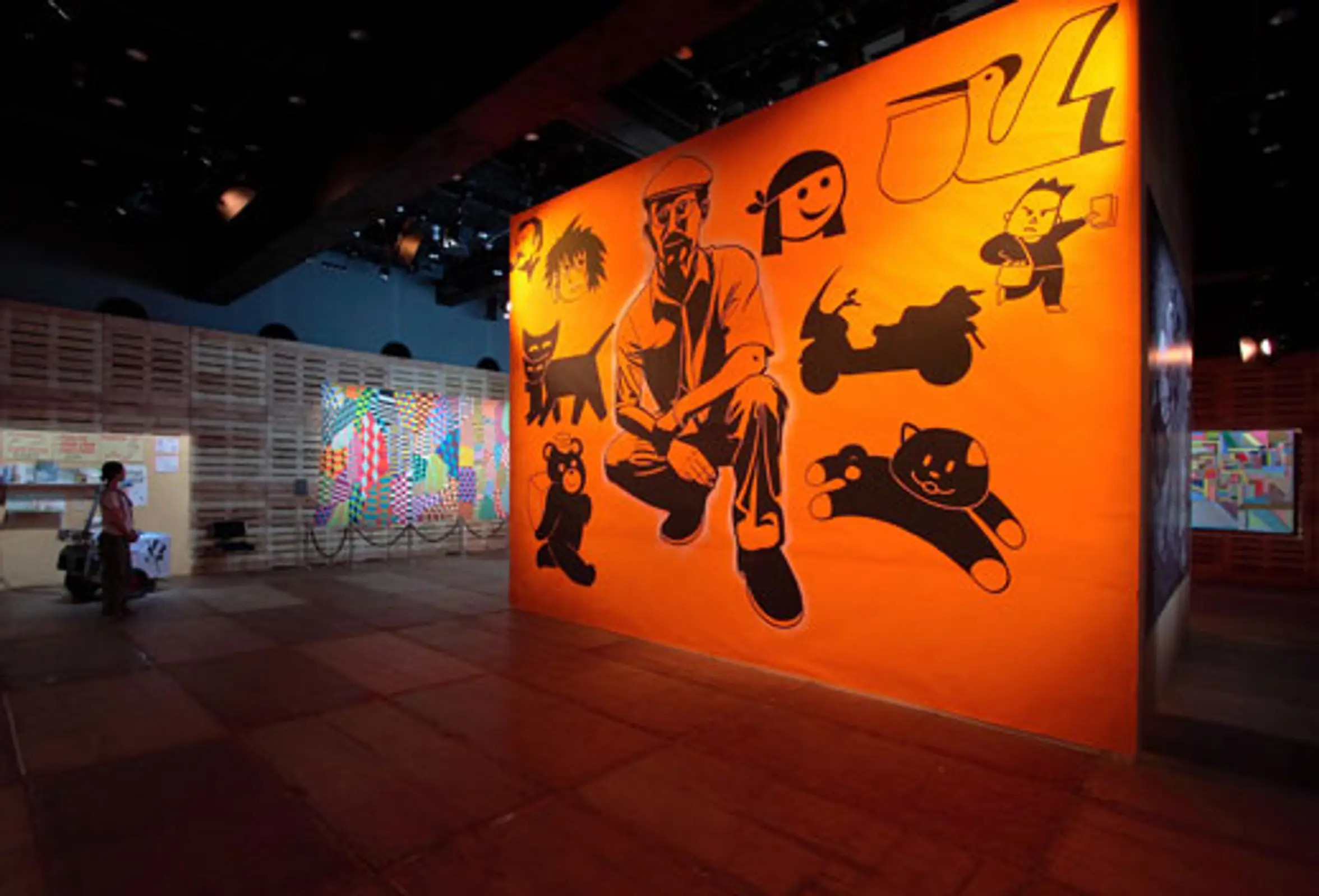


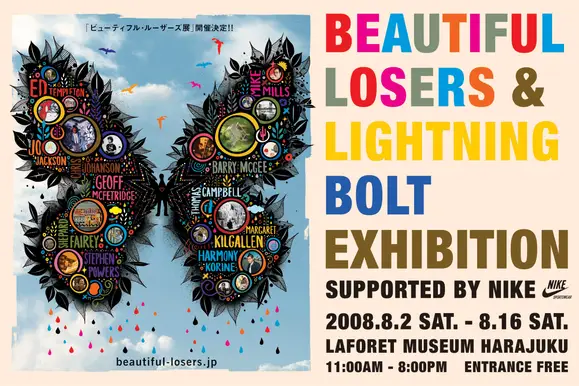
Starting in Cincinatti in 2004 and traveling around the world since then, “Beautiful Losers” now finds itself in Tokyo. The show capitalizes on the legacy Aaron Rose built up with his Alleged Gallery, a seminal space for street art that operated on New York’s lower east side which he from 1992 to 2001. Thus, the exhibition boasts names such as Todd James, KAWS, Barry McGee, Harmony Korine, Shepard Fairey, Spike Jonze, Ed Templeton, Chris Johanson, and Stephen Powers — the first generation of artists to have been influenced by do-it-yourself street culture, and who paved the way for the street inspired art to enter the “legitimate” art world.
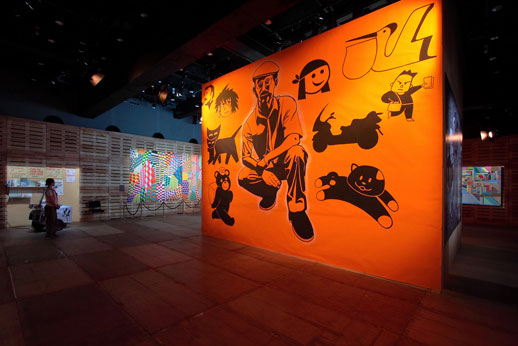
The Tokyo version of the show has been edited down, although this is hardly noticeable. The strongest works in the show include Stephen Powers’ huge wooden room in the center of the space, Chris Johanson’s geometric and bizarrely humorous paintings, Ed Templeton’s photography and a homemade tattoo installation by Alexis Ross.
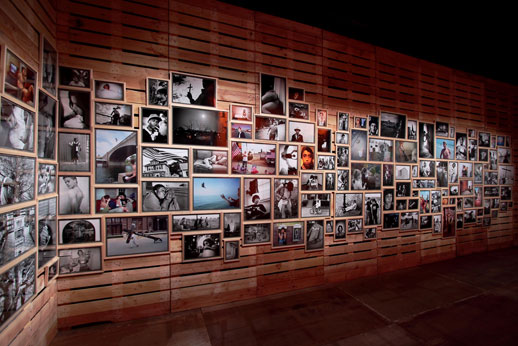
Filmmaker and photographer Harmony Korine has included a set of Polaroids titled “Polaroids from Gummo 1995 – 2008”. Korine is not really treading any new ground with these images of “white trash America”, bizarre and fashionable portraits of awkward youth. In one photo, one of the main characters from Gummo stands shirtless, cigar in mouth, wearing oversized high top sneakers while a Blondie record rests propped against the wall. Like many of his older films, Korine’s photo work is certainly beautiful, but leaves me feeling complicit in some kind of knowing and fashionable exploitation of wasted youths too young to be legally wasted.
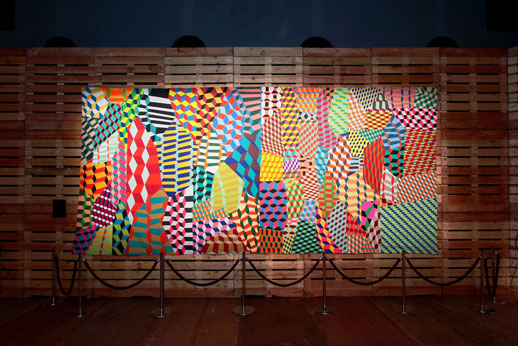
Forty-two year old Barry McGee (aka ‘Twist’) is showing a mesmerizing geometric work printed on a huge piece of stretched canvas. The work is a mish-mash of vivid Technicolor cubes, a style he has been using for a number of years. McGee was a student of the San Francisco Mission School along with a number of other artists in the show including Jo Jackson, Chris Johanson and Margaret Kilgallen. These artists went on to develop an aesthetic based on street art, signwriting and street culture. McGee’s work in this current Beautiful Losers show is more abstract and forceful than the classic “street” aesthetic he and his peers are known for. Although he has been producing these geometric paintings for years now, they still seem to sit outside of his other work, namely his graffiti installations and hobo caricatures.
Chris Johanson is also showing a vivid geometric work. This bizarre and humorous collage/painting, Untitled – contemporary cosmopolitan painting (2007), half-collage, simplistic, and deliberately ugly, shows two shirtless men, one cutting up lines of amphetamines while the other says “David, I find you very attractive”. Inside jokes like these permeate the whole exhibition.
Much of the show is characterized by work that is average at best. Some of Jo Jackson’s pieces have no more impact than an art school experiment in graphic design, and Mike Mills is showing a piece from his ‘Fireworks’ series, which I’m sad to say comes across as a mere emotional self-help illustration. Meanwhile, Shepard Fairey’s works — highly graphic and stylized portraits of pop cultural icons rendered in a faux communist poster style — are just what you would expect from his tired and very repetitive ‘OBEY’ empire.
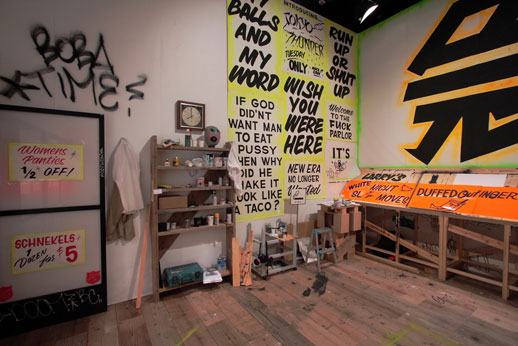
The one work that dominates and literally outshines all others with its glowing facade is Stephen Powers’ huge wooden room covered in a noisy plethora of signs, sayings and symbols, painted on fluorescent orange posters. As the man who began writing ESPO in the late eighties and disguised it as legitimate advertising, Stephen Powers is a significant character in graffiti history. For the ‘Beautiful Losers’ he lends a classic sign-writing style to clichéd graffiti phrases (“Fuck the Buff”), throw-away one-liners (“Stone cold Bummer”), comments on Japanese eating traditions (Whale meat $4.99 per) and homoerotic personal jokes (“Lets start a bromance”). The installation is a glorious exercise in idioms for idiots.
Another key work in the exhibition is by Alexis Ross, who is not officially listed as participating but nevertheless remains an important part of this group of artists. A respected tattoo artist and member of LA sign-writing group ‘Gents of Desire’, this mustachioed man is the creator of the homemade tattoo cart placed in the far corner of the exhibition. During the crowded opening reception, he picked up his homemade tattoo gun and set to work tattooing a skull on the arm of an overexcited Japanese man with a Mohawk.
The Beautiful Losers shows are conduits that follow on from the groundbreaking Street Market installations held since 2001, with which the perception of street-inspired works as “legitimate” art took root. With this, graffiti ‘writers’ began to refer to themselves more readily as graffiti ‘artists’ and a whole new subset of self endorsed ‘street artists’ started to emerge.
However, putting this ‘movement’ in context, there is something tragic about this show. The distance this kind of art has travelled has been so short, that looking back on it now, many of the works seem impotent, just limping along, weary of public scrutiny, and weary of being used in one too many corporate collaborations. The tacit promise of possibility has not yet been fulfilled, and what’s more, it seems like this whole new generation of street inspired art has forgotten this potential all together and is content with complacent repetition.
The excitement and hope of the late nineties is gone and I think it is only now that people are starting to come to terms with this change of mood. Before leaving the show, it is worth keeping an eye out for one poster hidden in among the visual cacophony of Stephen Powers’ wall of signs. Reading Street Art: Propping up the corpse, the poster has in all likelihood been written half in jest, and yet it cuts all too close to the truth.

 0Posts
Cameron McKean
Cameron McKean