
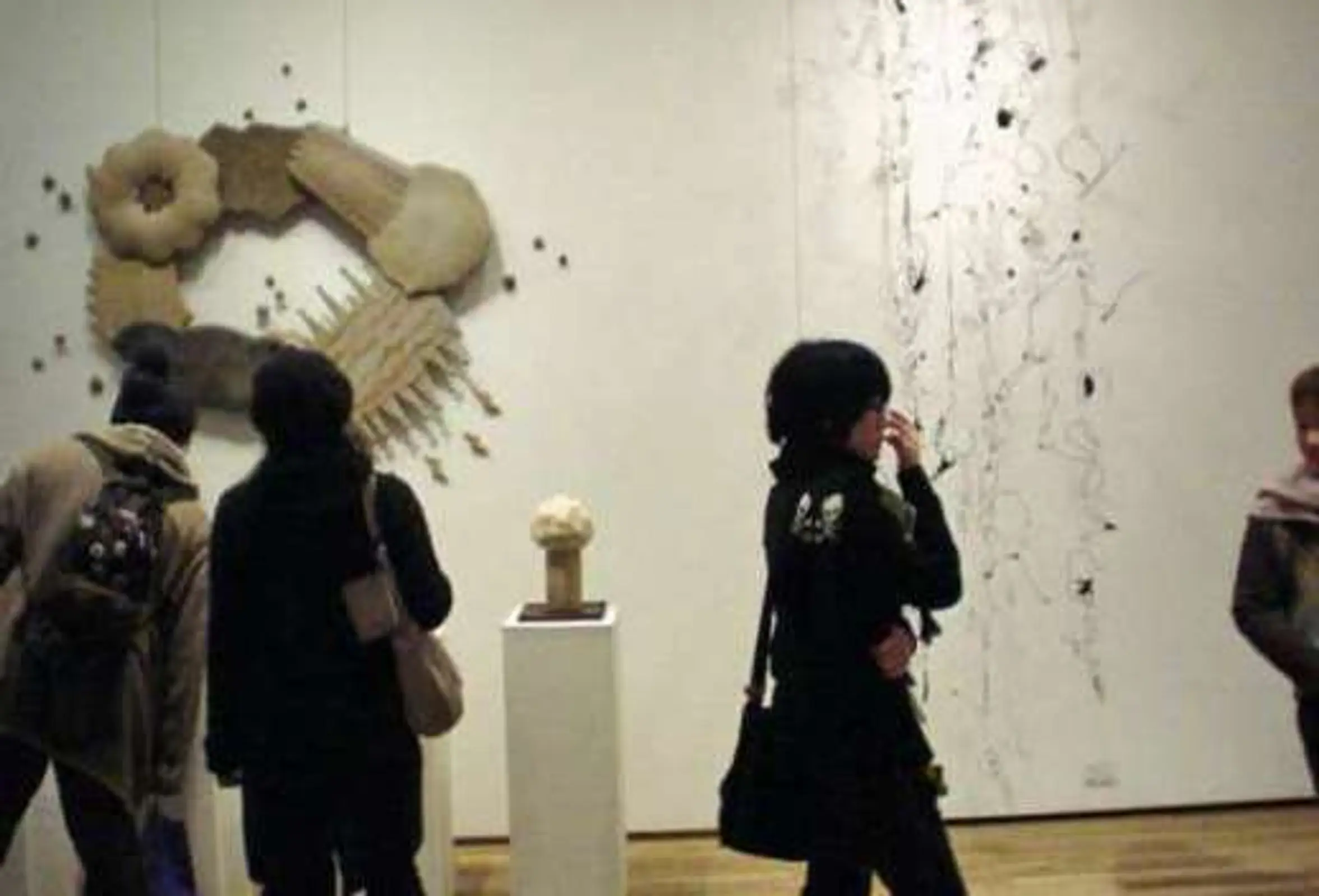
Graduation Day

It’s that season again: the end of the academic year, and this exhibition of graduating students’ work offers a chance to catch some of the future stars of the art world.

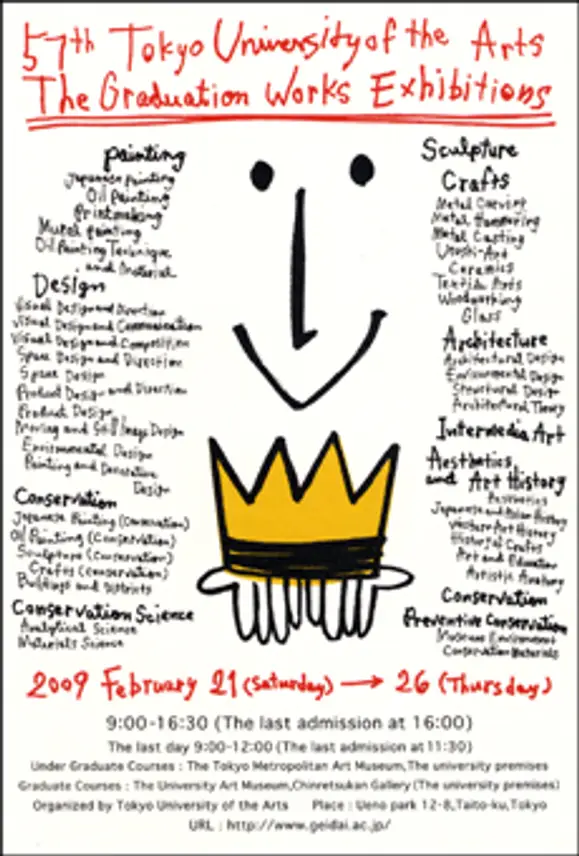
poster for 57th Tokyo University of the Arts Graduation Works Exhibition

57th Tokyo University of the Arts Graduation Works Exhibition

at The University Art Museum - Tokyo University of the Arts
in the Ueno, Yanaka area
This event has ended - (2009-02-21 - 2009-02-26)

9 people bookmarked this.
1 person recommend this.

In Reviews by Jessica Niles DeHoff 2009-02-23 print

This year’s graduation show at Tokyo’s famed University of the Arts (Tokyo Geijutsu Daigaku, popularly known as Geidai) is hands down the best student art show I have ever seen, and I’ve seen a lot. If you are at all interested in art — especially the more ‘traditional’ forms like painting and sculpture — you absolutely must figure out how to get there this week, during business hours, before the show closes. Yes, it is even worth taking the afternoon off work.

If you only have an hour or two, head straight for the university museum, which is showing student work on all of its floors. Skip the new-media installations and the area devoted to paintings in the Japanese tradition; save your time for the all-star work on levels 3 and B2.
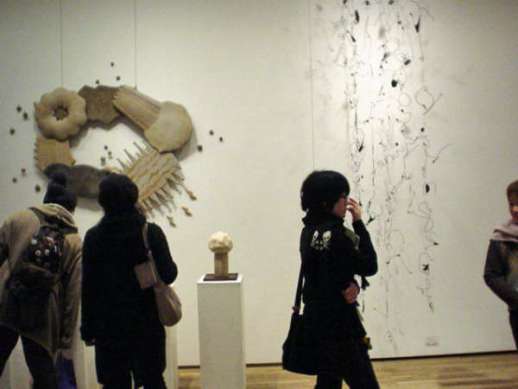
Photo: Jessica Niles DeHoff
What strikes me most about this show is the staggering variety of styles and methodologies on display. Most university art programs are handicapped by a strong ideological bent: abstract painting is in while realism is out, or sculpture in stone is hopelessly passé. But here, apparently, students are free to pursue whatever their interests might be, and they do so in an incredibly polished and professional manner, with impeccable results that are in most cases both conceptually interesting and aesthetically complete. On the third floor, one artist has warped musical scores into architectural drawings; another sculpted wood into an entwined goddess and dragon that would be at home in an ancient temple of some indeterminate culture; somebody else had the bizarre and fascinating idea of piecing trash together into a word-sculpture that reads “B Nice 2 Nature” when viewed from the front, but resolves itself into either a fish or a bird when viewed from either side.
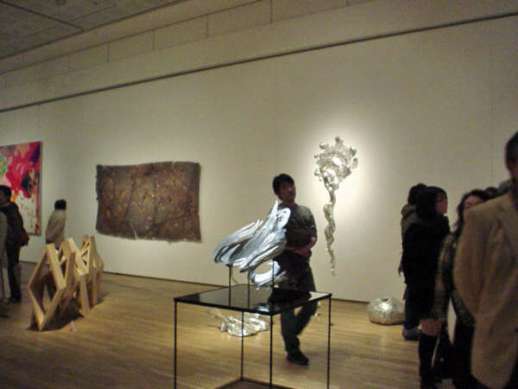
Photo: Jessica Niles DeHoff
A major weakness of contemporary Japanese art is the relentless interest in all things kawaii (cute). Takashi Murakami is perhaps Japan’s best-known art export, and he is as guilty of this stylistic pitfall — which he blames on Japan’s postwar emasculation — as anyone. (And Tokyo’s annual Design Festa also unfortunately tends toward the cute.) But at the Geidai show, there’s nary an anime character nor a doll-faced virgin sexpot to be seen. Only one or two pieces could be said to be influenced by kawaii culture — for example, the incredibly detailed narrative painting in which cartoony animals and spirits act out the Kojiki, one of Japan’s seminal texts — but here the cute is used in service to a larger idea instead of as an end in itself.
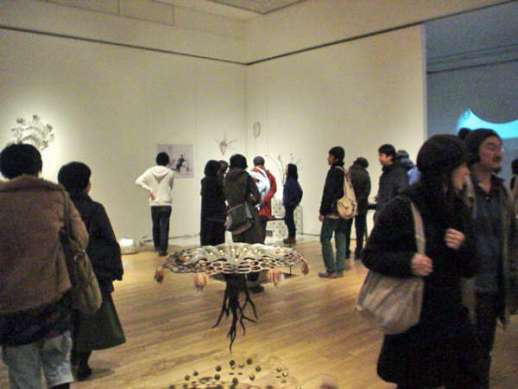
Photo: Jessica Niles DeHoff
The B2 level houses the final projects of students in craft and design (as opposed to the ‘fine arts’ of the third floor). This is all three-dimensional work, and whether it is done in melted coins, clay, or inlaid lacquer, it’s all executed at a high level of craftsmanship. Students have used both traditional and new techniques to make a variety of stand-alone pieces as well as installation-style environments.
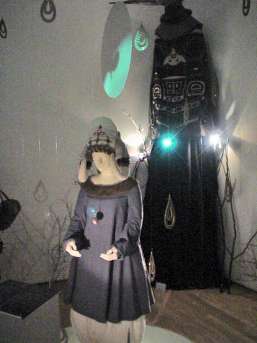
Arata Takano, 'From Darkness into Light'Especially notable in this latter category is Arata Takano’s ‘From Darkness into Light’, which draws on the ancient mythologies of Japan, China, and the Americas to create an otherworldly tableau. A dark totem pole creates an evil presence in a back corner of the exhibition space, threatening the human figure in the foreground, whose clothing is embroidered with Ainu motifs. Above, a film of a flying raven is projected onto a white disk to evoke the story of the raven that dragged the sun out from behind the moon at the cost of singeing his once-colorful feathers black. Glittery tears cascade from above, creating a curtain that sets off the space of the artwork.

On your way out of the museum building, stop by the eight-story building housing the oil-painting studios, which is open to the public all week. Go to enjoy the smell of turpentine and the feel of a dirty, functioning art space as much as the artwork, which is displayed in each student’s studio space so that you can be surrounded by one person’s artwork at a time.

For all of these students, despite the economic downturn, the future looks bright. Most of this work would be highly marketable if only it were for sale, but I guess we’ll have to wait until these ingenues find their way into the ‘corporate jobs’ of the art world: partnership with individual galleries.
Jessica Niles DeHoff

Jessica Niles DeHoff. Jessica is a Japan-based architect and urbanist. After stints at several American firms, she recently kicked off her own design practice by renovating a 19th-century rowhouse in Washington DC and building a new studio for a painter in Wisconsin. Her design work has been featured in Dwell magazine, and she has also published a set of urban-design guidelines in partnership with the Connecticut Main Street Program. Jessica holds degrees from Harvard College and Yale School of Architecture and she has taught at universities in the U.S. and abroad. Her interests primarily focus on the enrichment of the urban experience, the reinvention of historic buildings and materials, and a hands-on approach to the craft of design. She has traveled all over the world but currently resides in Tokyo, where she lives with her husband, two cats and one dog. » See other writings

Comments

  1. Anne O. Nymous
    2009-02-24

    dear jessica,

    since nobody comments here I’ll give it a try….

    i as well study at GeiDai and i think there is (1) a lot of kawaii going on (even if not seen at the ex). and (2) there is a lot missing at GeiDai: most important > questioning authority it is ridicilous.)
    And even if people think about alternatives to the art market/capitalism there is almost no chances but to “partnership” with galleries. (take ginza for example: the industry players are so almighty in that city > how can critical art find a place, apparently not in maison hermes or shiseido gallery.)
    but i think that’s the way it goes… new artists ready to enter that game. have fun everybody!

  2. Jessica
    2009-02-25

    Thanks for your comments – interesting to hear student perspectives -

  3. what is this?
    2009-02-25

    critical art?
    Great where?
    I have been seeking that and criical writing for a looonnnnngggg time.

  4. Anne O. Nymous
    2009-02-25

    it is much more complex. but its not that young people in tokyos art(-schools) are not critical at all (see the installation/intervention “shutter guy” of naoya sakaguchi at the ex). but i wanted to say that we need to change the structures (dispositifs) to change the perspectives of what we might be able to communicate. (and that might start with questioning authorities). so first we might stop perpetuating the myth of a fair art market based on righteous selection (it’s politics and marketing). we should question things. especially as students….

About TABlog

TABlog's writers and video reporters deliver regular reviews, features and interviews to stimulate discussion about all sides of Tokyo's creative scene.

The views expressed on TABlog are those of the author and do not necessarily reflect those of their employers, or Tokyo Art Beat, or the Gadago NPO.

All content on this site is © their respective owner(s).
Tokyo Art Beat (2004 - 2012) - About - Contact - Privacy - Terms of Use