Paintings Now Are Garbage

…was the slogan and rallying cry raised by one speaker at a recent satellite talk event to the “Roppongi Crossing 2010″ exhibition at Mori Art Museum.

poster for

"Roppongi Crossing 2010: Can There Be Art?" Exhibition

at Mori Art Museum
in the Roppongi, Akasaka area
This event has ended - (2010-03-20 - 2010-07-04)

228 people bookmarked this.
48 people recommend this.
9 people reviewed this.

In Reviews by Rebecca Milner 2010-05-01 print

There is not a single painting at “Roppongi Crossing 2010″. The only pieces that come close are the spray paint graphics of Hitotzuki’s ‘The Firmament’ (which doubles as a skateboard ramp) and a patch of wall adorned with the tags of an anonymous graffiti artist. In its absence, the still, silent (and ultimately transportable, storable and cohesive) canvas haunts the exhibition, itself brimming with multimedia (and multi-sensory) installations, delicate craftworks, and social commentary.

Asked by a member of the audience at Cross Talk if this was a conscious choice, the curatorial team (made up of Mori Art Museum Associate Curator Kondo Kenichi and guest curators Chieko Kinoshita and Kenji Kubota), explained: in narrowing the artists from eighty to twenty, they felt the painters initially considered reflected less the themes chosen for the exhibition.

Five themes had in fact guided the selection of artists, selected to represent the next wave of Japanese artists at the third edition of “Roppongi Crossing”: “creativity of genre crossing,” “aesthetics of the new generation,” “significance of collaboration,” “expression of the street,” and “reference to the society.”
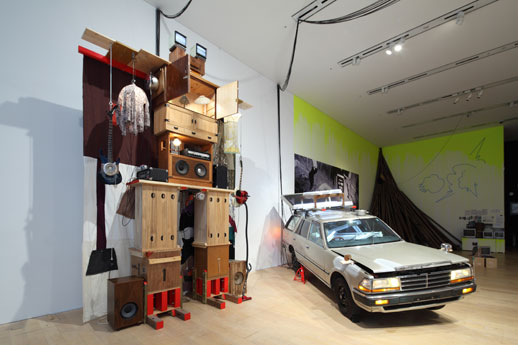
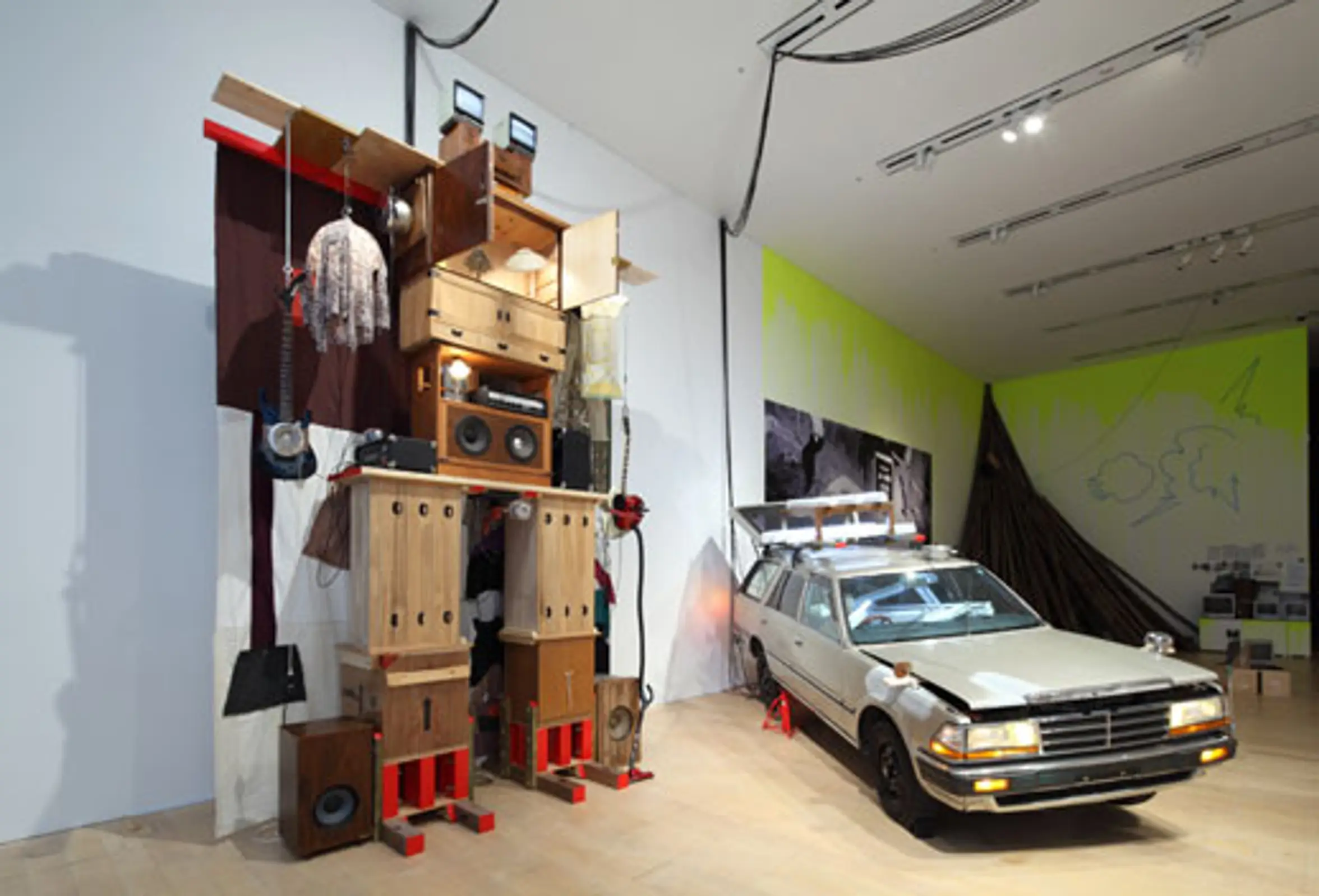
'Roppongi Crossing 2010: Can There Be Art?' Installation view: Mori Art Museum 20 March - 4 July, 2010<br />
Ujino, 'The Ballad of Extended Backyard' (2010)

With this framework, the curators hoped to project a kind of synergy of multiple creative fields (including music, architecture, and design) that would go beyond the sum of the assembled works. Moreover, they expressed a desire for the exhibition to resonant with something — some scene, some artistic community, some life — existing beyond the white walls of the museum.

It was a diplomatic explanation, one that was cut short by political economist, social critic and Dean of the Kyoto University of Art and Design Graduate School Akira Asada, who unable to hold his tongue (he was scheduled to speak after the intermission), dashed to the stage and promptly proclaimed: “paintings now are garbage.” With both “VOCA” and “Garden of Painting – Japanese Art of the 00s” still being held at the time (at the Ueno Royal Museum and The National Museum of Art, Osaka, respectively) this declaration seemed particularly charged. Asada went on to opine that paintings were “easy commodities.”

Following these words (though they were those of guest speaker Asada and not the curators) it was hard not to feel the palpable absence of paintings at Roppongi Crossing as something akin to the specter of the highly sellable, iconic images of the Nineties —something that the twenty artists selected to participate at the Mori Art Museum show appear to be emphatically trying to shake.
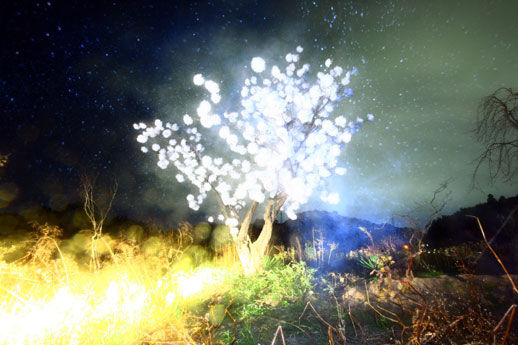
Shiga Lieko, 'Wedding Veil' (2007) C-Print

Rebecca Milner

Rebecca Milner. Born in San Diego, California in 1980, Rebecca studied modern English, French, and Spanish literature at Stanford University. She now works as a freelance fashion writer and trend scout, as well as doing occasional work as an interpreter, English teacher, and bar hostess. Happily infatuated with the mundane, she relishes making coffee, reading the newspaper, grocery shopping, and riding her bicycle. She is obsessed with all things urban, is an ambitious collector of magazines, makes terrible pottery, prefers graffiti to commissioned sculptures, has an unusual affinity for typefaces, and totally digs performance art. » See other writings

Comments

  1. Gary McLeod
    2010-05-01

    Rebecca,

    I agree with you about the absence of painting but for me it sadly almost went unnoticed, such is the trend to show work like this today.

    In addition I was busy relating what I was seeing to what I had already seen in the past 6 years. I remember seeing Teruya’s McDonalds bags at a small group show in what used to be Gallery Sowaka in Kyoto in 2005. I also stumbled across Ujino’s piece with a London Taxi in London last year and it caused quite a stir on South Bank but less so with me.

    My slightly focused eye aside, I found it interesting how my “better half”, who had never seen any of the works, responded to the show. She marveled at the skill and time consumed in Teruya’s cut out bags. She was besotted with Amemiya’s ‘compellingly absurd’ performance and wanted to join in with pulling and hauling over of Kato’s wooden leviathans. If something was trying too hard to speak to her, she was swiftly judgemental of it by merely moving on. That was even on the second time we went around!

    After the last Roppongi crossing, I wasn’t hoping for much but some things struck me as having the right balance of craftiness, quirkiness, and quality. What I would say with the aforementioned 3 artists, ‘spectacle’ was in an appropriate dosage and somewhat out-witted the last crossing event. Most of the work was forgettable but the memory of those 3 will at least stay with me for the right reasons.

    Could you say something about any particular works that did stand out for you? Or was it that unspectacular for you?

    Cheers

    Gary

  2. Rebecca
    2010-05-03

    Hi Gary,

    I appreciate your thoughtful comments. Will also urged me to add something of a review to this article. I tried actually, but after too many hours, I still couldn’t turn my wishy-washy feelings about this exhibition into concrete sentences and thought it was best to let it stand as a note on the conference. (An excuse, I know, but I at least wanted to get the conference bits up while it was still early enough to be relevant).

    Since you asked though, my eyes were, for better or for worse, drawn to the extremes. On the one side this meant the small-scale detail of the craftwork of Teruya Yuken and Aoyama Satoru (though these works were not new to me either). On the other there was something of the monumental in the Ujino and Kato Tsubasa installations. But I also felt that Tsubasa’s piece was crowded into a corner and that Ujino’s, while enchanting, complicated the exhibition (since the sound of it invaded other space). There was something noteworthy in the identity politics of Takamine Tadasu, Morimura Yasumasa, and S/N, though I would venture that that probably reflects the curators’ taste more than anything. The second half of the Cross Talk actually focused on S/N’s Dumb Type, which struck me as a somewhat incongruous selection, being a 15 year old work in a show that focused almost entirely on the very recent. Unfortunately I couldn’t time my visit to catch a screening of the 80+ min (!) video of the performance piece, though I still intend to make time to go back for this—and the exhibition in general as I still feel as though I am missing something.

    If anyone else has any thoughts on this exhibition to add, please do!

    Best,
    Rebecca

  3. Sleiman Azizi
    2010-05-06

    Hi,

    It’s hard to appeal to many people and galleries do need to find ways to promote themselves in order to stay afloat. Specactular and visible is the most obvious way of doing so.

    Depth in quality can be seen a kind of desperation but so too can a lack of it. This is not to say, though, that one shouldn’t try and for that reason, I hope that Roppongi Crossing is able to keep going and cross over to the other side.

    Thanks for the report :)

    Regards,

    Sleiman

  4. Paul Roquet
    2010-05-06

    Asada’s choice of words here in his sloganeering seems to hit on something, even as it gets it completely wrong. “Garbage” actually seems like a good word to describe many of the Crossing works – in the emphasis on inexpensive, on plywood & food scraps-sorts of materials, as well as the tossed-off, throwaway quality of the ideas (even the bundle of decontextualized quotes thrown up at the exit). Seen from the perspective of the curators, this embracing of “garbage” might be understood as a positive marker of art as a practice of community and dialogue rather than the creation of commodities. At the same time, it hints at what made the event somewhat unsatisfying as an exhibition – how many of these concepts seem rather old and worn in 2010 – recycled even – and hardly the stuff to define a new generation.

    I find the idea of “easy commodities” rather confusing – is it really so easy to become an iconic painting sold for oodles of money? Is this the horrendous fate that befalls all artworks unless they do their best to resist by disqualifying themselves outright? This kind of thinking only seems to leave us in the unsatisfying position of choosing between one type of garbage and another.

  5. Peter Bardazzi
    2010-05-12

    If art is always a reflection of a given society then contemporary art is in a peculiar situation. It criticizes society yet wants to be accepted by the same society it criticizes. Usually the first card played in in this game is painting. In terms of commodities: the popular culture now exists more on the Internet and in the video signal (TV, and less in film/fine art and certainly not in individual expression . This culture defines us, this culture is real and has been modified to work around our interaction with electronic media. Art (painting)are now a subtext….. unfortunately… I guess…hmmm

  6. Sleiman Azizi
    2010-05-12

    I often wonder if we place on art a burden it need not bear. I mean, should art really be considered as commentary and if so, a commentary on what? Society is funny but then again, when hasn’t it been?

  7. Amy Lincoln
    2010-06-19

    Hi Rebecca,

    I enjoyed reading your article, and was also noticing the absence of painting at the show. Although, the show of Jules de Balincourt paintings at the end balanced it out somewhat.

    Are you aware of this article by NY Times art critic Roberta Smith “Post-Minimal to the Max” ? link: http://www.nytimes.com/2010/02/14/arts/design/14curators.html

    She writes about how New York museum curators are remarkably uninterested in all the painters out there preferring instead to focus on artists whose work relates to art movements that emerged in the 60′s and 70′s (performance, installation, conceptual art, etc).

    It’s as true in Tokyo as it is in New York.

  8. Frito Van Gogh
    2011-05-31

    “‘Roppongi Crossing 2010: Can There Be Art?’”

    Ooh ooh, methinks somebody owes the creator of “Voyage into Space” some royalties…

About TABlog

TABlog's writers and video reporters deliver regular reviews, features and interviews to stimulate discussion about all sides of Tokyo's creative scene.

The views expressed on TABlog are those of the author and do not necessarily reflect those of their employers, or Tokyo Art Beat, or the Gadago NPO.

All content on this site is © their respective owner(s).
Tokyo Art Beat (2004 - 2012) - About - Contact - Privacy - Terms of Use