Roppongi Art Night 2010
This is the first installment in a series of articles produced collaboratively by the Tokyo Culture Creation Project and Tokyo Art Beat. The following is a report on Roppongi Art Night 2010, an art extravaganza first held in 2009 that drew more than 700,000 visitors to a variety of programs, exhibitions and performances held over a two-day period. [Rei Kagami]
Roppongi Art Night 2010 (hereafter referred to as Art Night), a one-night-only art festival staged in the Roppongi area, was held from 10:00 on March 27th (Sat) until 18:00 on March 28th (Sun).
The festival was organized by the Tokyo Metropolitan Government, the Office of Tokyo Culture Creation Project, and the Roppongi Art Night Executive Committee (comprising The National Art Center, Tokyo, the Suntory Museum of Art, Tokyo Midtown, 21_21 Design Sight, the Mori Art Museum, Mori Building and the Roppongi Shopping Street Association). The chairman of the committee was Fumio Nanjo, director of the Mori Art Museum, with Tadao Ando and Yoshiko Mori serving as special advisers.
Various events and performances were held at numerous venues throughout Roppongi during the “core time” from sunset on the 27th (17:58) until sunrise on the 28th (5:32). The jam-packed program featured up to 50 events happening simultaneously at different locations, resulting in more than a few harried visitors anxiously raring to catch everything they wanted to see. The following is a description of just some of these events.
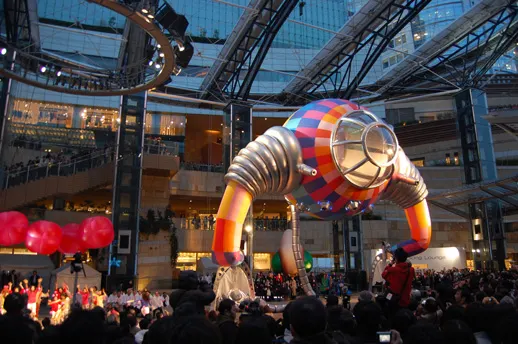
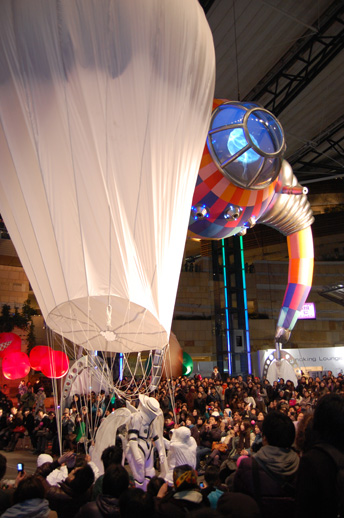
One of the highlights was artist Noboru Tsubaki’s new installation “Before Flower”, which made its appearance in the Roppongi Hills Arena just as the sun was beginning to go down. Tsubaki is known for a body of work that conveys social messages with a strong visual impact, including a giant 50 meter long locust that created a sensation at the Yokohama Triennale international art exhibition in 2001 (part of the “Insect World” project developed in collaboration with Hisashi Muroi). The title “Before Flower” refers to the seed-bearing gymnosperms that are thought to be early ancestors of life on Earth. Sensors attached to the ends of the claws of “Mother Night”, the main work in the installation that was modeled after a gymnosperm, detected the presence of carbon dioxide in the air, causing the image on the orb-like central screen to change. Although the work was inspired by primitive plant forms, there was also a whiff of the not-too-distant future in the way this gigantic 13 meter tall structure reared up to its full height, causing a stir in the excited audience. All at once, the venue erupted into a festival-like atmosphere. Scattered in various locations throughout Roppongi were also some 15,000 pink spore-like balls that had supposedly been released by the two gymnosperms Argos and Urmos. As the sun set and darkness fell, Roppongi grew even livelier, teeming with people reaching out to touch the sparkling lit-up spores.
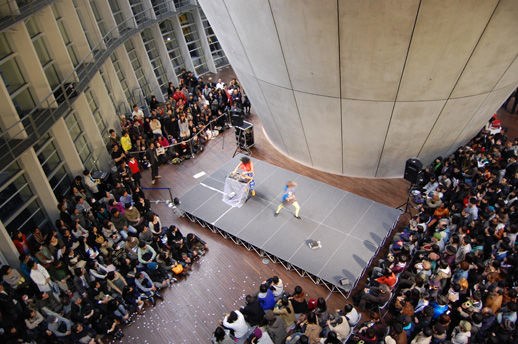
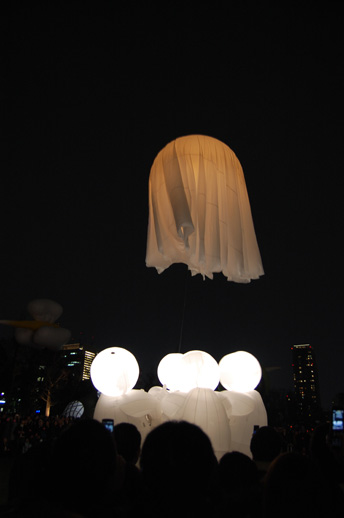
Another big draw was the fact that the Mori Art Museum and 21_21 Design Sight had decided to remain all night long. In addition, there were several discounts and perks that no doubt attracted a large number of people who would otherwise rarely set foot in a museum: the National Art Center, Tokyo offered free entry to its “Artist File 2010” Exhibition (only on the 27th), while the Mori welcomed visitors for only ¥500 from midnight on the 27th to 6:00 the next morning. Peak crowds at the Mori formed lines with waiting times of more than 30 minutes – a huge surge of visitors rarely seen at a contemporary art exhibition.
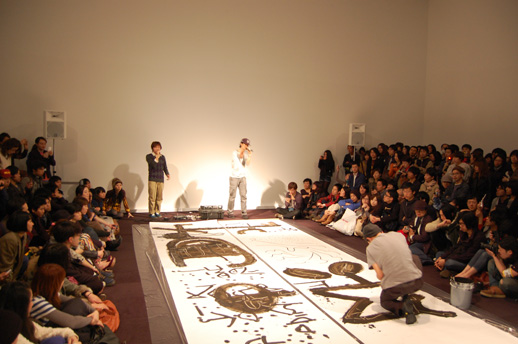
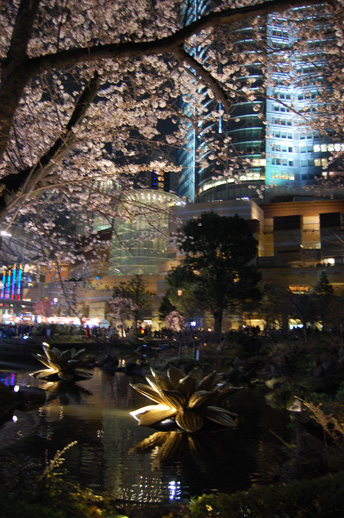
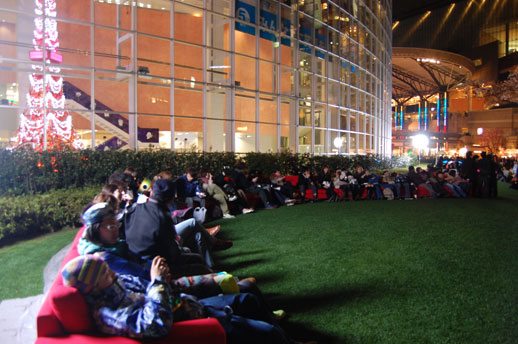
The “Roppongi Achi-Kochi Project”, on the other hand, was held in the streets, featuring works by 3 artists installed in shop windows and entrances and under trees. Like an orienteering exercise, participants used the landmarks indicated on their map in order to track down the works on display, excitedly gathering in front of the artworks they had discovered in order to take commemorative photos. In the Mohri Garden, the petals of Choi Jeong Hwa’s “Lotus”, an installation of giant water lilies floating on the surface of the pond, yawned open and shriveled shut, while visitors sat on a long sofa just next to it designed by the Danish interior brand BoConcept, set against the extraordinarily picturesque sight of cherry blossoms in half bloom illuminated at night.
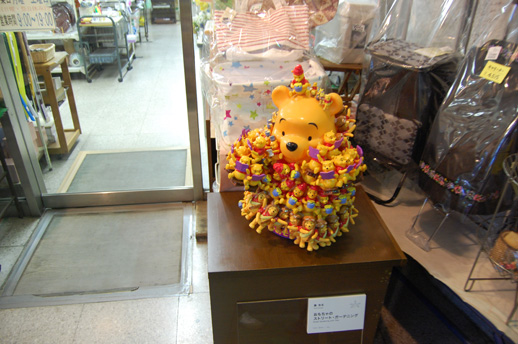
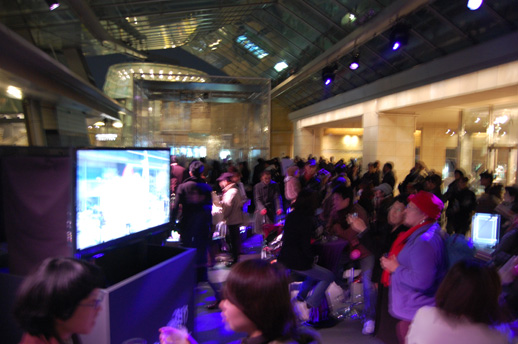
At the back of the Arena, Yotta Groove’s flashy decorated car pulled up and started selling roasted sweet potatoes. In the crisp night air, many visitors were no doubt just starting to feel peckish, and the yaki-imo sold like hot cakes. Enveloped in a purple mist, the lounge area stocked with drinks from sponsor companies was also doing a roaring business, making this a perfect night out on the town for the adults. Free shuttle buses, extended subway operating hours and free parking all helped to improve late-night public transportation and access.
As the Art Night wore on, venues all over Roppongi continued to be packed with sleepless visitors until dawn, with something or other always going on somewhere. With only one weary body to navigate all that the festival had to offer (and too little space), this writer was unfortunately unable to introduce readers to everything on the program.
Despite temperatures falling to a low of around 5℃, the turnout of more than 700,000 people was proof of the Japanese public’s high level of interest in art, as well as their predilection for a good carnival-like atmosphere (this, combined with the cosmopolitan nature of Roppongi, ensured a large number of foreign visitors as well). More than anything, however, this was an event where people could come together because of art, enjoy getting caught up in a night of fun, and forget about the recession and other social problems. I hope Art Night ends up being not just a one-night dream, but rather a testament to the collective energy of Tokyo as it continues to shrug off the recession. There was definitely something about the whole affair that gave me that impression – my exhaustion at the end of a long night, as the first rays of dawn appeared, felt on the contrary like a burst of unexpected energy.
Rei Kagami, TABlog writer
Born in 1975. Lives in Tokyo. After graduating from university, she worked full time while completing a correspondence course at Musashino Art University to qualify as a curator. After helping to organize some exhibitions as an assistant curator and working as an exhibition tour guide, she started full-time work in the art industry in 2005. 他の記事>>
(translated by Darryl Jingwen Wee)


Tokyo Culture Creation Project
Tokyo Culture Creation Project
SHARE


