Chim↑Pom "Real Times"
at SNAC / Mujin-to Production
in the Kiyosumi, Ryogoku area
This event has ended - (2011-05-20 - 2011-05-25)
37 people bookmarked this.
7 people recommend this.
3 people reviewed this.
While the recent disasters plaguing Japanās north-east region have made this a heartbreaking time for all in this country, it has also been one of hope and the triumph of the human spirit. International observers praised Japanese peopleās calm actions and community spirit. This has been a time filled with messages of solidarity and the constant call for everyone to keep their spirits high and āganbarÅā, keep persevering.
Unfortunately, the Japanese mediaās tendency for excessive sentimentality and hyperbole can have quite the reverse effect on the psyche. While the great earthquake and enormously destructive tsunami were a very real moment for many in northern coastal Japan, the hijacking of the āganbarÅ Nipponā message by television programs, politicians and virtually all advertising campaigns since March 11 seems to have left the artists of ChimāPom torn between genuine concern and all-out apathy.
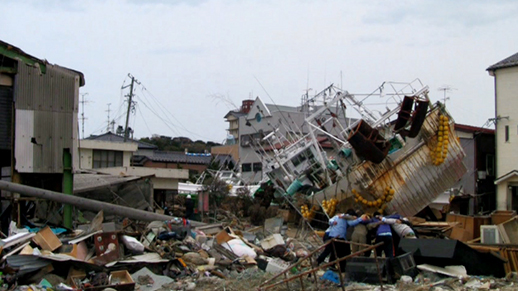
Definitely on the apathy side of things was their erotic-power generator, āErokitelā. Telephone calls to a certain sex-line would send signals to their custom generator and light up the room. It was a concept clearly in jest of all the talk of alternative energy sources in light of the nuclear plant crisis. If not nuclear power, why not sexual power?, they ask. In the same vein, a video shot like a football huddle nods to the various sporting analogies to be found in the post-earthquake recovery discourse. In ā100 KIAIā, all members of ChimāPom hold hands in the middle of a circle and take turns calling outādedications, messages of inspiration, sometimes nonsenseāand the rest of the team cheer. The dialogue is only semi-understandable, and after the hundredth cheer the pep-talk loses its climactic rhetoric.
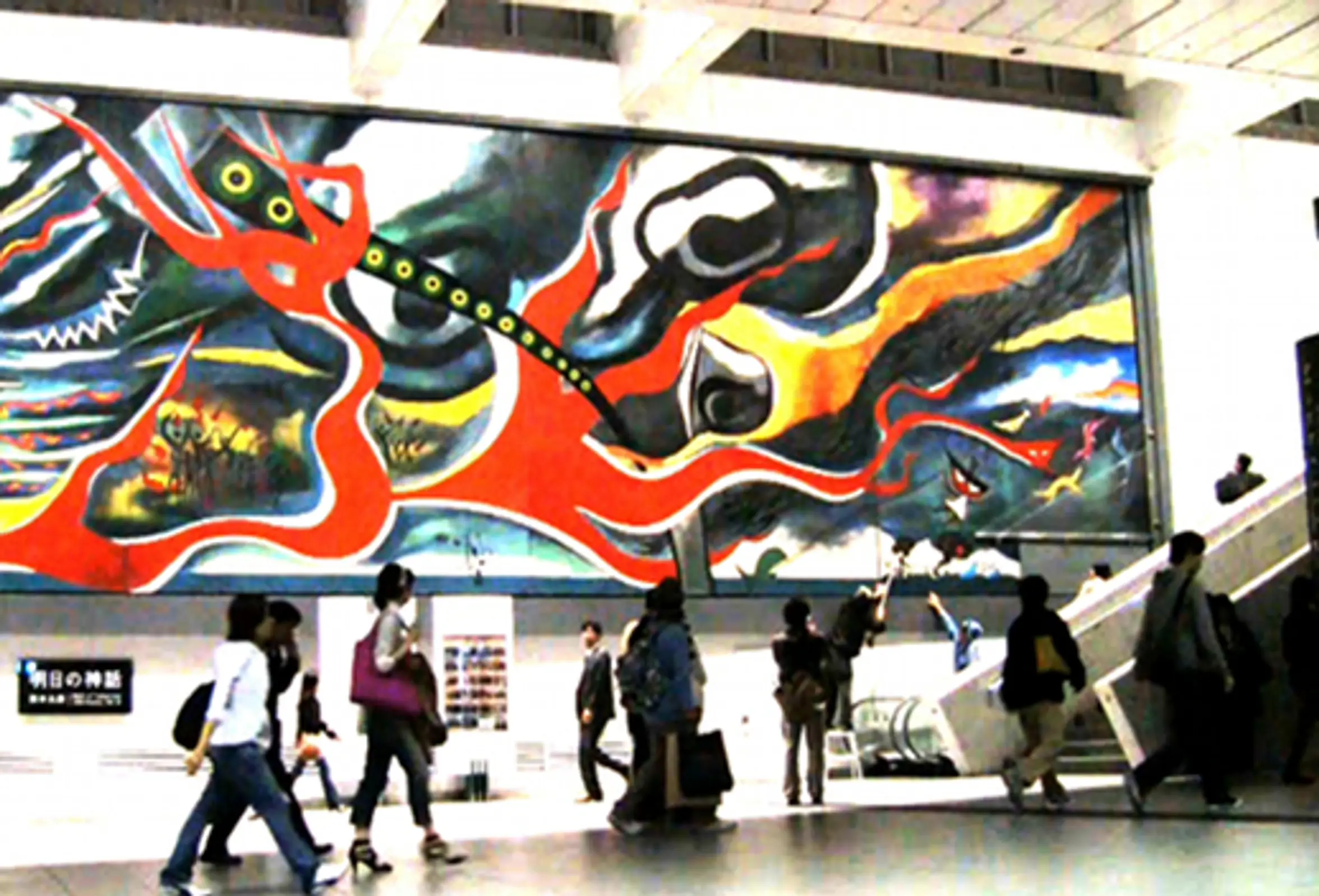
Prior to this exhibition, ChimāPom were in the news for one of the acts documented in this show. The group successfully added an extra piece to the epic mural, Taro Okamotoās ‘The Myth of Tomorrow’, found in Shibuya station. The footage of this illicit act (apparently short-lived) is screened with Edith Piafās iconic torch song, Non, je ne regrette rien.
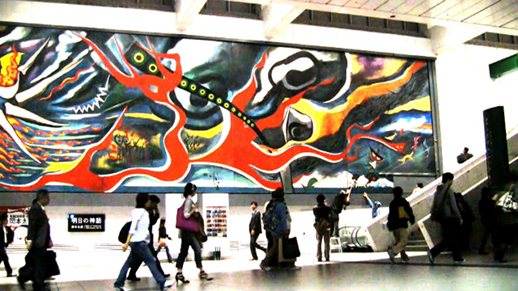
Taro Okamoto is a highly celebrated and loved artist in Japan. Coincidentally, at the time of ChimāPomās public art stunt, there was a major retrospective of Okamoto at the Tokyo National Museum of Modern Art. In this way, ChimāPom were living up to their image as dangerous renegades who challenge the sacredness of art. This particular work was targeted also because of the muralās theme. Okamoto painted an apocalyptic foresight into the future, and ChimāPom responded to the work by adding extra imagery of the broken and still-smoking nuclear plant to his vision. For the exhibition, the painting was hung on a wall right next to the video, giving it an air of the artefact rather than art itself.
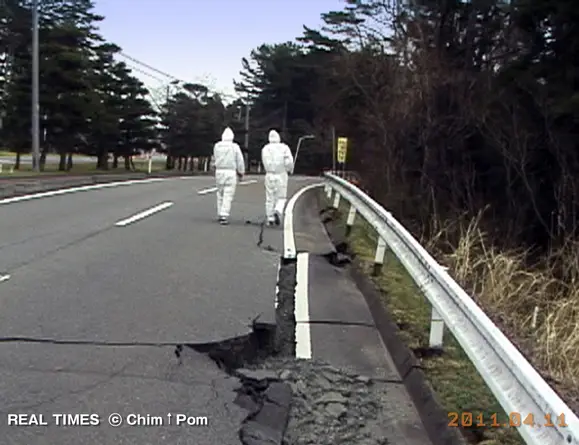
The masterpiece of the show was the eponymous video, ‘Real Times’. It follows the protective-suited artists as they head to a Fukushima lookout in view of the smoking nuclear plants. On the way, they walk along a road that has been cracked and warped after the earthquake. Once at the lookout, they take out a white flag and start painting what appears to be the red circle, the hinomaru, of Japanās national flag. However, the hinomaru is modified to resemble another well-known symbol; the sign for radioactive toxic waste.
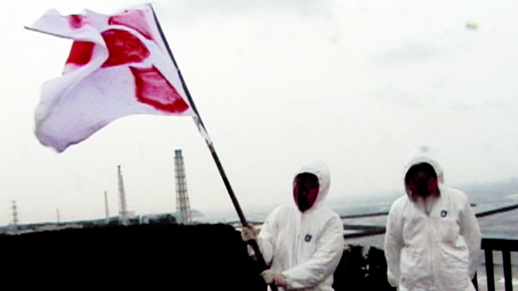
The title of the exhibition, āReal Timesā, suggests that perhaps these post-earthquake days are more real, more serious, than before. Perhaps it is also about the groupās struggle for sincerity rather than their usual tongue-in-cheek approach to various socio-political issues. However, this exhibition also ended with the afterthought that, for the country and for its art, these may be more confusing times than ever before.
Sophie
2011-06-12
Nice review. But one correction: Okamoto’s Myth of Tomorrow is an artistic impression of the moment the atomic bombs hit Hiroshima and Nagasaki, not (despite its title) an “apocalyptic foresight into the future”. The English text at the exhibition was actually very poorly translated and gave this impression in some way. Chim Pom stated that they were drawing the future into the past depicted in Okamoto’s piece.
I also thought that Chim Pom’s reaction, including the Erokitel, was anything but apathetic. Sure, it’s tongue in cheek and is hardly going to challenge solar or wind power for the new energy top spot. But they also offer it as a ‘solution’ of a kind, and they have a point: the one human energy that never seems to dull is lust.
I totally agree about 100 Kiai, though- it definitely got overworn by the 20th shoutout, never mind the 100th!
William Andrews
2011-06-12
Yes, Okamoto was portraying the hell of Hiroshima and Nagasaki (and clearly recalling Picasso’s “Guernica”) to show that our “tomorrow” has now become myth, i.e. atomic warfare has destroyed the possibility of a future. However, conversely, it also depicts from a Cold War context what was a very likely future apocalypse. Mistranslations aside I think we can read foresight into the painting as well.
Personally I feel the analogy between 3.11 and Fukushima with Okamoto’s painting is not strong enough. Sure, the Fukushima crisis is another man-made nuclear disaster…but there is a world of difference between Hiroshima and the issues surrounding nuclear power (especially when coupled with what was a totally unprecedented earthquake and tsunami).
Sophie
2011-06-13
Good points Will. I thought the article might have misinterpreted it somewhat but I see that it makes sense.
The details of TEPCO’s incompetence coming out now have suggested that they dismissed evidence that a similarly large tsunami hit about 1000 years ago. Unprecedented in living memory, yes, and according to written records, but I think there is some geological evidence that they merely overlooked when they put the generators in a basement that could have been flooded by a tsunami half the size of the one on March 11. But this is by the by… Chim Pom said they weren’t anti-nuclear, which I question, but I think they did something *similar* to Haruki Murakami who highlighted the bitter irony that Japan has been afflicted by nuclear issues twice in its history (he used the word ę ø, kaku, to refer Fukushima to make the connection more explicit). I think Chim Pom were doing the same- merely drawing attention to the fact that a chunk of Japan was, ironically, nearly finished off by the same “forces” that obliterated two cities in 1945, except this time by their own hand (as Murakami pointed out as well).
JJ
2011-07-28
Is ā100 KIAIā available online, or anywhere for purchase/viewing?
Even if 100 cheers lost some ‘climactic rhetoric’, the 15 second clip I saw recently here in the states was powerfully symbolic in the most sentimental ways.
I’d like to observe the piece in its entirety if at all possible. I sense it would not be harmful
to be seen by others; quite the opposite.
Any additional info on ā100 KIAIā would be appreciated, grateful for this site.
kind regards,
JJ
100 KIAI
2011-07-28
The video is available, just click my name.
good conceptual draft. view original.
Dan
2011-08-31
Oh, thanks for posting the link! I am pretty sure that the only member of ChimāPom who appears “100 Kiai” is Ellie. I think I remember reading that the other guys are people who live there, who Ellie had just met that day or something like that.
Not sure I agree with the analysis of “100 Kiai” in the post, I thought it was a completely unironic, cathartic release. For me it was the most powerful part of the show, I’m glad it’s up online.