
Exhibition/event has ended.

"Edo Artistic Practice: Court and Folk" Exhibition
Itabashi Art Museum


Finished
SHARE
During the Edo period, the Tokugawa shogunate was patron to artists from the Kano and Sumiyoshi schools as well as folk etching and ukiyo-e artists, all of whom were frequently commissioned for work. Before long, an artistic exchange that transcended the boundaries between warrior and commoner began to gain momentum, and many masterpieces emerged from a process of mutual inspiration among artists of different stripes, contributing to the lively flowering of Edo artistic culture.
In this exhibition, pieces from the museum's collection that reflected both public and private will be on display. In addition, folding screens will be on view at the "zashiki (Japanese tatami room) corner."
Related events:
Talk series on Japanese Art
Experts on various fields of art represented in the museum's collection will be invited to share their expertise with the audience.
April 12th (Sat) "Tawaraya Sotatsu"
Keiko Nakamachi (professor, Jissen Women's University)
April 26th (Sat) "The joy of Edo paintings"
Satoru Sakakibara (professor, Gunma Prefectural Women's University)
May 3rd (Sat) "Harunobu Suzuki"
Tadao Kobayashi (professor, Gakushuin University)
May 5th (Mon, national holiday) "Hikone folding screens and Kano Naganobu"
Taizo Kuroda (chief curator, Idemitsu Museum)
May 10th (Sat) "Muromachi era Sumi ink paintings and the West: on the trail of Kanto Sumi paintings"
Masahiko Aizawa (professor, Seijo University)
May 17th (Sat) "The 18th century Kyoto art world"
Yasuhiro Sato (professor, Tokyo University)
Each talk starts at 14:00 and lasts for 2 hours. Takes place in the lecture hall of the museum. Admission is free and available to the first 100 visitors.
In this exhibition, pieces from the museum's collection that reflected both public and private will be on display. In addition, folding screens will be on view at the "zashiki (Japanese tatami room) corner."
Related events:
Talk series on Japanese Art
Experts on various fields of art represented in the museum's collection will be invited to share their expertise with the audience.
April 12th (Sat) "Tawaraya Sotatsu"
Keiko Nakamachi (professor, Jissen Women's University)
April 26th (Sat) "The joy of Edo paintings"
Satoru Sakakibara (professor, Gunma Prefectural Women's University)
May 3rd (Sat) "Harunobu Suzuki"
Tadao Kobayashi (professor, Gakushuin University)
May 5th (Mon, national holiday) "Hikone folding screens and Kano Naganobu"
Taizo Kuroda (chief curator, Idemitsu Museum)
May 10th (Sat) "Muromachi era Sumi ink paintings and the West: on the trail of Kanto Sumi paintings"
Masahiko Aizawa (professor, Seijo University)
May 17th (Sat) "The 18th century Kyoto art world"
Yasuhiro Sato (professor, Tokyo University)
Each talk starts at 14:00 and lasts for 2 hours. Takes place in the lecture hall of the museum. Admission is free and available to the first 100 visitors.
Schedule | Apr 5 (Sat) 2008-May 18 (Sun) 2008 Opening Hours Information
| ||||||
|---|---|---|---|---|---|---|---|
| Fee | Free | ||||||
| Venue | Itabashi Art Museum https://www.city.itabashi.tokyo.jp/artmuseum/4000002/4000014.html  | ||||||
| Location | 5-34-27 Akatsuka, Itabashi-ku, Tokyo 175-0092 | ||||||
| Access | 15 minute walk from the South exit of Nishi-takashimadaira Station on the Toei Mita line; From the North exit of Narimasu Station on the Tobu Tojo line, take the Kokusai Kogyo bus and get off at Kuritsu Bijutsukan. | ||||||
| Phone | 03-3979-3251 | ||||||
| Related images | Click on the image to enlarge it 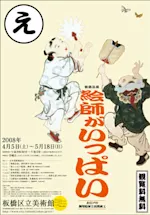 |
Back to Articles
SHARE
No comments yet