Vintage Vinyl

He’s big. He’s Scottish. And he’s over here. Extended by popular demand, Jim Lambie’s solo show is a feast for the eyes, an extravaganza, a psychedelic phantasmagoria. But what else?

poster for Jim Lambie

Jim Lambie "Unknown Pleasures"

at Hara Museum of Contemporary Art
in the Roppongi, Akasaka area
This event has ended - (2008-12-13 - 2009-05-10)

311 people bookmarked this.
60 people recommend this.
11 people reviewed this.

In Reviews by Jessica Niles DeHoff 2009-03-18 print

Jim Lambie has made a career out of dorm rooms. Specifically, your cool older brother’s room circa 1978. Psychedelic patterns in wild colors, piles of old album covers, and posters of music idols all feature prominently in Lambie’s oeuvre, though lava lamps are conspicuous by their absence. This guy hit adolescence in the heyday of punk and disco, and recovery seems to be taking him a while.

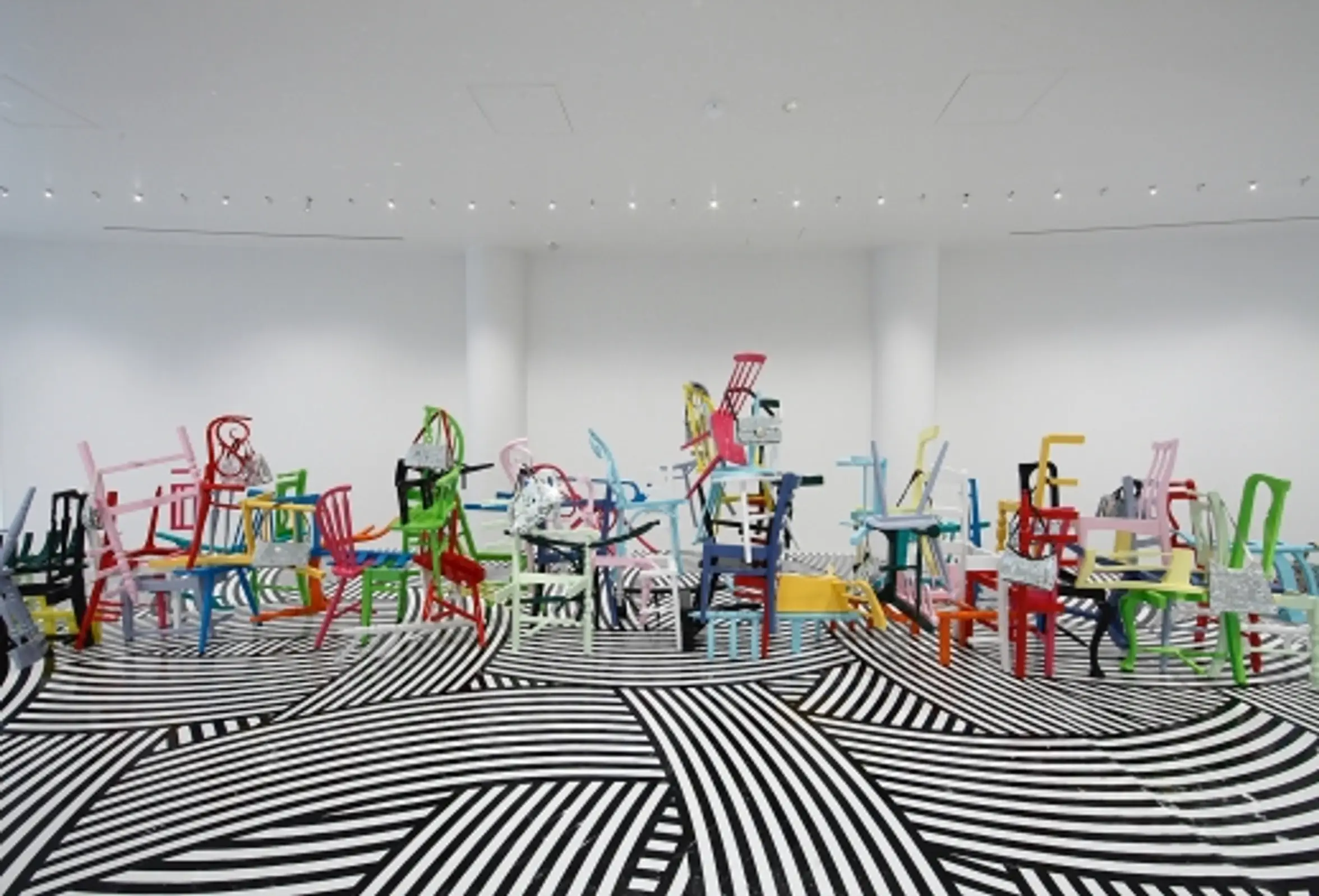
“Unknown Pleasures” exhibits a series of works that Lambie and his team of assistants installed at the Hara Museum in December last year. The show includes several of the Scottish artist’s trademarks: a vibrantly colored sculpture made of deconstructed chairs and mirrored handbags (‘Train in Vain’), a series of black-and-white posters of pop-culture idols overlaid with fragments of floral oil paintings (‘Found Flower Paintings’), multi-knobbed doors leading nowhere (‘Maybelline,’ ‘Plastic Ono,’ and ‘Kinda Blue’).
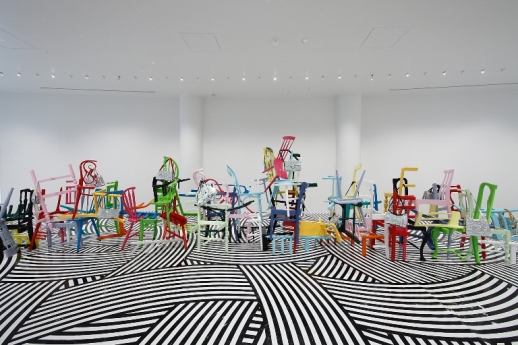
Jim Lambie, 'Train in Vain' (2008)<br /> Wooden chairs, handbags, mirrors, gloss paint, dimensions variable
And herein lies the rub. I admire some of Lambie’s work, I really do. He is a master at creating disorienting environments. But how often can an artist—especially one working in the genre of site-specific conceptual art—productively repeat a trademark move?

Lambie is perhaps best known for his patterned floor surfaces, which he makes using vinyl tape. In most cases, the tape echoes the outlines of the space, inviting the viewer to think about the interactions between art and architecture, two-dimensional and three-dimensional work, decoration and design.

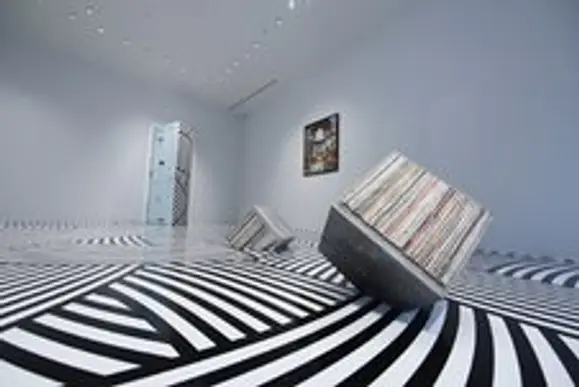
For this show, however, he has used the tape to create fan-shaped arcs in simple black and white (the work as a whole is called ‘The Strokes’). At first, this seemed appropriate: the Hara, after all, is housed in a High Modernist structure, a former residence designed by Jin Watanabe. Monochromatic arcs would surely meet with Bauhaus approval. But a little research reveals that Lambie has used this pattern before: in a show at Boston’s Museum of Fine Art last year, the same pattern appeared as a backdrop for the same colorful chairs that now make up ‘Train in Vain.’ How site-specific is that? (See a previous review of Lambie’s trademark stripes here on TABlog.)
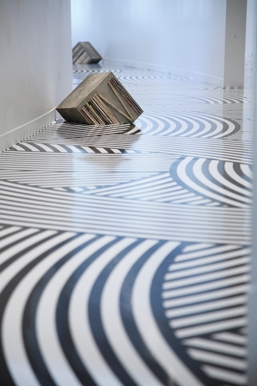
Jim Lambie, 'Sonic Reducer' (12 pieces) (2008)<br /> Concrete, album covers, 35.5 x 35.5 x 35.5 cm (each)Jim Lambie, 'I Didn't Know I Loved You Til' I Saw You Rock 'N' Roll' (2008)<br /> Mattress, gloss paint, 140 x 190 x 20 cm

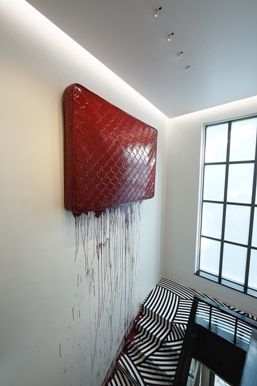
Frankly, I felt cheated by this exhibition. Over and over again, I would find myself excited about particular works, only to discover that they were not as original as they seemed. ‘I Didn’t Know I Loved You Til’ I Saw You Rock ‘N’ Roll’ – which is, to my mind, the strongest piece here – is a good example. The work consists of a mattress mounted onto the wall above the stairs. It is coated in high-gloss paint of a lurid maroon color that inevitably evokes blood as it drips down the wall and pools on the stair treads. Lambie has said that he chose to mount the piece here, where the viewer is nearing the house’s former bedrooms, because the mattress is a symbol of domesticity. Pretty cool, right? Well, yeah, until you realize Lambie has made other mattresses in other colors for other shows in institutional, not domestic, settings.

Maybe I’m asking too much. Lambie is a musician and DJ as well as a visual artist, and he often draws parallels between the two worlds. Perhaps it is useful for us viewers, too, to think of him as a rock star, as David Bowie instead of Rembrandt. Musicians must often perform the same material night after night, in venue after venue, and though you always want to believe that they’re playing your favorite song just for you, you’re wrong. I guess the international art market is getting to be the same way.

(Readers interested in seeing footage of the installation process and interviews with the artist should visit the Museum’s website here.)
Jessica Niles DeHoff

Jessica Niles DeHoff. Jessica is a Japan-based architect and urbanist. After stints at several American firms, she recently kicked off her own design practice by renovating a 19th-century rowhouse in Washington DC and building a new studio for a painter in Wisconsin. Her design work has been featured in Dwell magazine, and she has also published a set of urban-design guidelines in partnership with the Connecticut Main Street Program. Jessica holds degrees from Harvard College and Yale School of Architecture and she has taught at universities in the U.S. and abroad. Her interests primarily focus on the enrichment of the urban experience, the reinvention of historic buildings and materials, and a hands-on approach to the craft of design. She has traveled all over the world but currently resides in Tokyo, where she lives with her husband, two cats and one dog. » See other writings

Comments

  1. Joseph Bolstad
    2009-03-18

    I think you summed up the problems with this show in the last paragraph quite nicely.
    It’s not just that Lambie repeats himself from one museum show to the next, he repeats himself within the same show — to extend your metaphor, all the songs sound the same. For me, seeing another brightly painted door with various doorknobs attached didn’t amount to much. I understand Lambie was trying to treat the entire building as a kind of single composition, but the entire installation lacks dynamics. Given Lambie’s knack for transforming the ordinary, I was expecting more.

  2. JND
    2009-03-18

    You make an excellent point! I could not see the differences between the various doors either. And as for what you say – “Lambie was trying to treat the bldg as a kind of single composition” – I think this is a fascinating concept. I actually don’t think Lambie was trying to do this – despite the unifying floor pattern – but it would be great to see someone attempt it. Especially if they included the garden space as part of the composition!

  3. what is this?
    2009-05-08

    Mostly right on. I used to like Jim, the show last year at Tokyo Opera City was quite nice and engaging. [Why is he (so many others) being re-played so soon and so close by? but this is a separate nefarious story.] This show is a real clinker. As a fellow discophile and wannabe DJ I checked out the tunes in his concrete boxes. Well… where does he get this stuff? Salvation Army discards?
    The floors seemed to have been lifted from Sol Lewit and most of everything else seemed trivial and unnecessary. I too was disappointed, but besides the replay factor the details were the most disappointing. Filling a space is simple, connecting the dots and making it all matter is where things start to unravel. This show unraveled early and by the end we are left with a tattered sweater of left over scraps apparently recycled. NO MORE REPLAY PLEASE HE, Teppei Kaneuchi (teppanyaki) Satoshi Ohno Chiba, Izumi, Pixcel, Odani… are way over played and it is time to let them come up with a few ideas before parading their foolishness further

About TABlog

TABlog's writers and video reporters deliver regular reviews, features and interviews to stimulate discussion about all sides of Tokyo's creative scene.

T-shirt shop

The views expressed on TABlog are those of the author and do not necessarily reflect those of their employers, or Tokyo Art Beat, or the Gadago NPO.

All content on this site is © their respective owner(s).
Tokyo Art Beat (2004 - 2010) - About - Contact - Privacy - Terms of Use