
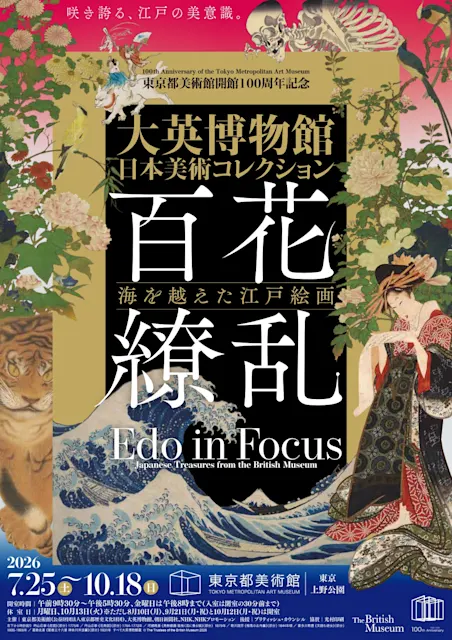
100th Anniversary of the Tokyo Metropolitan Art Museum Edo in Focus: Japanese Treasures from the British Museum
Tokyo Metropolitan Art Museum


Starts 7/25
SHARE
Founded in 1753, the British Museum is one of the world's great museums. Its collection of Japanese art is said to be the most comprehensive outside of Japan in quality as well as quantity. People’s fascination with the culture of Japan, a foreign land far across the seas, has been the driving force behind the collection’s expansion since the late 19th century, when Japonisme became a craze. The achievements of surgeon William Anderson (1842~1900) and other collectors and curators associated with the British Museum, and the connections they formed among them, extended across borders and decades and have been passed down to this day.
This exhibition will showcase selected masterpieces from the British Museum’s some 40,000-piece Japanese art collection with a focus on Edo-period paintings on byobu (folding screens), hanging scrolls (kakejiku), and handscrolls (emaki), as well as prints by eight renowned ukiyo-e artists including Utamaro, Sharaku, Hokusai, and Hiroshige. By also shedding light on recent research findings and the collection’s history, the exhibition will trace the British Museum’s role at the forefront of the collection, research, and conservation of Japanese art. It will, in this way, present opportunities to look back on the history of international cultural exchange and, at the same time, open a new dialogue between we who live today and Japanese art masterpieces in the care of the British Museum.
This exhibition will showcase selected masterpieces from the British Museum’s some 40,000-piece Japanese art collection with a focus on Edo-period paintings on byobu (folding screens), hanging scrolls (kakejiku), and handscrolls (emaki), as well as prints by eight renowned ukiyo-e artists including Utamaro, Sharaku, Hokusai, and Hiroshige. By also shedding light on recent research findings and the collection’s history, the exhibition will trace the British Museum’s role at the forefront of the collection, research, and conservation of Japanese art. It will, in this way, present opportunities to look back on the history of international cultural exchange and, at the same time, open a new dialogue between we who live today and Japanese art masterpieces in the care of the British Museum.
Schedule | Jul 25 (Sat) 2026-Oct 18 (Sun) 2026 Opening Hours Information
| ||||
|---|---|---|---|---|---|
| Fee | Adults ¥2300, University Students ¥1300, Seniors 65 & Over ¥1600, High School Students and Under free. | ||||
| Website | https://www.tobikan.jp/en/exhibition/2026_britishmuseum.html | ||||
| Venue | Tokyo Metropolitan Art Museum https://www.tobikan.jp/en/index.html | ||||
| Location | 8-36 Ueno Park, Taito-ku, Tokyo 110-8712 | ||||
| Access | 7 minute walk from the Park exit of JR Ueno Station, 10 minute walk from the Ikenohata exit of Keisei Ueno Station on the Keisei Main line, 10 minute walk from exit 7 at Ueno Station on the Ginza and Hibiya lines. | ||||
| Phone | 03-3823-6921 | ||||
| Related images | Click on the image to enlarge it  |
Traveling exhibition schedule
Back to Articles
SHARE
No comments yet