
Exhibition/event has ended.

Void of Nippon 77: Postwar Art History Landscape Sequences
Gyre Gallery


Finished
SHARE
Artists
On Kawara, Kimiyo Mishima, Natsuyuki Nakanishi, Jiro Takamatsu, Genpei Akasegawa, Tomio Miki, Isao Kitamura, Yoshio Kitayama, Satoru Aoyama, Teppei Kaneuji, Akira Kamo, Enrico Isamu Oyama, Yusuke Suga, Mika Tamori, Kokumintohyo
French philosopher Roland Barthes (1915–1980) saw Japan as a country full of signs, with an empty void at its center. In contrast to the Empire of Meaning, he called Japan the Empire of Signs. In his portrayal of Japan, the emperor, cities, onnagata actors, sukiyaki, etiquette, pachinko, and student movements were all just signs, freed from meaning in an unconstrained culture. By contrasting this Empire of Signs with the Empire of Meaning, he presented a Japan that he saw as freed from the threatening attachment of meaning known in the West. In Japanese culture, the signified (signifié) was not stopping the development of chains of signifiers (signifiants). A few months before his death, Yukio Mishima (1925-1970) inverted this view of Japan to examine it from a different perspective, describing it in words that still reverberate today: "Soon Japan will vanish altogether. In its place, all that will remain is an inorganic, empty, neutral, drab, wealthy, scheming, economic giant in a corner of the Far East.”*2 Japan’s “void,” as observed by both Barthes and Mishima, becomes our premise for throwing light back onto postwar artists through the work of a subsequent generation of artists active today. This reveals sequences*1 of landscapes (sequential patterns like the Sequenz used in music) in the meaning-free empty-centered void of postwar art history.
August 2022 marks seventy-seven years from the end of war in the Pacific. That is the same length of time as elapsed between Japan’s Meiji Restoration and the end of the Pacific War. To be specific, there were seventy-seven years between 1868 and 1945, and another seventy-seven years have now elapsed between 1945 and 2022. We have reached the point where Japan’s prewar and postwar periods are the same length. That historical continuity inspired the theme for this exhibition: “Postwar art history landscape sequences.” None of the works presented in this exhibition is autonomous or self-sufficient. They have the capability to repeat from age to age, forming chains and spreading out. Consequently, each of the works naturally expresses temporal continuity. In this exhibition, we refer to this phenomenon as a “sequence.”*1 The exhibition’s composition aims to connect artists whose work underlay the spirit of the times in prewar and postwar Japan with artists active today who represent new generations, thereby bringing the continuity of time into relief. Furthermore, it aims to objectify the spirit of the times through each of the individual periods in that history—Showa, Heisei, and Reiwa—raising questions about where we are now headed.
*1 Sequence (Ger. Sequenz) is a term used in music to refer torepeated use of a phrase of some sort, typically ascending ordescending with each repetition.
*2 Essay by Mishima in the Sankei Shimbun evening edition ofJuly 7, 1970.
August 2022 marks seventy-seven years from the end of war in the Pacific. That is the same length of time as elapsed between Japan’s Meiji Restoration and the end of the Pacific War. To be specific, there were seventy-seven years between 1868 and 1945, and another seventy-seven years have now elapsed between 1945 and 2022. We have reached the point where Japan’s prewar and postwar periods are the same length. That historical continuity inspired the theme for this exhibition: “Postwar art history landscape sequences.” None of the works presented in this exhibition is autonomous or self-sufficient. They have the capability to repeat from age to age, forming chains and spreading out. Consequently, each of the works naturally expresses temporal continuity. In this exhibition, we refer to this phenomenon as a “sequence.”*1 The exhibition’s composition aims to connect artists whose work underlay the spirit of the times in prewar and postwar Japan with artists active today who represent new generations, thereby bringing the continuity of time into relief. Furthermore, it aims to objectify the spirit of the times through each of the individual periods in that history—Showa, Heisei, and Reiwa—raising questions about where we are now headed.
*1 Sequence (Ger. Sequenz) is a term used in music to refer torepeated use of a phrase of some sort, typically ascending ordescending with each repetition.
*2 Essay by Mishima in the Sankei Shimbun evening edition ofJuly 7, 1970.
Schedule | Aug 15 (Mon) 2022-Sep 25 (Sun) 2022 Opening Hours Information
| ||||
|---|---|---|---|---|---|
| Fee | Free | ||||
| Website | https://en.gyre-omotesando.com/artandgallery/void-of-nippon77/ | ||||
| Venue | Gyre Gallery https://en.gyre-omotesando.com/art/ | ||||
| Location | 3F Gyre, 5-10-1 Jingumae, Shibuya-ku, Tokyo 150-0001 | ||||
| Access | 4 minute walk from exit 5 at Meiji-jingumae Station on the Chiyoda and Fukutoshin lines. 5 minute walk from exit A1 at Omotesando Station on the Hanzomon, Chiyoda and Ginza lines, 6 minute walk from the Omotesando exit of JR Harajuku Station. | ||||
| Phone | 03-3498-6990 | ||||
| Related images | Click on the image to enlarge it 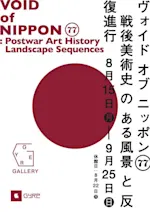 |
Back to Articles
SHARE
No comments yet