
Exhibition/event has ended.

Léa Bouton "The Rapture"
Untitled Space


Finished
SHARE
Artists
Léa Bouton
The spaces depicted by Léa Bouton are like empty crypts, mortuary chambers: finely, precisely carved by a sharp pencil. The bodies appear trapped and pulverized, subjected to a process of decay or progressive liquefaction. A universe of fluidity—but that of stagnant or still waters, as described by Bachelard in *Water and Dreams*. These are spaces of disorientation; three-dimensional spaces, but undermined by emptiness, by the absence of perspective—a kind of mockery of the vanishing point in classical painting. No horizon in these worlds, only an oppressive heaviness that entraps feminine subjectivity. Beckett, female version.
Moreover, the bodies themselves are subjected to deformation, flattening, and fragmentation. Mouths, vulvas, eyes: Léa offers a poetics of the orifice, a paradox between surface and depth. The hollows or abysses represented seem not to be escape routes, but rather the very site of drowning and the eruption of corporeal suffering. Beings with upturned eyes, blurred gazes. As for the multiplicity of bodily fluids that spurt forth like a final life impulse, we see blood, milk, tears, semen, even vomit. All variations of the abject and obscene—as if the contemporary body could only be represented as fragmented, agonized, exploded in its decomposed matter.
There is a scent of species extinction, in any case, and of the end of humanity. Hybridity of realms and materials: insects, human limbs, leather sofas, bedspreads, ambient minerality—all fall under the domain of the crawling. Léa combines enclosed and immense spaces at once, marked by vacuity. Her works “suspend us endlessly on the question of whether these tunnels are dead ends or escape routes, spaces in which one cannot exit or spaces where one might find air again (...) they render the place itself anxiety-inducing (...) it is a poverty far more grey and rancid that \[they] allow us to experience. It is the poverty of places devastated by history.1”
Faced with this disintegration, Léa’s art resembles a knife that flays surfaces and volumes. A vampiric art that bites deeply into matter, that tears—or rather reveals—the contemporary rupture, as suggested by the scattered dentures in several works. Léa recreates depth within flatness, relief within surface. The power of her creations lies in the tension between technical mastery of drawing, geometry, and the fluidity of the forms represented—evoking a sense of strangeness and horror. One finds echoes of fantastical and gory bestiaries, but radicalized by a kind of atomization, dispersion; placed here and there as unsettling presences. These demons are often marked by disfigurement, the unrepresentable: indistinct hair, toothy creatures, levitating forms like demonic spirits or nightmares evoking 19th-century Symbolist painting, totems or animist sculptures suggesting a decadent preciousness. Léa’s universe evokes the surrealism of Dalí or the derealization of Lynch, but she feminizes them: not only because the only bodies represented are female, but also because she portrays violence as eroticism and pleasure in these bodies (a double subversion). Dreamlike fluidity merges with another, feminine fluidity that unfolds in these cold, marmoreal spaces without ever escaping them. Interestingly, the creeping animality infects the female bodies. This teeming matter opposes the vertical, oppressive minerality, yet every element remains ambiguous: is the bloodiness a sign of murder or menstruation? Are the flattened bodies a symbol of the deterritorialized contemporary world, or a sign of spiritual abandonment? Is the contamination of beings a form of hybridization—or toxicity?
A tension between inside and outside, organic and inorganic, concrete and vegetative proliferation, between death and pleasure. A kind of forced exteriority, where the body is exposed to the extreme, as a symbol of matter itself, of its scandalous indistinction. This is also Fisher’s very definition of the *weird*: “the allure that the weird and the eerie possess (...) has to do with a fascination for the outside, for that which lies beyond standard perception, cognition and experience. This fascination usually involves a certain apprehension, perhaps even dread.” Léa’s works stage the contemplation of the inside from the outside, through a process of montage that juxtaposes disparate elements to make the strange emerge from the familiar. And it is indeed the **ominous**—a word that comes from the English “bad omen”—that arises from landscapes devoid of human presence, such as Léa’s gridded deserts:
“We find the eerie more readily in landscapes partially emptied of the human (...) the eerie is fundamentally tied up with questions of agency. What kind of agent is acting here? Is there an agent at all? These questions can be posed in a psychoanalytic register but they also apply to the forces governing capitalist society. Capital is at every level an eerie entity: conjured out of nothing, capital never exerts more influence than any allegedly substantial entity. The metaphysical scandal of capital brings us to the broader question of the agency of the immaterial and the inanimate: the agency of minerals and landscape, and the way that ‘we’ ‘ourselves’ are caught up in the rhythms, pulsions and patternings of non-human forces.
There is no inside except as a folding of the outside; the mirror cracks, I am an other, and I always was.2”
The dull threat that emanates from Léa’s works—with as much cruelty as brilliance—seems to stem from a kind of estrangement of the self, a disaggregation, a decomposition of all form, but also a possibility of existing in suspension. The body, as the only materialized agency, escapes the control that crushes it through the power of its metamorphoses.
1 Georges Didi-Huberman, Essayer voir, Les Éditions de Minuit, coll. « Fables du temps », 2014, p.33.
2 Mark Fisher, The weird and the eerie, Repeater Books, 2016, p.8.
Moreover, the bodies themselves are subjected to deformation, flattening, and fragmentation. Mouths, vulvas, eyes: Léa offers a poetics of the orifice, a paradox between surface and depth. The hollows or abysses represented seem not to be escape routes, but rather the very site of drowning and the eruption of corporeal suffering. Beings with upturned eyes, blurred gazes. As for the multiplicity of bodily fluids that spurt forth like a final life impulse, we see blood, milk, tears, semen, even vomit. All variations of the abject and obscene—as if the contemporary body could only be represented as fragmented, agonized, exploded in its decomposed matter.
There is a scent of species extinction, in any case, and of the end of humanity. Hybridity of realms and materials: insects, human limbs, leather sofas, bedspreads, ambient minerality—all fall under the domain of the crawling. Léa combines enclosed and immense spaces at once, marked by vacuity. Her works “suspend us endlessly on the question of whether these tunnels are dead ends or escape routes, spaces in which one cannot exit or spaces where one might find air again (...) they render the place itself anxiety-inducing (...) it is a poverty far more grey and rancid that \[they] allow us to experience. It is the poverty of places devastated by history.1”
Faced with this disintegration, Léa’s art resembles a knife that flays surfaces and volumes. A vampiric art that bites deeply into matter, that tears—or rather reveals—the contemporary rupture, as suggested by the scattered dentures in several works. Léa recreates depth within flatness, relief within surface. The power of her creations lies in the tension between technical mastery of drawing, geometry, and the fluidity of the forms represented—evoking a sense of strangeness and horror. One finds echoes of fantastical and gory bestiaries, but radicalized by a kind of atomization, dispersion; placed here and there as unsettling presences. These demons are often marked by disfigurement, the unrepresentable: indistinct hair, toothy creatures, levitating forms like demonic spirits or nightmares evoking 19th-century Symbolist painting, totems or animist sculptures suggesting a decadent preciousness. Léa’s universe evokes the surrealism of Dalí or the derealization of Lynch, but she feminizes them: not only because the only bodies represented are female, but also because she portrays violence as eroticism and pleasure in these bodies (a double subversion). Dreamlike fluidity merges with another, feminine fluidity that unfolds in these cold, marmoreal spaces without ever escaping them. Interestingly, the creeping animality infects the female bodies. This teeming matter opposes the vertical, oppressive minerality, yet every element remains ambiguous: is the bloodiness a sign of murder or menstruation? Are the flattened bodies a symbol of the deterritorialized contemporary world, or a sign of spiritual abandonment? Is the contamination of beings a form of hybridization—or toxicity?
A tension between inside and outside, organic and inorganic, concrete and vegetative proliferation, between death and pleasure. A kind of forced exteriority, where the body is exposed to the extreme, as a symbol of matter itself, of its scandalous indistinction. This is also Fisher’s very definition of the *weird*: “the allure that the weird and the eerie possess (...) has to do with a fascination for the outside, for that which lies beyond standard perception, cognition and experience. This fascination usually involves a certain apprehension, perhaps even dread.” Léa’s works stage the contemplation of the inside from the outside, through a process of montage that juxtaposes disparate elements to make the strange emerge from the familiar. And it is indeed the **ominous**—a word that comes from the English “bad omen”—that arises from landscapes devoid of human presence, such as Léa’s gridded deserts:
“We find the eerie more readily in landscapes partially emptied of the human (...) the eerie is fundamentally tied up with questions of agency. What kind of agent is acting here? Is there an agent at all? These questions can be posed in a psychoanalytic register but they also apply to the forces governing capitalist society. Capital is at every level an eerie entity: conjured out of nothing, capital never exerts more influence than any allegedly substantial entity. The metaphysical scandal of capital brings us to the broader question of the agency of the immaterial and the inanimate: the agency of minerals and landscape, and the way that ‘we’ ‘ourselves’ are caught up in the rhythms, pulsions and patternings of non-human forces.
There is no inside except as a folding of the outside; the mirror cracks, I am an other, and I always was.2”
The dull threat that emanates from Léa’s works—with as much cruelty as brilliance—seems to stem from a kind of estrangement of the self, a disaggregation, a decomposition of all form, but also a possibility of existing in suspension. The body, as the only materialized agency, escapes the control that crushes it through the power of its metamorphoses.
1 Georges Didi-Huberman, Essayer voir, Les Éditions de Minuit, coll. « Fables du temps », 2014, p.33.
2 Mark Fisher, The weird and the eerie, Repeater Books, 2016, p.8.
Schedule | Oct 10 (Fri) 2025-Oct 19 (Sun) 2025 Opening Hours Information
Opening Reception Oct 10 (Fri) 2025 18:00 - 20:00 | ||
|---|---|---|---|
| Fee | Free | ||
| Website | https://www.instagram.com/p/DO-gA_mCQQ-/?img_index=1 | ||
| Venue | Untitled Space https://www.instagram.com/untitled_space_tokyo/ | ||
| Location | 3-13-7 Kyojima, Sumida-ku, Tokyo 131-0046 | ||
| Access | 5 minute walk from exit A2 at Keisei-Hikifune Station on the Keisei Oshiage line, 10 minute walk from the East exit of Hikifune Station on the Tobu Skytree and Kameido lines. | ||
| Related images | Click on the image to enlarge it 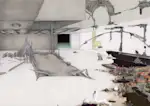 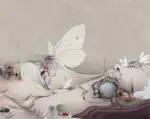 |
Back to Articles
SHARE
No comments yet