
Exhibition/event has ended.

Talk & Workshop "Lubunca: A Queer Anti-Language"
Tokyo University of the Arts, Ueno Campus


FinishedReservation Required
SHARE
Artists
Lilith Bardakçı
Lubunca: A Queer Anti-Language discusses the multifaceted world of Lubunca. Having been defined in multiple ways—as a slang spoken by some gay men and trans women, a jargon used by sex workers, a gay slang, a queer slang variety, and an LGBTQ slang variety — Lubunca embodies the vibrant identity and resistance within Turkey's queer community. Lilith Bardakçı terms it an anti-language spoken by Lubunyas, as it reveals a resilient reality distinct from the hegemonic societal norms. The term ‘Lubunya’ extends beyond categories like gay, lesbian, or trans, representing queer individuals who live beyond conventional Turkish societal structures and embrace non-normative lifestyles.
Bardakçı will unveil the etymological roots and historical context of Lubunca, as well as discussing its sociolinguistic functions and its role as a tool for secrecy and solidarity. Key insights reveal Lubunca’s critical role in facilitating discreet communication among queer individuals about sensitive issues, thus protecting the community from societal and legal repercussions. As noted by Nicholas Kontovas, Beyoğlu (Istanbul, Turkey), the birthplace of Lubunca, was a hub for many gay and transgender sex workers, along with non- Muslim minorities like the Romani. Lubunca allowed these groups to unite in resistance against Turkish law enforcement. Today, it continues to exclude non-members while discussing sexual and criminal matters. Lubunca also serves as a dynamic instrument for gender performance, empowering LGBTI+ activists and YouTubers to enhance their visibility and assert their identities in public and media spaces. Delving deeper, the talk will examine how Lubunca constructs an alternative reality for its speakers. As Bardakçı suggests, in line with Halliday’s concept of anti-languages, Lubunca relexicalizes Turkish to create and sustain an anti-society where conventional ideas of sex, gender, sexuality, crime, and social hierarchy are redefined. Ülker Street Culture exemplifies this resilient reality, similar to the ‘second-life’ described by Adam Podgorecki.
In this session, Bardakçı will offer an in-depth definition of Lubunca, framing it as an anti-language that not only ensures secrecy but also facilitates the expression and preservation of a distinct queer identity and reality. It peels back the layers of Lubunca and discovers its profound impact on Turkey’s queer community. Additionally, a workshop will be held, providing an interactive and playful way to explore and co-learn how perceptions of gender and sexuality among Lubunyas have evolved over time and how this evolution has influenced the development of Lubunca.
Venue: Tokyo University of the Arts Ueno Campus Taki Plaza 3F Community Salon
Guest: Lilith Bardakçı (online)
Language: Japanese / English
Talk: 15:00-16:15
Workshop: 16:30-18:00
Capacity: 50 people
*There is limited space for the talk + workshop so priority will be given to those who have reserved a spot beforehand.
Reservations: https://docs.google.com/forms/d/e/1FAIpQLSdKV-Xby9AGCNQH4dfdcNmXjcC5d7qMfGbfzqkThlEf2V7Sbg/viewform
Bardakçı will unveil the etymological roots and historical context of Lubunca, as well as discussing its sociolinguistic functions and its role as a tool for secrecy and solidarity. Key insights reveal Lubunca’s critical role in facilitating discreet communication among queer individuals about sensitive issues, thus protecting the community from societal and legal repercussions. As noted by Nicholas Kontovas, Beyoğlu (Istanbul, Turkey), the birthplace of Lubunca, was a hub for many gay and transgender sex workers, along with non- Muslim minorities like the Romani. Lubunca allowed these groups to unite in resistance against Turkish law enforcement. Today, it continues to exclude non-members while discussing sexual and criminal matters. Lubunca also serves as a dynamic instrument for gender performance, empowering LGBTI+ activists and YouTubers to enhance their visibility and assert their identities in public and media spaces. Delving deeper, the talk will examine how Lubunca constructs an alternative reality for its speakers. As Bardakçı suggests, in line with Halliday’s concept of anti-languages, Lubunca relexicalizes Turkish to create and sustain an anti-society where conventional ideas of sex, gender, sexuality, crime, and social hierarchy are redefined. Ülker Street Culture exemplifies this resilient reality, similar to the ‘second-life’ described by Adam Podgorecki.
In this session, Bardakçı will offer an in-depth definition of Lubunca, framing it as an anti-language that not only ensures secrecy but also facilitates the expression and preservation of a distinct queer identity and reality. It peels back the layers of Lubunca and discovers its profound impact on Turkey’s queer community. Additionally, a workshop will be held, providing an interactive and playful way to explore and co-learn how perceptions of gender and sexuality among Lubunyas have evolved over time and how this evolution has influenced the development of Lubunca.
Venue: Tokyo University of the Arts Ueno Campus Taki Plaza 3F Community Salon
Guest: Lilith Bardakçı (online)
Language: Japanese / English
Talk: 15:00-16:15
Workshop: 16:30-18:00
Capacity: 50 people
*There is limited space for the talk + workshop so priority will be given to those who have reserved a spot beforehand.
Reservations: https://docs.google.com/forms/d/e/1FAIpQLSdKV-Xby9AGCNQH4dfdcNmXjcC5d7qMfGbfzqkThlEf2V7Sbg/viewform
Schedule | Nov 17 (Sun) 2024 Reservation RequiredOpening Hours Information
| ||
|---|---|---|---|
| Fee | Free | ||
| Website | https://okamemochi.com/co-learning_vol2 | ||
| Venue | Tokyo University of the Arts, Ueno Campus http://www.geidai.ac.jp/english/ | ||
| Location | 12-8 Ueno Park, Taito-ku, Tokyo, 110-8714 | ||
| Access | 10 minute walk from the Park exit of JR Ueno Station, 10 minute walk from exit 2 at Nezu Station on the Chiyoda line. | ||
| Related images | Click on the image to enlarge it 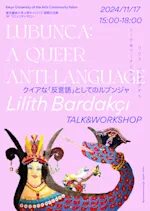 |
Back to Articles
SHARE
No comments yet