
Exhibition/event has ended.

Paul Gauguin Exhibition
The National Museum of Modern Art, Tokyo


Finished
SHARE
Artists
Paul Gauguin
The artist Paul Gauguin (1848-1903) turned his back on the highly developed western civilization of the end of the 19th century and made his way alone to the solitary island of Tahiti in the South Seas.
It can be said that his tumultuous life exemplifies that of the lonely wandering artist who sacrifices his life for art.
Awakened by his inner "wildness", Gauguin searched for the "paradise" which would nurture his idiosyncratic imagination. His search led him to Brittany with its strong tradition of Celtic culture, Martinique with its sparkling tropical nature, Arles, in the South of France, which provided the stage for his legendary collaborative work with Van Gogh, in addition to Tahiti where he made two long sojourns. In this way, Gauguin continued to travel with no end in sight. During this process, he arrived at the fundamental subject matter of the dichotomy between human life and death, civilized and savage. The aim of Gauguin's paintings was to express the deep emotions and contemplations of human existence through the language of form.
His great masterpiece that was painted in Tahiti, "Where Do We Come From? What Are We? Where Are We Going?" (1897-98), represents the consolidation of what he sought to achieve through his art. Along with the enigmatic title, this work represents his spiritual testament which he left behind for future generations. The exhibition will display this masterpiece along with approximately 50 works including oil paintings, prints and sculptures on loan from within Japan and abroad. Through these works we hope to reconsider Gauguin's art as a message for the turmoil in today's world.
[Image: "Where Do We Come From? What Are We? Where Are We Going?" Detail (1897-98) oil on canvas, Museum of Fine Arts, Boston Tompkins Collection-Arthur Gordon Tompkins Fund, 36.270 Photograph © 2009 Museum of Fine Arts, Boston. All rights reserved.]
It can be said that his tumultuous life exemplifies that of the lonely wandering artist who sacrifices his life for art.
Awakened by his inner "wildness", Gauguin searched for the "paradise" which would nurture his idiosyncratic imagination. His search led him to Brittany with its strong tradition of Celtic culture, Martinique with its sparkling tropical nature, Arles, in the South of France, which provided the stage for his legendary collaborative work with Van Gogh, in addition to Tahiti where he made two long sojourns. In this way, Gauguin continued to travel with no end in sight. During this process, he arrived at the fundamental subject matter of the dichotomy between human life and death, civilized and savage. The aim of Gauguin's paintings was to express the deep emotions and contemplations of human existence through the language of form.
His great masterpiece that was painted in Tahiti, "Where Do We Come From? What Are We? Where Are We Going?" (1897-98), represents the consolidation of what he sought to achieve through his art. Along with the enigmatic title, this work represents his spiritual testament which he left behind for future generations. The exhibition will display this masterpiece along with approximately 50 works including oil paintings, prints and sculptures on loan from within Japan and abroad. Through these works we hope to reconsider Gauguin's art as a message for the turmoil in today's world.
[Image: "Where Do We Come From? What Are We? Where Are We Going?" Detail (1897-98) oil on canvas, Museum of Fine Arts, Boston Tompkins Collection-Arthur Gordon Tompkins Fund, 36.270 Photograph © 2009 Museum of Fine Arts, Boston. All rights reserved.]
Schedule | Jul 3 (Fri) 2009-Sep 23 (Wed) 2009 Opening Hours Information
| ||||
|---|---|---|---|---|---|
| Fee | Adults ¥1500, University Students ¥1000, High School Students ¥600 | ||||
| Website | http://www.momat.go.jp/english/artmuseum/paul_gauguin_2009/index.html | ||||
| Venue | The National Museum of Modern Art, Tokyo http://www.momat.go.jp/english | ||||
| Location | 3-1 Kitanomaru Koen, Chiyoda-ku, Tokyo 102-8322 | ||||
| Access | 3 minute walk from exit 1b at Takebashi Station on the Tozai line. 5 minute walk from exit 4 at Kudanshita Station on the Hanzomon and Tozai lines or Toei Shinjuku line. 15 minute walk from exit A1 at Jimbocho Station on the Toei Shinjuku and Mita lines or Hanzomon line. | ||||
| Phone | 050-5541-8600 (Hello Dial) | ||||
| Related images | Click on the image to enlarge it 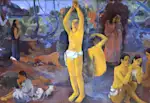 |
Back to Articles
SHARE
No comments yet