
Exhibition/event has ended.

Tamotsu Murakami "Emergence-Windless Forest"
Makii Masaru Fine Arts


Finished
SHARE
Artists
Tamotsu Murakami
On Tamotsu Murakami
My first encounter with the works of Tamotsu Murakami was at his solo exhibition in 1989, which was held at the Yurakucho Asahi Gallery in Ginza. During the twenty years since that occasion, he has continuously produced his works through devising a unique method that derived from the traditional Japanese dry-lacquer technique.
In his early wooden sculptures and in his early dry-lacquer works that he adopted in the mid-1980s, mythical motifs such as Susano'o (Shinto god of the sea and storms), Amanojaku (a demon-like creature), and Shishi (a guardian lion) made their appearances. These somewhat devilish but lovable creatures that he created in his works dwelled within nature, such as under the earth, within water, and in the woods, as can be understood from one of his titles Shishi Under the Earth. In his 1991 work Legendary Crow-Billed Goblin on a Flight Deck, a crow-billed goblin in a backward, arched form looks as if it is about to take off from a flight deck. The group of works he created around 1990 was in the form of a coffin with legs. This series seemed to represent a depressing scene that would develop toward the story of death, but strangely enough, it could also be seen as portraying humorous living creatures. From around this same period, his works began to take on more abstract forms. In his next series A Tool to Listen to the Wind, he adopted a flute as his motif. The works in this series, which were mostly exhibited by leaning the objects against walls, allowed viewers to perceive faint sounds playing within a sense of boundlessly drifting space-time. This image then evolved to the series Ship of the Wind, in which he worked with the motif of a balloon.
The works in this exhibition, Emergence: Windless Forest, are from his Emergence series, which he began creating in 2000. In these works, Murakami has fixated the exact moments when insects are blessed with their wings. In their dignified appearances, they also reveal textures like those found in nature. Thus, his works convey a sense of lightness in the same way as his early works. Viewers might be quite amused as they walk around to see the backsides of the works, where he created “spaces” between the wings and the body. His aim to formalize “nonexistent forms” is indeed actualized in those expressions.
Murakami has consistently focused on vulnerable lives and has given shapes to those figures, while also bringing smiles to viewers’ faces. They can perceive a sense of gracefulness and a feeling of drifting about from his works, while at the same time feeling as if they are being tenderly embraced. He purposefully leaves his refined expressions and clever techniques in the background, and evades the pretensions of high art. I hope that many people take this opportunity to enjoy Tamotsu Murakami’s works and his open invitation into his unique world of art.
-Taeko Nanpei (curator, translator)
[Image: "Emergence: Moth Wings (detail)", dry lacquer, 152x158x78cm]
My first encounter with the works of Tamotsu Murakami was at his solo exhibition in 1989, which was held at the Yurakucho Asahi Gallery in Ginza. During the twenty years since that occasion, he has continuously produced his works through devising a unique method that derived from the traditional Japanese dry-lacquer technique.
In his early wooden sculptures and in his early dry-lacquer works that he adopted in the mid-1980s, mythical motifs such as Susano'o (Shinto god of the sea and storms), Amanojaku (a demon-like creature), and Shishi (a guardian lion) made their appearances. These somewhat devilish but lovable creatures that he created in his works dwelled within nature, such as under the earth, within water, and in the woods, as can be understood from one of his titles Shishi Under the Earth. In his 1991 work Legendary Crow-Billed Goblin on a Flight Deck, a crow-billed goblin in a backward, arched form looks as if it is about to take off from a flight deck. The group of works he created around 1990 was in the form of a coffin with legs. This series seemed to represent a depressing scene that would develop toward the story of death, but strangely enough, it could also be seen as portraying humorous living creatures. From around this same period, his works began to take on more abstract forms. In his next series A Tool to Listen to the Wind, he adopted a flute as his motif. The works in this series, which were mostly exhibited by leaning the objects against walls, allowed viewers to perceive faint sounds playing within a sense of boundlessly drifting space-time. This image then evolved to the series Ship of the Wind, in which he worked with the motif of a balloon.
The works in this exhibition, Emergence: Windless Forest, are from his Emergence series, which he began creating in 2000. In these works, Murakami has fixated the exact moments when insects are blessed with their wings. In their dignified appearances, they also reveal textures like those found in nature. Thus, his works convey a sense of lightness in the same way as his early works. Viewers might be quite amused as they walk around to see the backsides of the works, where he created “spaces” between the wings and the body. His aim to formalize “nonexistent forms” is indeed actualized in those expressions.
Murakami has consistently focused on vulnerable lives and has given shapes to those figures, while also bringing smiles to viewers’ faces. They can perceive a sense of gracefulness and a feeling of drifting about from his works, while at the same time feeling as if they are being tenderly embraced. He purposefully leaves his refined expressions and clever techniques in the background, and evades the pretensions of high art. I hope that many people take this opportunity to enjoy Tamotsu Murakami’s works and his open invitation into his unique world of art.
-Taeko Nanpei (curator, translator)
[Image: "Emergence: Moth Wings (detail)", dry lacquer, 152x158x78cm]
Schedule | Oct 2 (Fri) 2009-Oct 14 (Wed) 2009 Opening Hours Information
Opening Reception Oct 2 (Fri) 2009 18:00 - 00:00 30-minute artist talk is also scheduled. | ||||
|---|---|---|---|---|---|
| Fee | Free | ||||
| Venue | Makii Masaru Fine Arts http://www.makiimasaru.com  | ||||
| Location | 1-7-7 Asakusabashi, Taito-ku, Tokyo 111-0053 | ||||
| Access | 2 minute walk from the East exit of Asakusabashi Station on the JR Sobu line, 2 minute walk from exit A3 at Asakusabashi Station on the Toei Asakusa line. | ||||
| Phone | 03-3865-2211 | ||||
| Related images | Click on the image to enlarge it 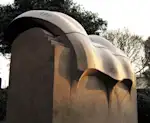 |
Back to Articles
SHARE
No comments yet