
Exhibition/event has ended.

Masayuki Nagare “Samurai”
Nanzuka Agenda


Finished
SHARE
Artists
Masayuki Nagare
Masayuki Nagare is perhaps the earliest Japanese artist to have achieved significant success within the American art scene, in the context of a nation that had once been an enemy in the Pacific War. Receiving a “samurai education” both in academics and sports under the supervision of his father, Nagare enrolled at Ritsumeikan University in 1941. However, in 1943 he personally volunteered to join the Imperial Japanese Navy as a student officer and experienced the end of the war as a Zero fighter pilot. After the war, Nagare travelled all over Japan from Tokyo to Shimonoseki to “witness the misery of the defeated nation.” Seemingly guided by his destiny to live and work as an artist, Nagare held his first one-man exhibition in 1955, entitled “On the Basis of Flight Space” at the Mimatsu Gallery in Tokyo. The exhibition consisted of a series of works including, “Flying,” “Ascent,” “Voyage,” and “Live,” and was dedicated to the memory of Japanese and American pilots who were killed in World War II. It was thereafter, in the process of helping to restore a broken Jizo statue during his travels in the Ishikawa prefecture, that Nagare became indelibly captivated by the beauty of “ware-hada,” (slip stone) a technique that takes advantage of the broken surface of the stone.
This exhibition reintroduces Nagare’s oeuvre with representative works such as “Nagarebachi,” which derives its motif from Zero fighter propellers and Shamisen plectrums, “Sakimori” (Frontier Guardian), a sculpture in the image of a guardian titled after a word of the same etymology, “Pirika,” a sculpture of a goddess named after an Ainu word for “beautiful,” and a miniature version of the work “Cloud Fortress.”
This exhibition reintroduces Nagare’s oeuvre with representative works such as “Nagarebachi,” which derives its motif from Zero fighter propellers and Shamisen plectrums, “Sakimori” (Frontier Guardian), a sculpture in the image of a guardian titled after a word of the same etymology, “Pirika,” a sculpture of a goddess named after an Ainu word for “beautiful,” and a miniature version of the work “Cloud Fortress.”
Schedule | May 30 (Sat) 2015-Jun 27 (Sat) 2015 Opening Hours Information
Opening Reception May 30 (Sat) 2015 18:00 - 00:00 | ||
|---|---|---|---|
| Fee | Free | ||
| Website | http://nug.jp/en/exhibition/2015masayukiNagare.html | ||
| Venue | Nanzuka Agenda | ||
| Location | 2-17-3-B1 Shibuya, Shibuya-ku, Tokyo 150-0002 | ||
| Access | 3 minutes walk from the East exit of JR Shibuya Station. | ||
| Related images | Click on the image to enlarge it 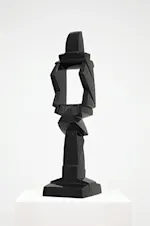 |
Back to Articles
SHARE
No comments yet