
Exhibition/event has ended.

Madsaki “1984”
Kaikai Kiki Gallery


Finished
SHARE
Artists
Madsaki
The show will feature the artist’s new series of paintings and sculptures based on Mattel’s Masters of the Universe franchise, including its popular toy line, comic book covers, and action figure packaging.
The exhibition title “1984” refers to the year that Masters of the Universe was at the peak of its popularity in the US. Of course, the year also evokes George Orwell’s science fiction novel, but what is the connection between these concepts?
In 1980, Madsaki was six years old and had just moved from Osaka, Japan to Bergen County, New Jersey with no English skills whatsoever. Experiencing racism and making few friends at school, Madsaki became obsessed with He-Man and the Masters of the Universe, an animated series based on Mattel’s Masters of the Universe toy line.
In 1984, Apple released a television ad for their Macintosh computers directed by renowned filmmaker Ridley Scott. The story of the “indie” contender Apple going head to head with the industry giant, IBM, signified the dawn of a new age for computers, but also symbolized a seismic change in the times. The ad was a reference to George Orwell’s novel 1984, which explored the correlation between authority, the establishment, and personal freedom. The unconquerable wall Madsaki faced was language, and it was his hero, He-Man, who broke through that wall. The allusion to Orwell’s 1984 is an attempt to illustrate the worldview and true hero of the artist’s life.
This exhibition, named after that seminal year, features paintings portraying the Masters of the Universe world, sculptures created by enlarging the action figures from the era by roughly fifteen times, and paintings depicting an awkward 10-year old Madsaki.
The exhibition title “1984” refers to the year that Masters of the Universe was at the peak of its popularity in the US. Of course, the year also evokes George Orwell’s science fiction novel, but what is the connection between these concepts?
In 1980, Madsaki was six years old and had just moved from Osaka, Japan to Bergen County, New Jersey with no English skills whatsoever. Experiencing racism and making few friends at school, Madsaki became obsessed with He-Man and the Masters of the Universe, an animated series based on Mattel’s Masters of the Universe toy line.
In 1984, Apple released a television ad for their Macintosh computers directed by renowned filmmaker Ridley Scott. The story of the “indie” contender Apple going head to head with the industry giant, IBM, signified the dawn of a new age for computers, but also symbolized a seismic change in the times. The ad was a reference to George Orwell’s novel 1984, which explored the correlation between authority, the establishment, and personal freedom. The unconquerable wall Madsaki faced was language, and it was his hero, He-Man, who broke through that wall. The allusion to Orwell’s 1984 is an attempt to illustrate the worldview and true hero of the artist’s life.
This exhibition, named after that seminal year, features paintings portraying the Masters of the Universe world, sculptures created by enlarging the action figures from the era by roughly fifteen times, and paintings depicting an awkward 10-year old Madsaki.
Schedule | Sep 11 (Fri) 2020-Oct 1 (Thu) 2020 Opening Hours Information
Opening Reception Sep 10 (Thu) 2020 17:00 - 20:00 | ||||
|---|---|---|---|---|---|
| Fee | Free | ||||
| Venue | Kaikai Kiki Gallery http://en.gallery-kaikaikiki.com/  | ||||
| Location | B1F Motoazabu Crest Bldg., 2-3-30 Motoazabu, Minato-ku, Tokyo 106-0046 | ||||
| Access | 8 minute walk from exit 1 at Hiroo Station on the Hibiya line, 13 minute walk from Azabu-juban Station on the Toei Oedo or Namboku line. | ||||
| Phone | 03-6823-6038 | ||||
| Related images | Click on the image to enlarge it 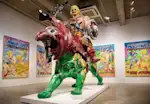 |
Back to Articles
SHARE
No comments yet