
Exhibition/event has ended.

Woodblock Prints Depicting a Giant Catfish: Reflection of Edo People’s Imagination (Archived at the Ojaku Bunko Library)
National Museum of Japanese History


Finished
SHARE
Japan was hit by many earthquakes in the Edo period (1603-1867), especially late in the period, when there was a succession of large quakes. The Zenkoji Earthquake in 1847 drew much attention from those in Edo (Tokyo). In 1854, two large quakes, the Ansei Tokai Earthquake and the Ansei Nankai Earthquake, occurred one after another. Then on November 11, 1855, the Ansei Edo Earthquake caused devastating damage to the city of Edo. Shortly after this earthquake, various printed works appeared, such as “tile-block printing” broadsheets (kawaraban), which reported on or reacted to the damage. Among these, it is thought that more than 200 woodblock prints, today called Namazu-e, were issued, until they were banned by the authorities in December of the same year. Based on motifs of a mystical giant underground catfish, which at that time was believed to cause earthquakes, the Namazu-e dealt with a variety of subjects and ideas, reflecting a wide range of the people’s feelings, such as their fear of earthquakes, satirical attitudes to social conditions after the earthquake, and desire for social reforms. Through a collection of the roughly 200 pieces of Namazu-e archived at the Ojaku Bunko Library, this exhibition illustrates the strong imagination of the Edo people, who addressed the unprecedented damage caused by the earthquake with a brave spirit and sense of humor. It is shown for the first time in Japan.
Schedule | Jul 13 (Tue) 2021-Sep 5 (Sun) 2021 Opening Hours Information
| ||||||
|---|---|---|---|---|---|---|---|
| Fee | Adults ¥600; University Students ¥250; High School Students and Under, Persons with Disability Certificates + Companion free. Special Exhibition Fees may be charged separately. | ||||||
| Venue | National Museum of Japanese History https://www.rekihaku.ac.jp/english  | ||||||
| Location | 117 Jonai-cho, Sakura-shi, Chiba 285-8502 | ||||||
| Access | 15 minute walk from the South exit of Keisei Sakura Station on the Keisei Main line; From the South exit of JR Sakura Station, take the Chiba Green bus towards Tamachi Shako and get off at National Museum of History and Folklore. The venue is near from there. | ||||||
| Phone | 050-5541-8600 (Hello Dial) | ||||||
| Related images | Click on the image to enlarge it 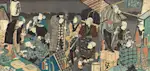 |
Back to Articles
SHARE
No comments yet