

Mathilde Denize "Time and Light"
Gallery Perrotin Tokyo


Until Jun 27
SHARE
Artists
Mathilde Denize
Time and Light, French contemporary artist Mathilde Denize’s first solo exhibition in Japan at Perrotin Tokyo will be presented at Perrotin Tokyo. In this exhibition, Denize further develops a consistent artistic ethic explored throughout her earlier practice—one that seeks out latent continuities among forms that appear fragmentary and mutually heterogeneous, and reweaves them into new configurations. While her previous works, exemplified by costume-paintings, took up discarded everyday objects and earlier paintings as materials to be cut, dismantled, arranged, and stitched together—literally “re-generating” them—the present exhibition shifts this inquiry toward works that remain close to painting itself, concentrating on the internal operations of the pictorial field rather than on the incorporation of found objects.
In this exhibition, composed of the new Contours series, Denize does not simply reiterate her previous approaches. Instead, she deliberately returns to the tableau, the traditional format of painting. This return, however—resisting the convention that fixes painting as an immutable plane—does not signify a retreat to the completed flat surface. Rather, it constitutes an attempt to re-enter the institution of painting while retaining the experience of her earlier works, which were sculptural, bodily, and at times mobile. In Contours, the tableau does not emerge as a stable terminus, but as a site of exchange in which multiple temporalities and relations overlap.
What sustains this expansion is the magnetic field of Denize’s imagination and thought, which affirms fragmentation and recomposition. Here, materials are re-situated along different temporal axes, and residues of the past are not preserved as nostalgia but function as structural elements that generate the present work. Time does not proceed linearly; memory accumulates in layers. Such acts of making become a form of archaeological operation, yet what is excavated is not lost meaning, but relations that remain unfinished. The unsettling sense of animation emitted by Denize’s work arises from this very cycle—cutting and binding, forgetting and re-emergence.
Ephemeral pinks, clematis-like purples, light-bearing yellows, deeply sunken blues, velvety reds recalling aged velvet, and whites that drift across the surface—using paints discarded from film sets and advertising productions—these colors that compose the canvas do not remain at the level of sensory effect. They are arranged as structures that generate relations and movement, entering into a clear resonance with the practice of Sonia Delaunay, a pioneer of early twentieth-century modernism. Delaunay’s simultanéisme—re-evaluated through recent large-scale retrospectives (Tate Modern, 2015; Guggenheim Museum, 2023)—a visual approach in which multiple realities emerge simultaneously through the relations between color and form, as well as her assertion that “colours are words, their relations rhythms,” is reconfigured in the present tense within Denize’s work. Across her canvases and the spaces in which they are situated, contrasts and shifts in saturation produce a fluid landscape in which meaning is continuously generated. Color, prior to indicating meaning, is positioned as a poetic unit that acts upon space and the body. In other words, color is liberated from subject matter and acquires an independent life.
Such structural thinking also intersects with the isomorphism explored by the Symbolist poet Stéphane Mallarmé. Mallarmé treated poetic language not as a mere tool of communication, but as a “material” that itself constructs space, pursuing structures in which language, sound, and visual arrangement are brought into harmony. Poetry, for Mallarmé, was not something to be read, but something to be experienced as space with silence. The structural correspondences that exist between language, music, and visual art appear clearly in Denize’s work as well. In the white cube, the paintings, aligned along a single line as if tracing a horizon, generate rhythm through color and form. Taken together, the paintings function as a single album, or their arrangement operates like a musical score, through which visual language is transposed into a musical configuration. Silence and interval, repetition and variation, seep into the space. Rooted not in concept but in affect, and animated by a multiplicity of meanings—or by subtle and mysterious relations—this can be situated as a contemporary response to the Mallarméan inquiry.
What is crucial in this exhibition, however, is that the relations that emerge here are not subsumed into a reenactment of history. Denize does not look back on modernism or symbolism, but instead takes up, in the present tense, the questions they left unfinished—how far art can become homologous with the world, and how form might precede meaning.
In Contours, color and form do not bear fixed meanings, but enter into autonomous relations as they intersect with time, light, and space. As Cy Twombly remarked, “Each line ... is the event of its own materialization.” Painting here does not emerge as a completed object, but as a field of relations that continues to transform while accompanied by contingency. It is a constellation of relations—polyphonic and shifting—that cannot be reduced to a single point of view.
Within such a condition, the viewer is no longer permitted to remain in a passive position. What is presented is not a static, closed optical sensation, but a site of experience in which body and gaze, time and light, continue to enter into relation with one another. Contours poses a question for us: to reconsider painting not as an image that converges toward completion, but as an event lived and experienced within thought and perception.
In this exhibition, composed of the new Contours series, Denize does not simply reiterate her previous approaches. Instead, she deliberately returns to the tableau, the traditional format of painting. This return, however—resisting the convention that fixes painting as an immutable plane—does not signify a retreat to the completed flat surface. Rather, it constitutes an attempt to re-enter the institution of painting while retaining the experience of her earlier works, which were sculptural, bodily, and at times mobile. In Contours, the tableau does not emerge as a stable terminus, but as a site of exchange in which multiple temporalities and relations overlap.
What sustains this expansion is the magnetic field of Denize’s imagination and thought, which affirms fragmentation and recomposition. Here, materials are re-situated along different temporal axes, and residues of the past are not preserved as nostalgia but function as structural elements that generate the present work. Time does not proceed linearly; memory accumulates in layers. Such acts of making become a form of archaeological operation, yet what is excavated is not lost meaning, but relations that remain unfinished. The unsettling sense of animation emitted by Denize’s work arises from this very cycle—cutting and binding, forgetting and re-emergence.
Ephemeral pinks, clematis-like purples, light-bearing yellows, deeply sunken blues, velvety reds recalling aged velvet, and whites that drift across the surface—using paints discarded from film sets and advertising productions—these colors that compose the canvas do not remain at the level of sensory effect. They are arranged as structures that generate relations and movement, entering into a clear resonance with the practice of Sonia Delaunay, a pioneer of early twentieth-century modernism. Delaunay’s simultanéisme—re-evaluated through recent large-scale retrospectives (Tate Modern, 2015; Guggenheim Museum, 2023)—a visual approach in which multiple realities emerge simultaneously through the relations between color and form, as well as her assertion that “colours are words, their relations rhythms,” is reconfigured in the present tense within Denize’s work. Across her canvases and the spaces in which they are situated, contrasts and shifts in saturation produce a fluid landscape in which meaning is continuously generated. Color, prior to indicating meaning, is positioned as a poetic unit that acts upon space and the body. In other words, color is liberated from subject matter and acquires an independent life.
Such structural thinking also intersects with the isomorphism explored by the Symbolist poet Stéphane Mallarmé. Mallarmé treated poetic language not as a mere tool of communication, but as a “material” that itself constructs space, pursuing structures in which language, sound, and visual arrangement are brought into harmony. Poetry, for Mallarmé, was not something to be read, but something to be experienced as space with silence. The structural correspondences that exist between language, music, and visual art appear clearly in Denize’s work as well. In the white cube, the paintings, aligned along a single line as if tracing a horizon, generate rhythm through color and form. Taken together, the paintings function as a single album, or their arrangement operates like a musical score, through which visual language is transposed into a musical configuration. Silence and interval, repetition and variation, seep into the space. Rooted not in concept but in affect, and animated by a multiplicity of meanings—or by subtle and mysterious relations—this can be situated as a contemporary response to the Mallarméan inquiry.
What is crucial in this exhibition, however, is that the relations that emerge here are not subsumed into a reenactment of history. Denize does not look back on modernism or symbolism, but instead takes up, in the present tense, the questions they left unfinished—how far art can become homologous with the world, and how form might precede meaning.
In Contours, color and form do not bear fixed meanings, but enter into autonomous relations as they intersect with time, light, and space. As Cy Twombly remarked, “Each line ... is the event of its own materialization.” Painting here does not emerge as a completed object, but as a field of relations that continues to transform while accompanied by contingency. It is a constellation of relations—polyphonic and shifting—that cannot be reduced to a single point of view.
Within such a condition, the viewer is no longer permitted to remain in a passive position. What is presented is not a static, closed optical sensation, but a site of experience in which body and gaze, time and light, continue to enter into relation with one another. Contours poses a question for us: to reconsider painting not as an image that converges toward completion, but as an event lived and experienced within thought and perception.
Schedule Now in session | Mar 24 (Tue) 2026-Jun 27 (Sat) 2026 37 days left Opening Hours Information
| ||||
|---|---|---|---|---|---|
| Fee | Free | ||||
| Venue | Gallery Perrotin Tokyo https://www.perrotin.com/  | ||||
| Location | 1F Piramide Bldg., 6-6-9 Roppongi, Minato-ku, Tokyo 106-0032 | ||||
| Access | 1 minute walk from exit 1a or 1b at Roppongi Station on the Hibiya or Toei Oedo line. | ||||
| Related images | Click on the image to enlarge it 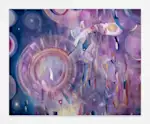 |
Back to Articles
SHARE
No comments yet