
Exhibition/event has ended.
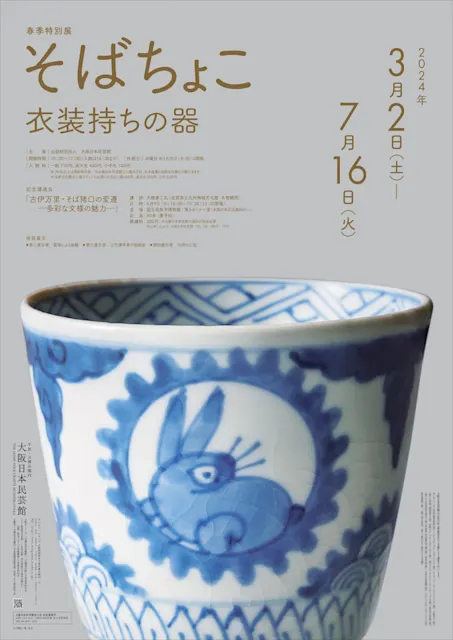
Spring Special Exhibition: Soba-Choko - Vessels with Garment Handles
The Japan Folk Crafts Museum Osaka


Finished
SHARE
A soba-choko is a vessel traditionally used for serving soba dipping sauce. Originally used as a dish for serving food on trays, it became widely popular among the common people as a container for dipping sauce during the Edo period when soba became fashionable. Many of the soba-choko vessels housed in the Osaka Museum of Folk Craft are examples of Imari ware from the Edo period, also known as Ko-Imari. Produced primarily in Arita, Saga Prefecture, and shipped nationwide from the port of Imari, these vessels gained their name from this distribution route.
As Soetsu Yanagi noted in his work "Indigo Painted Soba-Choko," the charm of soba-choko lies in the variety of intricate patterns adorning them. These patterns encompass a wide range of motifs including plants, animals, figures, landscapes, geometric shapes, and cultural artifacts. Craftsmen combined multiple motifs or added unique touches to individual patterns, resulting in an endless array of designs. These patterns adorn various parts of the vessel, particularly the body and rim, showcasing the skill of the artisans, especially when painting on curved surfaces.
The collection of antique Imari soba-choko housed in our museum was generously donated by the collector Teizo Sato in 1979. In this exhibition, approximately 1,000 pieces will be showcased from a collection of over 3,000 soba-choko.
As Soetsu Yanagi noted in his work "Indigo Painted Soba-Choko," the charm of soba-choko lies in the variety of intricate patterns adorning them. These patterns encompass a wide range of motifs including plants, animals, figures, landscapes, geometric shapes, and cultural artifacts. Craftsmen combined multiple motifs or added unique touches to individual patterns, resulting in an endless array of designs. These patterns adorn various parts of the vessel, particularly the body and rim, showcasing the skill of the artisans, especially when painting on curved surfaces.
The collection of antique Imari soba-choko housed in our museum was generously donated by the collector Teizo Sato in 1979. In this exhibition, approximately 1,000 pieces will be showcased from a collection of over 3,000 soba-choko.
Schedule | Mar 2 (Sat) 2024-Jul 16 (Tue) 2024 Opening Hours Information
| ||||
|---|---|---|---|---|---|
| Fee | Adults ¥710, University and High School Students ¥450, Junior High and Elementary School Students ¥100, Persons with Disability Certificates + 1 Companion free. | ||||
| Venue | The Japan Folk Crafts Museum Osaka | ||||
| Location | 10-5 Senri Banpaku Koen, Suita-shi, Osaka 565-0826 | ||||
| Access | 15 minute walk from Banpaku-kinen-koen Station on the Osaka Monorail. | ||||
| Phone | 06-6877-1971 | ||||
| Related images | Click on the image to enlarge it  |
Back to Articles
SHARE
No comments yet