Exhibition/event has ended.

"The Power of Setagaya - 50 Years of Community Building"
Lifestyle Design Center


Finished
SHARE
Setagaya City’s urbanization began in the 1920s with the decision to construct a railroad, and it has continued to develop as a suburb of Tokyo through today. Unique lifestyle cultures are created in places where many people gather and live. One such lifestyle culture that has developed in Setagaya over a century of urbanization is machi-zukuri (community development).
The term machi-zukuri began to be well-known to people in Japan in the 1970s. In Setagaya City, community development and public facilities improvement have been advanced with the idea of “people’s participation” since the 1980s. In addition, as better participation has become essential for community development, since the 1990s, a system to support various community development activities by the people of Setagaya has been created.
How has community development progressed in Setagaya, and what legacy has it left behind? And how has it enriched the “community and lifestyle” of the local people?
This exhibition will look at the “community” created through community development with people’s participation in Setagaya as well as the “lifestyle” that has grown through this. It will do so in five parts: “Spaces for Community Development,” “Geographic Features and Urban Planning,” “Graphic Design and Urban Design,” “Workshops and Toolboxes,” and “Citizens’ Design.”
The term machi-zukuri began to be well-known to people in Japan in the 1970s. In Setagaya City, community development and public facilities improvement have been advanced with the idea of “people’s participation” since the 1980s. In addition, as better participation has become essential for community development, since the 1990s, a system to support various community development activities by the people of Setagaya has been created.
How has community development progressed in Setagaya, and what legacy has it left behind? And how has it enriched the “community and lifestyle” of the local people?
This exhibition will look at the “community” created through community development with people’s participation in Setagaya as well as the “lifestyle” that has grown through this. It will do so in five parts: “Spaces for Community Development,” “Geographic Features and Urban Planning,” “Graphic Design and Urban Design,” “Workshops and Toolboxes,” and “Citizens’ Design.”
Schedule | Jan 31 (Wed) 2024-Apr 21 (Sun) 2024 Opening Hours Information
| ||||
|---|---|---|---|---|---|
| Fee | Free | ||||
| Website | https://www.setagaya-ldc.net/program/564/ | ||||
| Venue | Lifestyle Design Center https://www.setagaya-ldc.net/ | ||||
| Location | Carrot Tower, 4-1-1 Taishido, Setagaya-ku, Tokyo 154-0004 | ||||
| Access | Direct walk from Sangen-jaya Station on the Tokyu Den-en-toshi and Tokyu Setagaya lines. | ||||
| Phone | 03-5432-1543 | ||||
| Related images | Click on the image to enlarge it 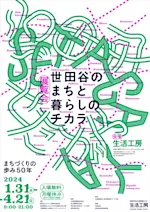 |
Back to Articles
SHARE
No comments yet