
Exhibition/event has ended.

Timeless Beauty Kana Calligraphy and Heian Court Art
Miho Museum


Finished
SHARE
Expo 2025 will be held in Japan at Yumeshima, Osaka, under the theme “Design Future Society for Our Lives” next spring. In addition to promoting “Cool Japan,” Japan’s branding strategy to the world, this event provides opportunities to reevaluate Japanese culture. When we think about Japan’s “allure” or “attraction,” we begin to realize the importance of Japanese aesthetics, which connects its past and traditions to the future.
In ancient Heian times (794–1185), Japan adopted Buddhism and the administrative and civil codes based on Chinese models, and over time discontinued sending envoys to the continent to begin its own cultural journey. As Japan progressed in its own style of clothing, food, and lifestyle, a distinctive expression of Japanese poetry and cursive script, hiragana, came to be created, leading to the blossoming of a court culture that has become synonymous to Japan’s sense of beauty. This culture faded as the samurai class rose to prominence, but it continued to be passed down and evolved into the object of admiration again in the new era of peace under the Tokugawa shogunate.
This exhibition, featuring Miho Museum’s Higurashi Album for the first time, explores the beauty of the Japanese kana script. Now in the format of hanging scrolls, this work was formerly compiled as a tekagami—an album of fragments of exemplary calligraphy that served as a model for aspiring calligraphers—by the art connoisseur Yoshida Tanzaemon. Later it was owned by entrepreneur Yasuda Zenjirō (1838–1921), before passing into the hands of Sugawara Tsūsai (1894–1981), the president of a railway company, who carefully selected thirty-one folios and had them remounted as hanging scrolls on the occasion of his beloved wife’s 13th memorial. The thirty-one hanging scrolls include celebrated calligraphic fragments from the peerless Kōya edition, the Toganoo edition decorated with exquisite gold-and-silver floral and bird motifs, and the elegant Ishiyama edition, based on arranging the skilled calligraphers in the 5-7-5-7-7 syllable structure of classical Japanese. In addition to the Higurashi Album, this exhibition presents Miho Museum’s collection of decorative artworks, Buddhist art, Rinpa-style screens of the Tale of Genji, paintings of immortal poets, and other works that reflect Heian court culture from its inception to aspirations towards it in the early Momoyama period (1573–1615).
Please enjoy the essence of the refined beauty and miyabi, elegance, left to us by the residents of the ancient capital.
In ancient Heian times (794–1185), Japan adopted Buddhism and the administrative and civil codes based on Chinese models, and over time discontinued sending envoys to the continent to begin its own cultural journey. As Japan progressed in its own style of clothing, food, and lifestyle, a distinctive expression of Japanese poetry and cursive script, hiragana, came to be created, leading to the blossoming of a court culture that has become synonymous to Japan’s sense of beauty. This culture faded as the samurai class rose to prominence, but it continued to be passed down and evolved into the object of admiration again in the new era of peace under the Tokugawa shogunate.
This exhibition, featuring Miho Museum’s Higurashi Album for the first time, explores the beauty of the Japanese kana script. Now in the format of hanging scrolls, this work was formerly compiled as a tekagami—an album of fragments of exemplary calligraphy that served as a model for aspiring calligraphers—by the art connoisseur Yoshida Tanzaemon. Later it was owned by entrepreneur Yasuda Zenjirō (1838–1921), before passing into the hands of Sugawara Tsūsai (1894–1981), the president of a railway company, who carefully selected thirty-one folios and had them remounted as hanging scrolls on the occasion of his beloved wife’s 13th memorial. The thirty-one hanging scrolls include celebrated calligraphic fragments from the peerless Kōya edition, the Toganoo edition decorated with exquisite gold-and-silver floral and bird motifs, and the elegant Ishiyama edition, based on arranging the skilled calligraphers in the 5-7-5-7-7 syllable structure of classical Japanese. In addition to the Higurashi Album, this exhibition presents Miho Museum’s collection of decorative artworks, Buddhist art, Rinpa-style screens of the Tale of Genji, paintings of immortal poets, and other works that reflect Heian court culture from its inception to aspirations towards it in the early Momoyama period (1573–1615).
Please enjoy the essence of the refined beauty and miyabi, elegance, left to us by the residents of the ancient capital.
Schedule | Mar 15 (Sat) 2025-Jun 8 (Sun) 2025 Opening Hours Information
| ||||
|---|---|---|---|---|---|
| Fee | Adults ¥1300, University and High School Students ¥1000, Junior High and Elementary School Students free. | ||||
| Website | https://www.miho.jp/en/exhibition/spring2025/ | ||||
| Venue | Miho Museum http://www.miho.or.jp/en/ | ||||
| Location | 300 Momodani, Tashiroshigaraki-cho, Koka-shi, Shiga 529-1814 | ||||
| Access | From Ishiyama Station on the JR Biwako line, take the Teisan bus for 50 minutes and get off at Miho Museum. The venue is a short walk from there. | ||||
| Phone | 0748-82-3411 | ||||
| Related images | Click on the image to enlarge it 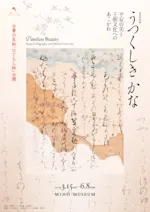 |
Back to Articles
SHARE
No comments yet