
The Year in Art 2007
SHARE


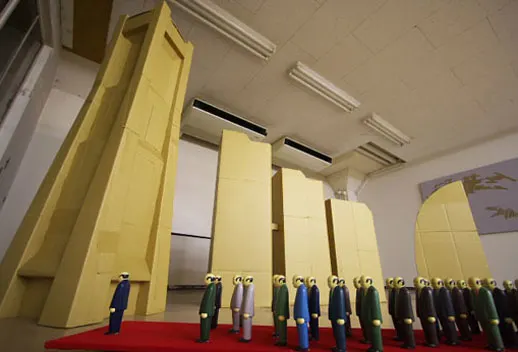
Tokyo kicked off the year with the Art@ Agnes art fair, for which 31 galleries each occupied a room in the luxury Agnes Hotel and Apartments in Iidabashi. Displaying art in a hotel room is at once a liberation from the déjà vu of the white cube and yet also imposes a variety of constraints; the inventiveness of displays and installation varied greatly from gallery to gallery. Artist group Boice Planning eclipsed everyone with their confrontational performance piece, proving that an art fair doesn’t just have to be about galleries lining up their precious things (more commentary in the review I wrote at the time, here).
Takefloor 404+504 showed the video work of Guy Ben-Ner that took the mode of the silent comedy film and filled it with bizarre but endearing domestic scenarios (reviewed by David Willoughby). The gallery has just changed its name to Take Ninagawa and has moved to a larger space in Higashi Azabu, cementing the gallery’s status as a serious member of Tokyo’s new generation of young galleries.
On March 10, Gallery ef, housed in a 140 year old wooden warehouse that miraculously survived two great fires, the 1923 Kanshin Earthquake and the 1945 firebombing of Tokyo, commemorated the anniversary of the bombing with “3.10 – The words of 100,000 people”, a one-night collaborative production between butoh dancer Ikko Suzuki and sound artist Kirara Kawachi. Performing in the middle of an audience limited to only 25 people, with no more than a couple of square metres of open space in which to move, Suzuki realized the ghostly, multi-layered soundtrack of elderly survivors recounting the night of the attack with agile with forty-five minutes of uncompromisingly intense and visceral movement. The low lights faded to black, and when he became visible again he was up there on the beams of the gallery walls, rocking from side to side like a demon in the night. Utterly spine-chilling and mesmeric, this performance was among the most powerful works of art I have ever witnessed.

![Ryuichi Ohira, 'Mikei [Scenery]' (2007) shown at Tokyo Gallery + BTAP](http://www.tokyoartbeat.com/tablog/entries.en/wp-content/uploads/2007/12/ohiraryuichitatami2.jpg "Photo: AR")
April saw the opening of “Art LAN @ Asia” a diverse display of contemporary Asian art held at Zaim in Yokohama (reviewed by Dominick Chen). Many of the works on show came from artists represented by Tokyo Gallery + BTAP, which focuses almost exclusively on the work of artists from Japan, China and Korea. Tokyo Gallery + BTAP held “A sense of de-tach-ment”, a solo show of photography by Riichi Yamaguchi (interview with the artist by Lena Oishi) who makes a sensitive exploration of themes of physicality and alienation in contemporary society. The opening of this exhibition also featured a butoh performance by Yasuchika Konno (watch the video here), of a different kind to the one that took place at Gallery ef, but bizarre and haunting all the same. Tokyo Gallery + BTAP’s following exhibition, “25 x 4 = [ ]” introduced the work of four 25 year-old Japanese artists, all of whom showed an intense amount of attention paid to detail and crafting in their work. Ryuichi Ohira’s sculpture was literally the centerpiece of the show; with the gallery floor completely covered in tatami mats, it took a moment to realize that the darker one in the centre was his work, painstakingly carved out of wood.

Anyone who read my review of Art Fair Tokyo will know that I wasn’t a big fan, and the harshness of my choice of words raised a few eyebrows here and there. AFT suffers from its decision to give relatively even-handed representation of the players in Tokyo’s art market; trite appropriations of Western painting made for a Japanese audience sadly forms a large part of what sells within Tokyo, and so AFT is inescapably tainted by this reality. Aesthetic gripes aside, from what I have heard of its former incarnation as NICAF, it sounds like AFT 2007 was a marked improvement, and while its higher sales figures this year were very small in comparison to the big name art fairs elsewhere, this trend is encouraging and I hope it will continue. However, I still believe that there has to be a way of cultivating a higher standard of presentation without compromising an art fair’s commercial objectives. The good news is that the organisers of next year’s new satellite art fair 101Tokyo feel the same way and are taking active steps to address this issue and provide us with something different. For a start 101Tokyo will focus exclusively on contemporary art and will have many more international galleries participating than at AFT. I look forward to this much-needed step up in Tokyo’s art market.
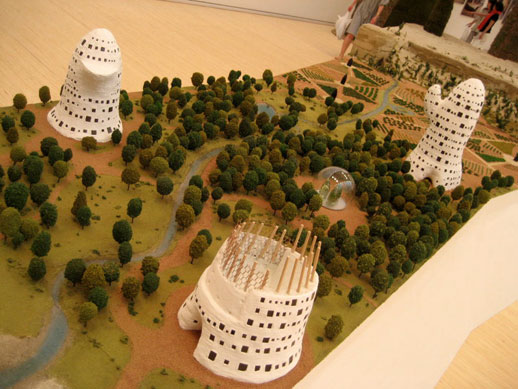
Tokyo Opera City Art Gallery tends to go to concerted lengths to transform its vast exhibition spaces into something uniquely impressive for each exhibition. The cosy huts installed in the “Architecture of Terunobu Fujimori and Rojo” exhibition, which ran from April to July, brought viewers closer to the intimacy of Fujimori’s vision of an organic future for architecture (see Michael Balderi’s feature for a discussion of Fujimori’s work in comparison with Tadao Ando’s).
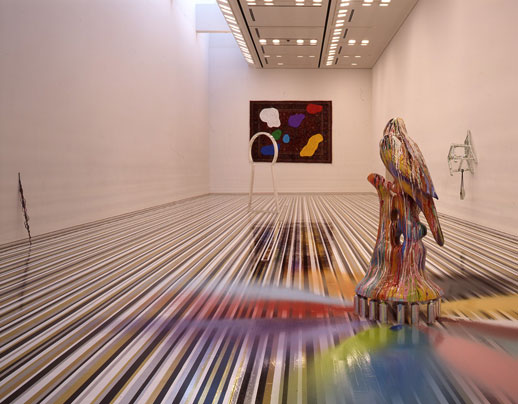
Its next show “Melting Point” was one of those ‘must-see’ exhibitions (review by David Willoughby) consisting of three large installations, by Jim Lambie, Ernesto Neto and Kiyomichi Shibuya. Transcendental and enlightening art it was not, but I enjoyed the visual razzmatazz of Lambie’s installation – A Space Odyssey 2007, as it were. I was new to Lambie’s work, however, and therefore willing to take it at face value. Being more familiar with what Ernesto Neto is capable of, I was disappointed by his contribution to this exhibition, as it lacked the warm, embracing comfort or the amusing curiosity of the works featured in his simultaneous exhibitions at Gallery Koyanagi and Tomio Koyama Gallery last year, nor any other show of his that I have seen.
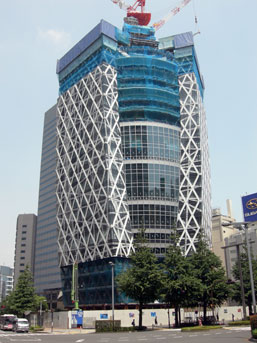
The heat and humidity of this year’s summer in Tokyo was so overwhelming that my promised monthly coverage of the growth of a rather large gherkin in the centre of Shinjuku wilted completely. The gherkin however, has not, and continues to grow at a mighty rate, its profile now clearly visible on the Shinjuku skyline.
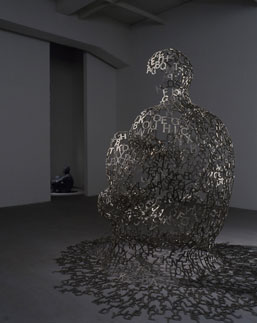
Museum at Tamada Projects held “Silent Voices”, an atmospherically solo exhibition of work by Jaume Plensa (interview with the artist by Lena Oishi). Spotlit within the dark, cavernous spaces of this ex-warehouse in Tsukishima, Plensa’s human-sized and superhuman-sized sculptures were striking indeed; it can’t be that often that an artist who makes works as big as these can exhibit in Japan without compromising on presentation.
British photographer Martin Parr took over one floor of the Tokyo Metropolitan Museum of Photography with his retrospective “Fashion Magazine” (reviewed by Meighan Ellis). Of more interest to me was the smaller show “Paul Smith @ Ilford”, held simultaneously at Paul Smith Space Gallery. The dozen or so photographs on display depicted working class people on the streets of Ilford (Parr’s favourite area of South London) wearing clothing or carrying accessories designed by Paul Smith. The individual images were highly engaging and there is no doubt that Parr is a talented photographer, however this exhibition’s underlying problem was the lack of explanation about the way in which these scenarios were set up. How casually were these models found, and what, if anything, were they paid or given in return for having these unusual portraits taken? While some of the models fit more or less comfortably into the conventionally accepted image of high-fashion cool, one or two came across as awkward and ridiculous in these outfits that they would never normally wear. If an ironic joke about the fashion world was being made here, were the participants aware of it? Without this clarification, the exhibit had an uncomfortable overtone of mockery and exploitation about it.

The Mori Art Museum continued to dominate the Tokyo art world with its large scale productions. For the first five months of the year, everyone flocked to its simultaneously held exhibitions “The Smile in Japanese Art: From the Jomon Period to the Early 20th Century” and “All About Laughter: Humor in Contemporary Art”. The former was delightful for its straightforward, measured display of art that truly spoke for itself, while the latter was largely an overcrowded, chaotic mess of international work from the past fifty years, some of it good but lost in the noise, much of it bad. This show barely elicited a smile out of me, let alone a laugh. On the other hand, the Mori Art Museum does very well with large-scale solo shows and “Art and Architecture – A Life of Creativity”, the May to September retrospective of LeCorbusier’s work – including his lesser-known painting work – was well spaced, visually engaging and thoroughly informative.
Mori’s current exhibition “Roppongi Crossing 2007: Future Beats in Japanese Contemporary Art” (reviewed by Gary McLeod; exhibition closes January 14th) is so broad in terms of the types of work on display that there really is something for everybody. With such a diverse line up of artists chosen by a panel of four curators it’s hard to talk of there being any overall conceptual unity or curatorial coherence. Perhaps for better or for worse one can say that this exhibition is an accurate illustration of the seemingly unstoppable diversification of contemporary art. And so it seems that the narrative has been set: this is essentially an enormous group show of artists represented by Tokyo’s top commercial galleries. Like them or not, now that the Mori has given them its stamp of approval, these artists will be the focus of any international interest in Japan over the years to come; to call them the ‘Future Beats’ of Japanese contemporary art is something of a pre-determined, self-fulfilling prophecy.
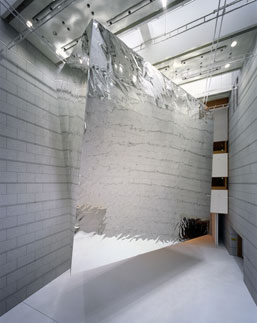
Talking of prophecies, “Space for your Future” at the Museum of Contemporary Art, Tokyo (reviewed by Melaney Lee; exhibition closes January 20) brought together artists, architects and designers from both Japan and abroad to exhibit works that investigate what the future has in store for us. I really wanted to like this exhibition and its curatorial attempt to unite so many creators under a single approach, but after leaving I felt that whatever reservations I had about “Roppongi Crossing’s” risk-free catalogue-like display, all was now forgiven. The inherent problem of any attempt to portray the future is that by definition you are limited to doing so only with the means you have available to you today, although of course, an imaginative approach can transcend these limitations. The show’s main letdown was its video work. Video media has the easiest of all futures to predict – higher and higher resolution – and yet much of the video technology in this exhibition was already unmistakably dated. However, one unexpected highlight was Mika Ninagwa’s lurid and fantastical photographic installation of goldfish. Not all of the works stood up well as individual entities, but a number of them had a surprising emotional intensity to them: the first fish you see ahead of you as you enter the room has a haunting expression of despair on its face. While I don’t really care if Ninagawa envisages the future as a world full of emotive goldfish, I found this installation to be alluring and hypnotic.
MOT’s ealier exhibition, which ran from April to July, was Marlene Dumas’ “Broken White” – a stunning solo show of the South African artist’s work. While the Golden Week hordes piled into the Mori Art Museum’s “All About Laughter” exhibition, the MOT was blissfully empty, allowing visitors to enjoy her raw portraits on paper of full frontal nudes, the texture of their skin and the subtle contours of their bodies rendered so masterfully despite the artist’s use of such thin washes of ink. What was a beautiful and captivating display did seem to run out of steam towards the end, however. Her recent, large-scale oil portraits of deceased terrorists somehow did not carry the same force as the lovers and friends she depicted in her earlier work, the collaborative photographic work with Araki seemed almost purposefully made to cover the remaining wall space, and the video work in the final room, titled Fuck and depicting violently shaking cherry blossom branches, was boringly obvious.
On October 13, TAB celebrated its 3rd birthday at Super Deluxe, with 600 people cramming into the event space for the biggest party we’ve had yet! (video by Yelena Gluzman). Gallery Koyanagi then held a solo exhibition of work by Rika Noguchi “Marabu – The Sun”. Noguchi used a pinhole camera to capture the eerie stillness of a Marabou stork in Berlin Zoo. The mysterious, almost human figure of the bird exerts an ambiguous presence: despite its slender nobility, there was something about its form that gave the works an aura of menace. Such a sense of fictional construct is not often found in Japanese photography, so much of which is typically concerned with gazing at fragments of our everyday surroundings.There’s nothing quite like an exhibition that lets you know where you stand in the grand scheme of things. In November, the Machida City Museum of Graphic Arts held “Woodblock Prints East vs West – From Buddhist Prints to the Present”, a transhistorical, international artistic boxing match of sorts. Demonstrating a curatorial world view as black and white as some of the prints hanging on the walls, the exhibition was divided not into ‘sections’ or ‘parts’ but ‘rounds’ that pitted the Japanese prints against Western ones. On leaving the exhibition, viewers were invited to vote for the side they thought had won. At the time I visited in the show’s last week, East had collected some 550 votes, and West some 150. Presented with infinite possibilities for deriding this curatorial contrivance, conversely I find myself lost for words.
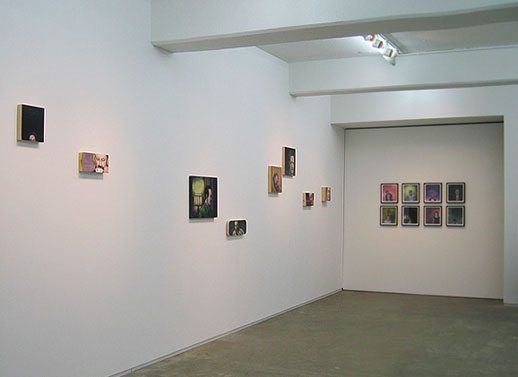
Following his solo show at the Hara Museum of Contemporary Art last year, Hawaiian-Japanese painter Jason Teraoka (interview with the artist last year by Lena Oishi) came back to Tokyo for his first solo exhibition “Heroes, Villains and Victims” at Tomio Koyama Gallery, revealing a new glossy finish on his paintings of ambiguous, cinematic persona depicted in his work.
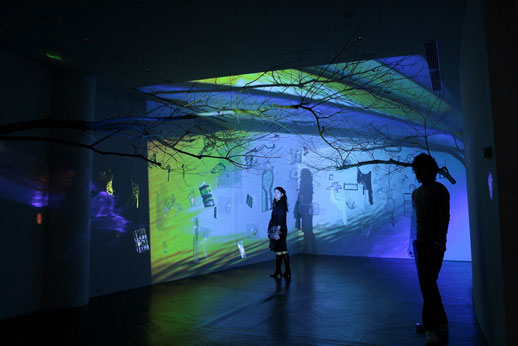
Of the exhibitions running into the new year, my favourite is Pipilotti Rist “Karakara” (interview with the artist by James Way; exhibition closes February 11) at the Hara Museum of Contemporary Art. Video art often feels either too cold and clinical to engage with or so warm and fuzzy that you might as well go to sleep. Pipilotti Rist’s video projections, however, are intimate, intelligent, funny and uplifting.
—
So what does next year have in store? Not that many gallery or museum websites give advance notice about their upcoming shows, but of those that do, here are some potential highlights of 2008. If not already listed on TAB, details of these exhibitions will become available nearer their start dates.
Art@Agnes (January 12 – 13) will once again start the year off. January has at least three potentially exciting solo shows taking place: Apichatpong Weerasethakul at SCAI the Bathhouse, up and coming video artist Yuki Okumura at Misako & Rosen, and poster art by Seiji Toda at the Ginza Graphic Gallery. Meanwhile, until March, Shiseido Gallery will hold their annual “Shiseido Art Egg”, a three-part exhibition of promising young artists. Art Fair Tokyo will return in the first week of April, accompanied by its new satellite fair 101 Tokyo. Later in the month it will be interesting to see what the Mori Art Museum makes of Britain’s infamous annual art farce when it holds “History in the Making: A Retrospective of the Turner Prize”. The second and third weeks of February will see the Japan Media Arts Festival at the National Art Center.
At some point in the first four months of the year, the galleries currently clustered together in the “Roppongi Complex” (Magical Artroom, Ota Fine Arts, Taro Nasu Gallery, Weissfeld Roentgenwerke and Gallery Min Min) are believed to all headed their separate ways as their lease in that building comes to an end, thereby diluting the gallery-going possibilities within the so-called Roppongi Art Triangle (nominally the area between The Mori Art Museum, the National Art Center and the Suntory Museum). Arata Isozaki, the architect of the The Hara Museum ARC has built the Kankai Pavilion, due to open in the summer. Doubling the museum’s exhibition space, this extension will be dedicated to the art collection of Meiji Industrialist Rokuro Hara. Lastly, as Martina Gahn explained in her article earlier this year, the Tokyo gallery world has matured with the opening of some new ‘next generation’ galleries, so let’s hope the trend continues and more appear in 2008.
Wishing you a Merry Christmas, a Happy New Year and a great year of art in Tokyo for 2008!

Ashley Rawlings
Ashley Rawlings
SHARE