Is Well-Being Something We "Create" Rather Than "Aim For"? Exploring the Future at the "International Conference on Open Access to Culture 2026"
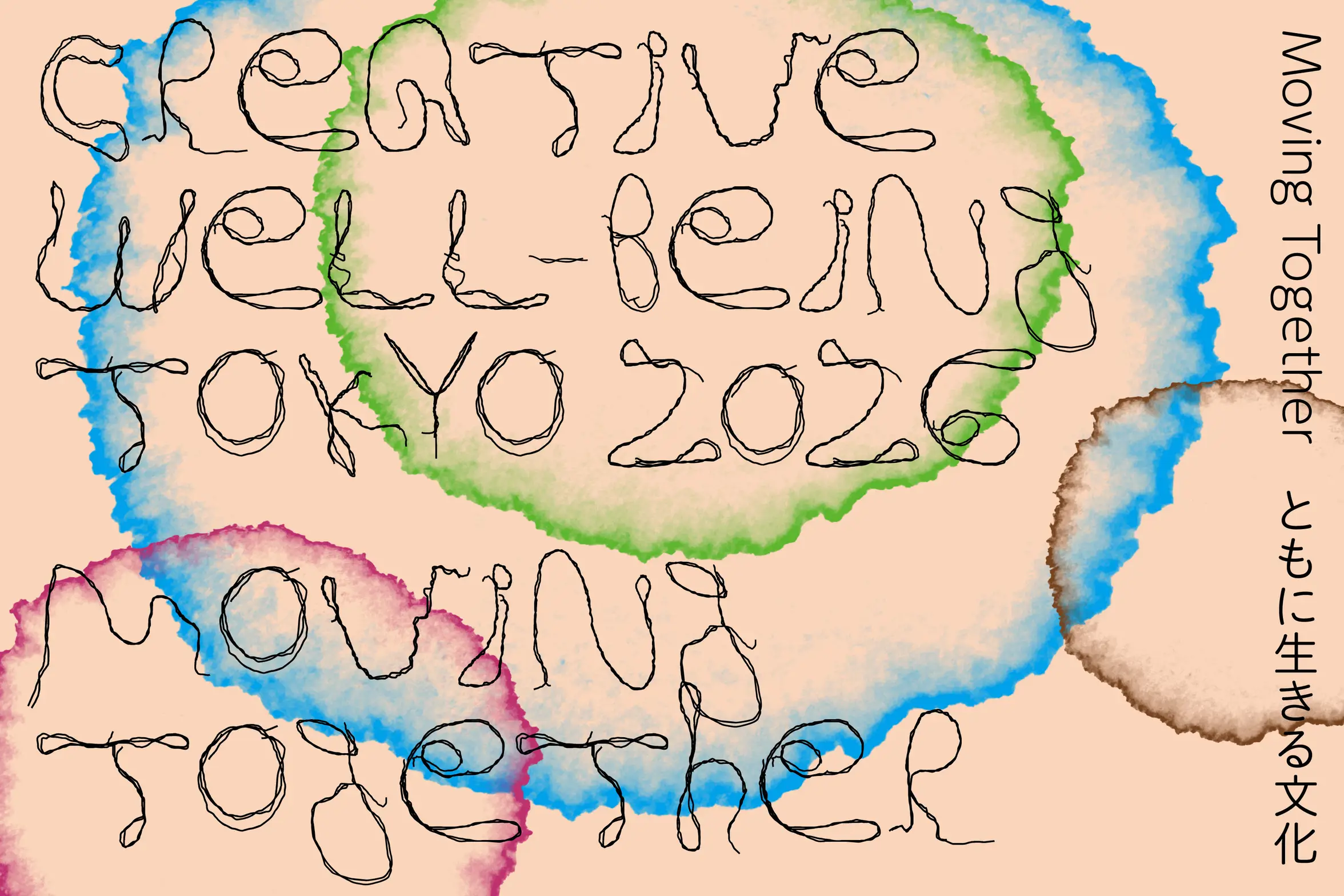
"International Conference on Open Access to Culture 2026" key visual Design: Maiko Higuchi, Typeface “Clementite”: François Dey / Silly Type Foundry



To begin with, what is "well-being"? Being healthy, physically and mentally, and living a better life: many people may picture such a state to be ideal. What the "International Conference on Open Access to Culture 2026" explores, however, steps beyond that.
The "Conference on Open Access to Culture" was conceived in 2022 as part of Creative Well-being Tokyo (CWT), led by the Tokyo Metropolitan Government and Arts Council Tokyo, and it marks its 5th edition this year. The 2026 theme is a culmination of the conferences to this point: "Moving Together—A Culture of Mutuality."
Through the three pillars of Conference, Studio (Networking), and Gallery (Exhibition), the event encourages us to consider our relations with others, our surroundings, and ourselves in a multifaceted way. How have five years of trial and error shaped the questions the project explores today? We talked with the international conference director Tsukasa Mori, along with Miyu Okazaki, who is in charge of planning.
Five days of thought and immersion in "Moving Together"
──"The International Conference on Open Access to Culture 2026" will feature various programs across five days with the theme of "Moving Together—A Culture of Mutuality." What is going to be under discussion?
Okazaki: The title is concerned with taking action. By considering "creative well-being" as a concept, we want to think about what kinds of actions we can take to create that state. "Moving Together" is not just about acting together. It also suggests setting communities and collectives in motion. The conference brings together people who embody this idea through their work.
Mori: We have already held a kick-off event, "Multispecies," featuring programs by artists and researchers. This theme developed from a conception of "otherness" that came out of the discussion of "belonging" in the previous conference.
The "Multispecies" concept focuses on how all kinds of beings, including humans, are intertwined in shaping the world. When we consider "others" we tend to think in a humancentric way, but the discussion becomes deeper when we include wider perspectives incorporating factors like the environment and other forms of life. With this issue in mind, we had the photographer Naoki Ishikawa speak about the world of mountains higher than 8,000 meters. Sakura Koretsune, an artist who produces work with the theme of people living alongside whales, and Tatsushi Fujihara, a researcher specializing in the history and philosophy of food and agriculture, also addressed the relationship between humankind and the world in respect to their different fields.

──So, in the kick-off, you expanded the concept of "others" as far as possible.
Mori: That’s right. Based on that, in the opening session, Toru Koyamada, artist and President of Kyoto City University of Arts, will talk in detail about his ongoing project in Kyoto. I think we will discover many ideas to reflect upon in his exploration of a scale of time beyond human perception. Also, the artist Tomoko Konoike has produced many site-specific pieces with motifs of animals. Another speaker, philosopher Yuriko Saito, will examine the way we grasp art not as an extraordinary act, but rather as beauty within our daily lives.

Okazaki: Session 1, "Practicing Interdependence," will enable people who are active in communities to exchange ideas. Christine Wong Yap is an artist who works with immigrant communities and individuals experiencing mental health challenges. Another artist, Natsumi Seo, has been working closely with local residents in areas struck by disasters, including the Great East Japan Earthquake. Researcher Yu Morishita conducts fieldwork in Hokkaido, where his research facility is, aiming to reassess local environmental resources in order to reconstruct existing relationships. The word "Interdependence" in the title refers to a relationship that goes beyond the fixed roles of those providing and receiving support, instead considering how people can support one another, with these roles shifting depending on the circumstances. This is the kind of relationship we have in mind when we use the phrase "Practicing Interdependence."
Session 2 is called "Identity and Culture." The speakers are Jumana Emil Abboud, an artist of Palestinian origin, Mokottunas Kitahara, a researcher with Ainu roots, and Jo Matsuzaki, a Deaf university professor. While identity is shaped by a complex interplay of various elements, ignorance or unexamined assumptions can sometimes silence people, or erase their cultures and roots. The three speakers in this session will engage in a dialogue about how they address and relate to the "self," which is an aspect of being that cannot be separated from living in society.

Mori: We will question the social structures that impose certain norms upon us, and consider the ways we can live within such a society. While there are inevitably challenges and tensions in the prospect of people with differing norms living together, we will confront these hurdles, and discuss the potential for dialogue and expression.
──I see, discussion will deepen through a gradual shift in focus, moving from environment or region to identity. Where will Session 3 take us?
Okazaki: Session 3, "Moving Together—Living through Dreams," will feature Gita Wolf, founder of the Indian publisher Tara Books, and Sangita Jogi, an artist whose book it published. Coming from a small village in India, Jogi emerged from an environment where she had limited opportunities to attend school and had to do domestic work, but drawing pictures opened up a new path for her. Erika Kobayashi, who translated the book into Japanese, and Kanako Nishi, who provided a recommendation comment, are both appearing as guest speakers. The way in which one person’s dream inspires empathy, and passes from person to person into the world truly embodies the idea of "Moving Together."
Finally, the closing session, "Creative Well-being—A Culture of Mutuality," will feature the moderators who guided us through the three-day event. They will summarize the discussions held to that point, reaffirming the role of creativity in generating well-being, and providing messages aimed at the future and the next generation. The panelists include creative director Kazuko Koike, artist Tatsuo Miyajima, the Deputy Mayor for Culture and the Creative Industries for London, Justine Simons, and Masanori Aoyagi, the Director General of Arts Council Tokyo. These speakers have been active at the forefront of the creative sector and public administration, including government institutions, for a long time, across their respective fields.
Mori: The moderators for the session are Naoko Horiuchi and Roger McDonald, curators from Arts Initiative Tokyo (AIT). They will anchor the discussions from start to finish, with insight from their ethical and aesthetic perspectives.


 0Posts