




TeamLab: Hama-rikyu Gardens


 0Posts
Artists
TeamLab
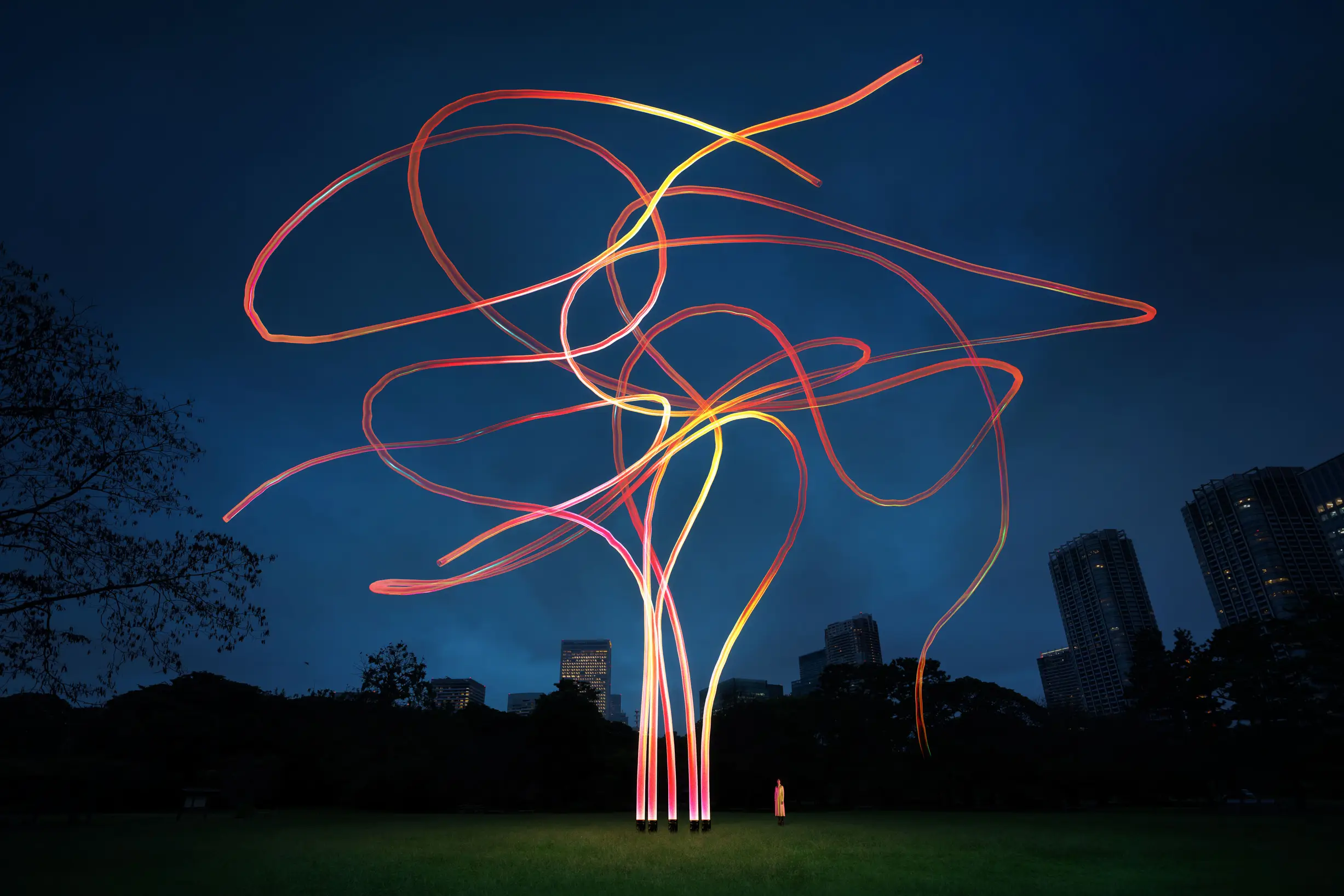
Hama-rikyu Gardens is a representative example of a daimyo garden—a garden belonging to a feudal lord—from the Edo period (1603 - 1868). Its tidal pond, Shioiri-no-ike, draws seawater from Tokyo Bay, its scenery changing with the ebb and flow of the tides. The site was originally a coastal marshland covered with reeds, where the Tokugawa shoguns hunted waterfowl with hawks. Land reclamation began around 1654, and a residence known as “Kofu Hama-yashiki” was subsequently built here. During the reign of the sixth shogun (1709 - 1712), it became known as “Hama-goten” and served the shogun family for approximately 160 years. With the beginning of the Meiji era, it became an imperial detached palace. Although many of its buildings were lost to earthquakes and war, the gardens opened to the public in 1946 as a gift from the Imperial Family. For approximately 400 years, this site has remained in use, its role evolving from a falconry ground to a retreat for the shogun family, then an imperial detached palace, and finally a garden for the public. In this exhibition, the garden, with its long continuity of time, becomes an art space. Influenced by the wind and rain, as well as by the ever-changing forest, this art space is transformed by the existence of the people of today. As we wander through the garden’s forest, walking where layers of time and the present intersect, nature and people, the long continuity of time and the present, all form a continuity without boundaries.
Schedule | Nov 25 (Wed) 2026-Dec 24 (Thu) 2026 Opening Hours Information
| ||
|---|---|---|---|
| Fee | Adults ¥2500; High School Students and Junior High School Students ¥1500; Elementary School Students ¥900; Infants free. | ||
| Website | https://www.teamlab.art/e/hamarikyu/ | ||
| Venue | Hama-rikyu Gardens https://www.tokyo-park.or.jp/park/format/index028.html | ||
| Address | Hamarikyuteien, Chuo-ku, Tokyo 104-0046 | ||
| Access | 8 minute walk from exit A1 at Tsukijishijo Station on the Toei Oedo line, 10 minute walk from the East exit of Shiodome Station on the Yurikamome line, 12 minute walk from the Shiodome exit of JR Shimbashi Station. | ||
| Phone | 03-3541-0200 |




No comments yet