
Yamaga Seika: Boundless Imagination in Textile Art—Celebrating the 140th Anniversary of His Birth


 0Posts
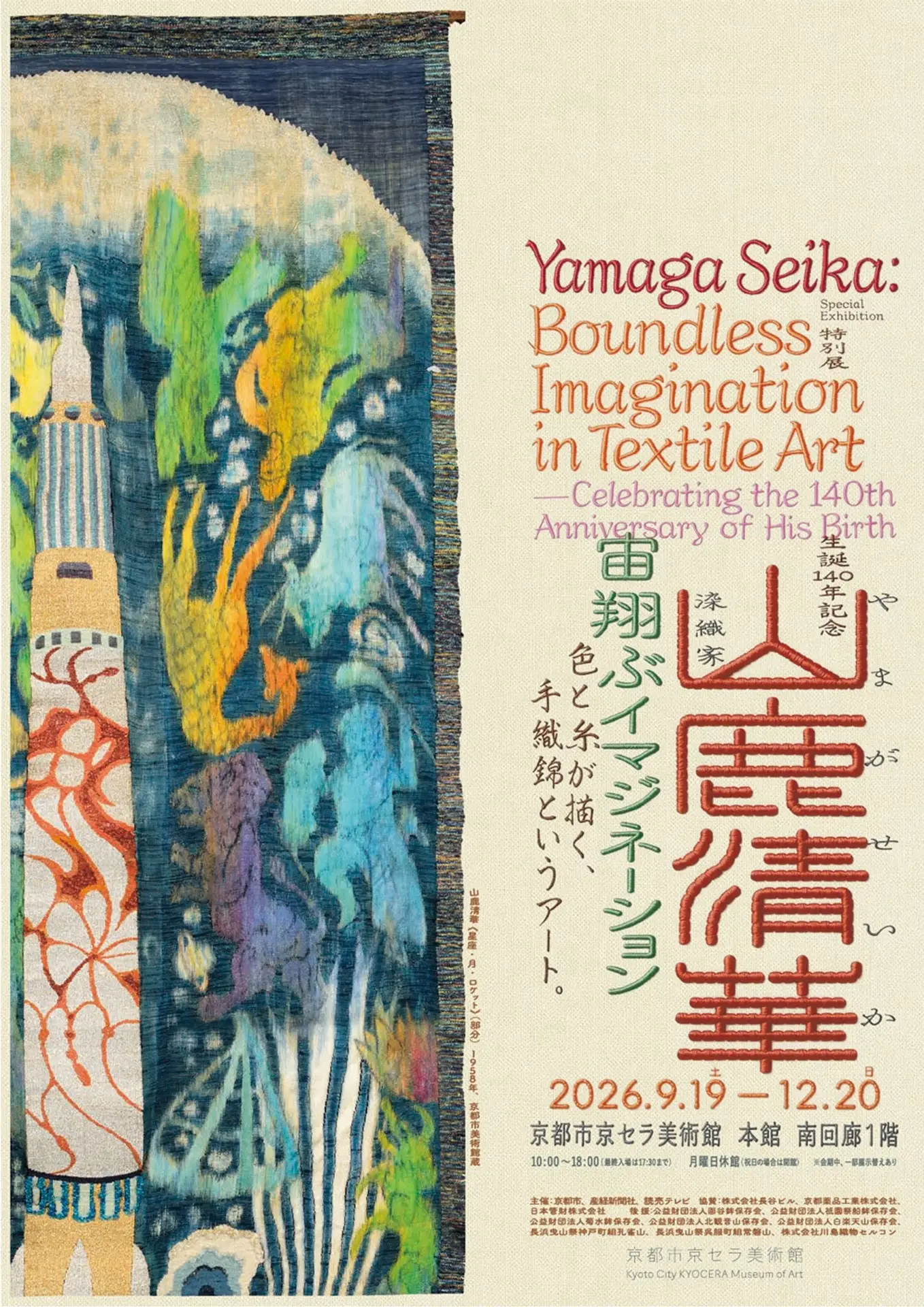
Yamaga developed teori-nishiki (handwoven brocade), a distinctive form of textile art in which the artist oversees every stage of production, from design and material selection to the weaving process itself. Through representative works and archival materials, this exhibition traces the career of this little-known Kyoto-born artist, featuring tapestries created for the Gion Festival as well as spatial decorations produced in collaboration with architect Murano Togo, among other works.
Born into a family engaged in letterpress printing in Kyoto, Yamaga Seika (1885–1981) began studying Nishijin-ori textile design and nihonga painting in his teens. He later became a student of Kamisaka Sekka, under whom he further expanded the scope of his artistic practice.
Yamaga gained recognition after developing teori-nishiki (handwoven brocade), a form of tapestry weaving in which the artist personally undertakes every stage of production—from design and yarn selection to the weaving process itself. In 1927, he was awarded a Special Prize in the newly established Arts and Crafts category of the Imperial Art Exhibition (Teiten) for his work Handwoven Brocade: Dutch Ship.
Yamaga’s choice of subject matter was remarkably diverse and unconventional. For festival decorations and ritual hangings, he employed traditional motifs such as celestial maidens and cloud dragons, while works submitted to official exhibitions—including wall hangings—featured strikingly modern imagery such as locomotives, rockets, and Tokyo Tower. While devoted to the preservation of textile traditions across the Meiji, Taisho, and Showa eras, Yamaga was also a rare figure endowed with a bold, forward-looking creative spirit.
This exhibition marks the first retrospective of Yamaga Seika’s work in 40 years.
Born into a family engaged in letterpress printing in Kyoto, Yamaga Seika (1885–1981) began studying Nishijin-ori textile design and nihonga painting in his teens. He later became a student of Kamisaka Sekka, under whom he further expanded the scope of his artistic practice.
Yamaga gained recognition after developing teori-nishiki (handwoven brocade), a form of tapestry weaving in which the artist personally undertakes every stage of production—from design and yarn selection to the weaving process itself. In 1927, he was awarded a Special Prize in the newly established Arts and Crafts category of the Imperial Art Exhibition (Teiten) for his work Handwoven Brocade: Dutch Ship.
Yamaga’s choice of subject matter was remarkably diverse and unconventional. For festival decorations and ritual hangings, he employed traditional motifs such as celestial maidens and cloud dragons, while works submitted to official exhibitions—including wall hangings—featured strikingly modern imagery such as locomotives, rockets, and Tokyo Tower. While devoted to the preservation of textile traditions across the Meiji, Taisho, and Showa eras, Yamaga was also a rare figure endowed with a bold, forward-looking creative spirit.
This exhibition marks the first retrospective of Yamaga Seika’s work in 40 years.
ScheduleNow in session | Sep 19 (Sat) 2026-Dec 20 (Sun) 2026 57 days left Opening Hours Information
| ||||
|---|---|---|---|---|---|
| Fee | Adults ¥1800; University and High School Students ¥1300; Junior High School Students and Under, Persons with Disability Certificates + 1 Companion free. | ||||
| Website | https://kyotocity-kyocera.museum/en/exhibition/20260919-20261220 | ||||
| Venue | Kyoto City Kyocera Museum of Art https://kyotocity-kyocera.museum/en/ | ||||
| Address | 124 Okazaki Enshoji-cho, Sakyo-ku, Kyoto-shi, Kyoto 606-8344 | ||||
| Access | 8 minute walk from exit 1 at Higashiyama Station on the Tozai subway line, 16 minute walk from exit 12 at Sanjo Station on the Keihan line; From JR Kyoto Station, take the #5 or #86 Kyoto City bus and get off at Okazaki Koen/Bijutsukan,Heian Jingu-mae. | ||||
| Phone | 075-771-4334 |




No comments yet