
Bugaku Costumes: The Enduring Beauty of Textiles


 0Posts
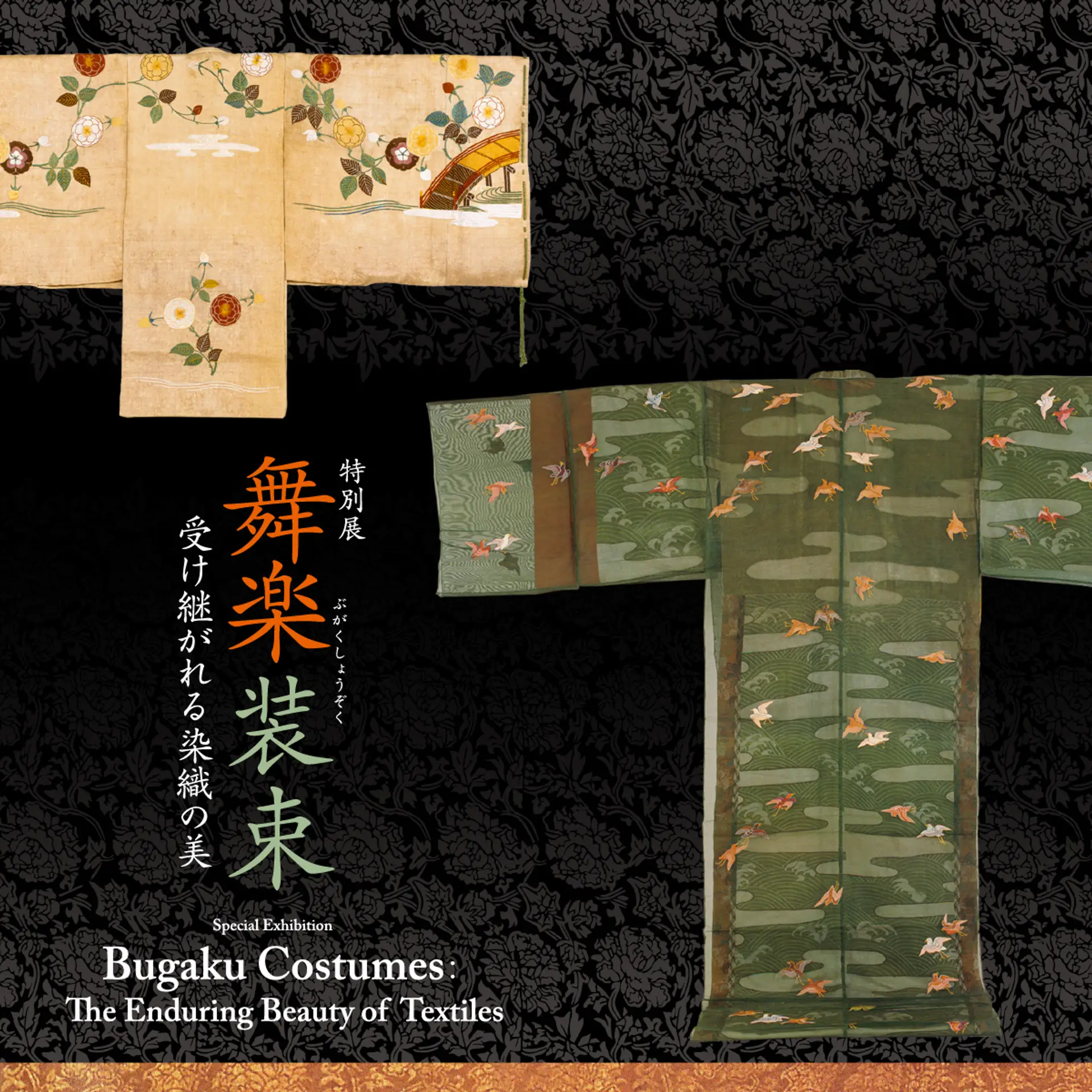
Gagaku, traditional Japanese court music and dance, has achieved its own unique development while incorporating the music and dance from the Asian continent that began to reach Japan in the fifth century. Gagaku that includes dance is called Bugaku. The costumes worn in Bugaku are lavish transformations of the garb of the court military officials once in charge of the dance. For dances with music of Chinese origins, sahō, the left, the costumes have red as their base color. Those associated with the Korean Peninsula, uhō, the right, have primarily blue costumes.
Bugaku performances were not limited to the court; they were also popular at major temples and shrines. Extant examples of costumes handed down at the Amano-sha Shrine (also known as the Niutsuhime-jinja Shrine), the shrine to the tutelary deity of Mount Kōya, were created with fascinating designs in effective use of the textile techniques of the fourteenth and fifteenth centuries. During Japan’s Warring States period, which began with the Ōnin War (1467-1477) and continued for about a century, Bugaku suffered badly, but was revived and gradually systematized by members of the court and people in power. In that process, costume design also converged, with great consistency among the costumes used at the court and the major temples and shrines throughout Japan. Through the costumes handed down at the Shitennōji Temple in Osaka, which has sustained a lasting Bugaku tradition, the superb works in the collection of Rinnoji Temple in Tochigi prefecture, displayed for the first time in four decades, and other works, visitors will be able to experience their beauty. Please savor the beauty of these costumes, which adorned Bugaku for centuries and still do today.
Bugaku performances were not limited to the court; they were also popular at major temples and shrines. Extant examples of costumes handed down at the Amano-sha Shrine (also known as the Niutsuhime-jinja Shrine), the shrine to the tutelary deity of Mount Kōya, were created with fascinating designs in effective use of the textile techniques of the fourteenth and fifteenth centuries. During Japan’s Warring States period, which began with the Ōnin War (1467-1477) and continued for about a century, Bugaku suffered badly, but was revived and gradually systematized by members of the court and people in power. In that process, costume design also converged, with great consistency among the costumes used at the court and the major temples and shrines throughout Japan. Through the costumes handed down at the Shitennōji Temple in Osaka, which has sustained a lasting Bugaku tradition, the superb works in the collection of Rinnoji Temple in Tochigi prefecture, displayed for the first time in four decades, and other works, visitors will be able to experience their beauty. Please savor the beauty of these costumes, which adorned Bugaku for centuries and still do today.
Schedule | Oct 24 (Sat) 2026-Nov 23 (Mon) 2026 Opening Hours Information
| ||||
|---|---|---|---|---|---|
| Fee | Online ticket: Adults ¥1600, University Students ¥700, High School Students and Under free. Same-day ticket: Adults ¥1800, University Students ¥900, High School Students and Under free. | ||||
| Website | https://www.nezu-muse.or.jp/en/exhibitions/upcoming/ | ||||
| Venue | The Nezu Museum http://www.nezu-muse.or.jp/en/ | ||||
| Address | 6-5-1 Minami-Aoyama, Minato-ku, Tokyo 107-0062 | ||||
| Access | 8 minute walk from exit A5 at Omotesando Station on the Ginza, Hanzomon and Chiyoda lines. | ||||
| Phone | 03-3400-2536 |




No comments yet